QUESTION IMAGE
Question
multiple choice question
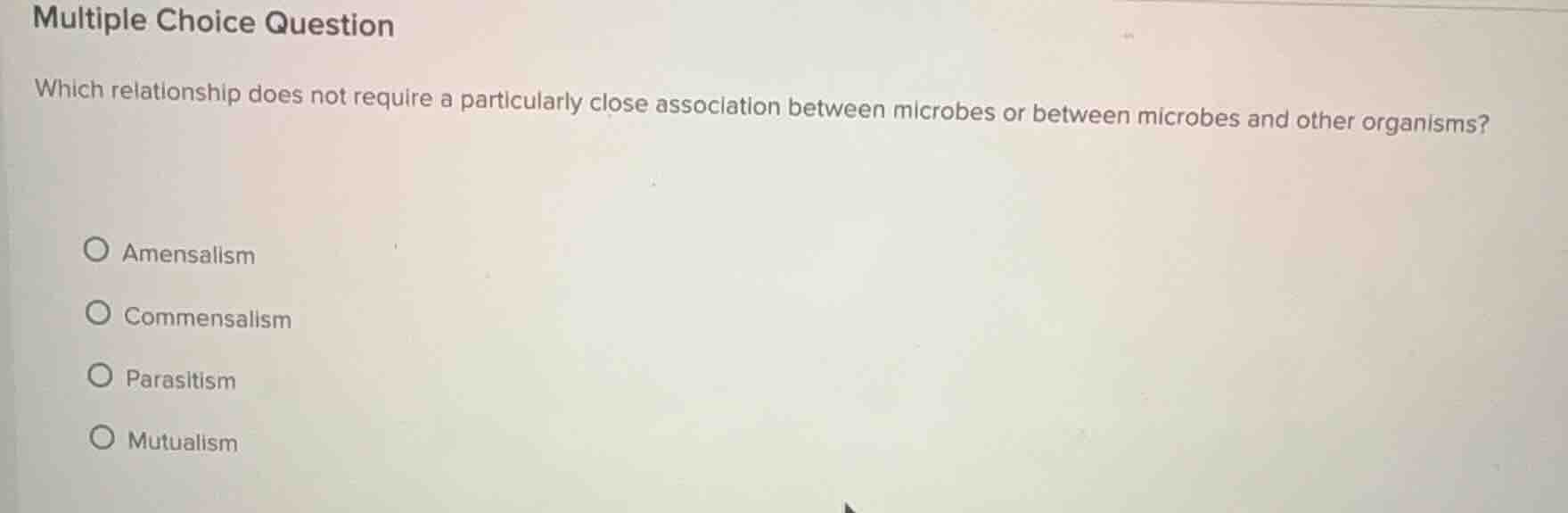
which relationship does not require a particularly close association between microbes or between microbes and other organisms?
amensalism
commensalism
parasitism
mutualism
Define symbiotic vs. nonsymbiotic relationships
Symbiotic relationships (mutualism, commensalism, parasitism) are close, intimate, and often obligatory physical associations between different species. Nonsymbiotic relationships (such as synergism and antagonism/amensalism) involve free-living organisms that do not require a close, continuous physical association to interact.
Evaluate the given options
- Amensalism: A nonsymbiotic relationship where one organism is harmed or inhibited while the other remains unaffected (e.g., production of antibiotics by one microbe inhibiting another). It does not require a close physical association.
- Commensalism: A symbiotic relationship requiring a close physical association where one partner benefits and the other is unaffected.
- Parasitism: A symbiotic relationship requiring a close physical association where one organism benefits at the expense of the host.
- Mutualism: A symbiotic relationship requiring a close physical association where both organisms benefit.

Snap & solve any problem in the app
Get step-by-step solutions on Sovi AI
Photo-based solutions with guided steps
Explore more problems and detailed explanations
- (A) Amensalism (Correct answer)
- (B) Commensalism
- (C) Parasitism
- (D) Mutualism