QUESTION IMAGE
Question
multiple choice question
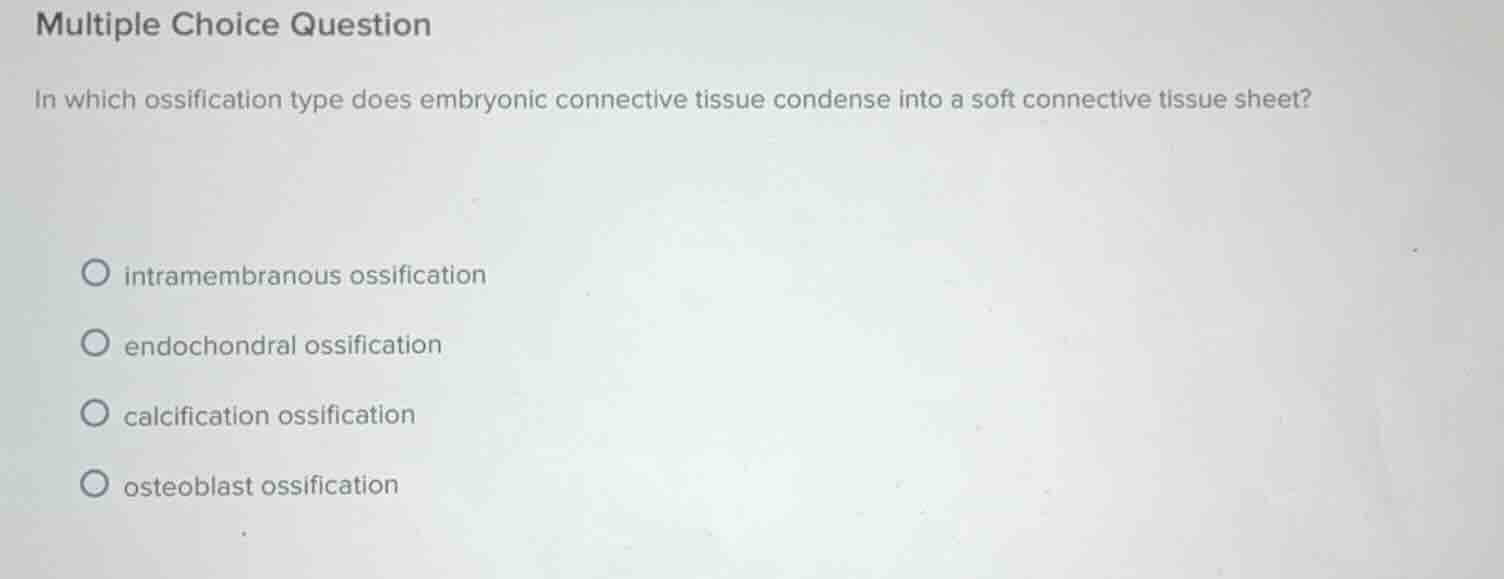
in which ossification type does embryonic connective tissue condense into a soft connective tissue sheet?
intramembranous ossification
endochondral ossification
calcification ossification
osteoblast ossification
<pre_analysis>
{
"quality": "clear",
"question_count": 1,
"skills_matched": [
"direct_cot",
"multiple_choice_formatter",
"explain_then_answer",
"tutor",
"mastery_adaptive_brevity"
],
"needs_drawing": false,
"concepts_used": [
"Ossification Types",
"Intramembranous Ossification",
"Endochondral Ossification"
],
"new_concepts": [],
"current_concepts": [
"Ossification Types",
"Intramembranous Ossification",
"Endochondral Ossification"
]
}
</pre_analysis>
<reasoning>
Analyze the question prompt
The question asks to identify the type of ossification in which embryonic connective tissue (mesenchyme) condenses into a soft connective tissue sheet (membrane).
Evaluate the options based on bone development
Using the Ossification Types and Intramembranous Ossification knowledge points
- Intramembranous ossification is the process where bone develops directly from sheets of mesenchymal (embryonic) connective tissue. This is the mechanism by which flat bones of the skull, the clavicles, and most cranial bones are formed.
- Endochondral ossification is the process where bone develops by replacing a pre-existing hyaline cartilage model.
- Calcification ossification and osteoblast ossification are not standard biological types of bone development.
Match with the correct choice
The description of embryonic connective tissue condensing into a soft sheet directly defines the starting phase of intramembranous ossification.
</reasoning>
<answer>
<mcq-correct>intramembranous ossification</mcq-correct>
<mcq-option>endochondral ossification</mcq-option>
<mcq-option>calcification ossification</mcq-option>
<mcq-option>osteoblast ossification</mcq-option>
</answer>
<post_analysis>
{
"subject": "Natural Science",
"question_type": "Multiple Choice",
"knowledge_point": [
"Natural Science",
"Biology",
"Ossification Types"
]
}
</post_analysis>
Snap & solve any problem in the app
Get step-by-step solutions on Sovi AI
Photo-based solutions with guided steps
Explore more problems and detailed explanations
<pre_analysis>
{
"quality": "clear",
"question_count": 1,
"skills_matched": [
"direct_cot",
"multiple_choice_formatter",
"explain_then_answer",
"tutor",
"mastery_adaptive_brevity"
],
"needs_drawing": false,
"concepts_used": [
"Ossification Types",
"Intramembranous Ossification",
"Endochondral Ossification"
],
"new_concepts": [],
"current_concepts": [
"Ossification Types",
"Intramembranous Ossification",
"Endochondral Ossification"
]
}
</pre_analysis>
<reasoning>
Analyze the question prompt
The question asks to identify the type of ossification in which embryonic connective tissue (mesenchyme) condenses into a soft connective tissue sheet (membrane).
Evaluate the options based on bone development
Using the Ossification Types and Intramembranous Ossification knowledge points
- Intramembranous ossification is the process where bone develops directly from sheets of mesenchymal (embryonic) connective tissue. This is the mechanism by which flat bones of the skull, the clavicles, and most cranial bones are formed.
- Endochondral ossification is the process where bone develops by replacing a pre-existing hyaline cartilage model.
- Calcification ossification and osteoblast ossification are not standard biological types of bone development.
Match with the correct choice
The description of embryonic connective tissue condensing into a soft sheet directly defines the starting phase of intramembranous ossification.
</reasoning>
<answer>
<mcq-correct>intramembranous ossification</mcq-correct>
<mcq-option>endochondral ossification</mcq-option>
<mcq-option>calcification ossification</mcq-option>
<mcq-option>osteoblast ossification</mcq-option>
</answer>
<post_analysis>
{
"subject": "Natural Science",
"question_type": "Multiple Choice",
"knowledge_point": [
"Natural Science",
"Biology",
"Ossification Types"
]
}
</post_analysis>