QUESTION IMAGE
Question
multiple choice question
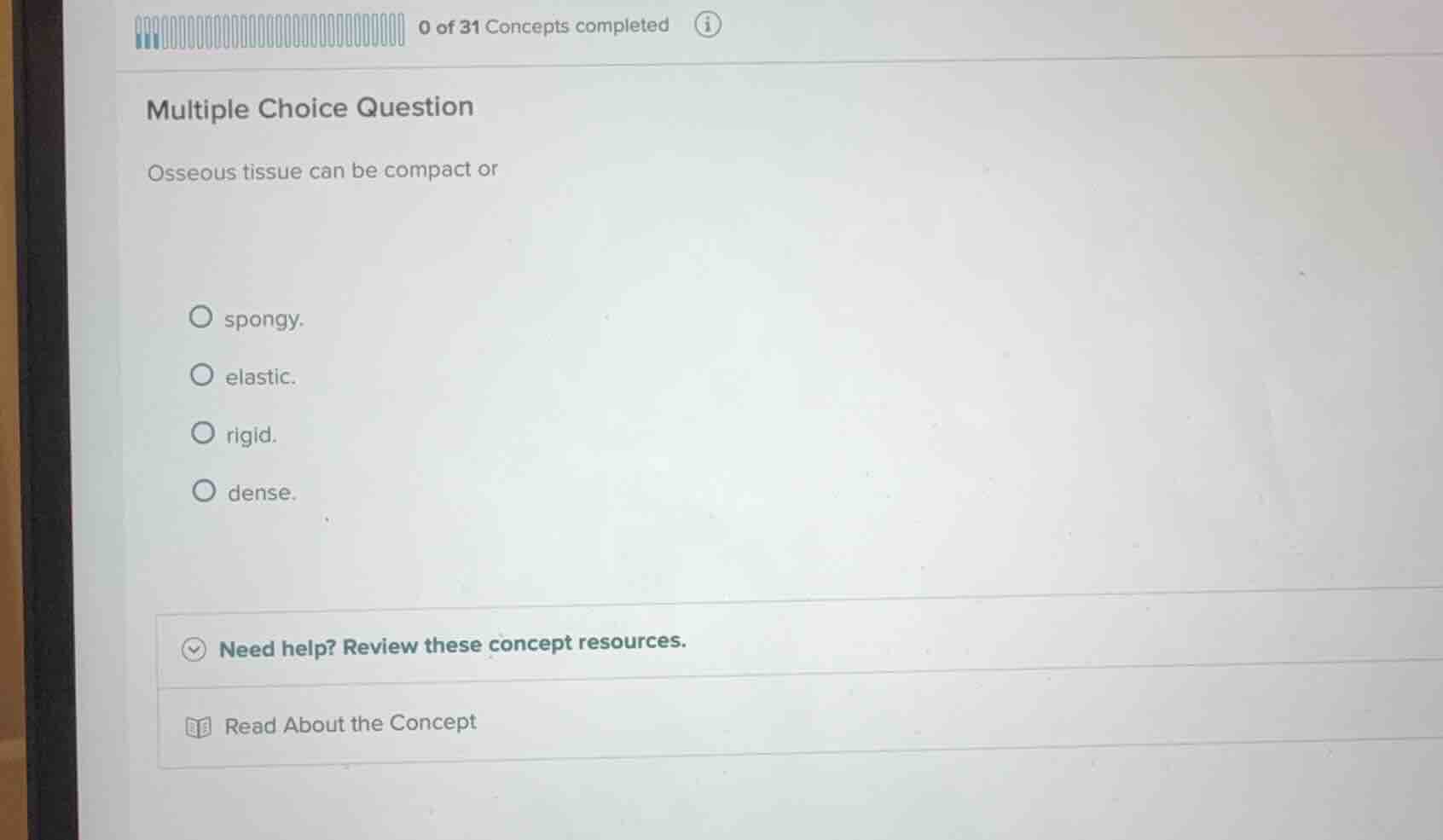
osseous tissue can be compact or
- spongy.
- elastic.
- rigid.
- dense.
<pre_analysis>
{
"quality": "clear",
"question_count": 1,
"skills_matched": [
"direct_cot",
"multiple_choice_formatter",
"explain_then_answer",
"quick"
],
"needs_drawing": false,
"concepts_used": [
"Skeletal Anatomy",
"Skeletal System"
],
"new_concepts": [
"Osseous Tissue Types"
],
"current_concepts": [
"Skeletal Anatomy",
"Skeletal System",
"Osseous Tissue Types"
]
}
</pre_analysis>
<reasoning>
Identify the core anatomical subject
The question asks about the classification of osseous (bone) tissue. Osseous tissue is categorized into two main structural types based on density and organization.
Evaluate the given options
- spongy: Also known as cancellous or trabecular bone, this is the highly porous, lightweight form of bone tissue found at the ends of long bones and inside vertebrae.
- elastic: This refers to a type of cartilage (elastic cartilage), not osseous tissue.
- rigid: While bone tissue is rigid, "rigid" is a general physical property rather than a specific structural classification of osseous tissue.
- dense: "Dense" is a classification used for connective tissue proper (like tendons and ligaments), not a primary structural division of osseous tissue.
Match with standard anatomical classification
Osseous tissue is structurally classified as either compact (cortical) bone, which is dense and forms the hard outer shell, or spongy (cancellous) bone, which is porous and located internally. Therefore, osseous tissue can be compact or spongy.
</reasoning>
<answer>
<mcq-correct>spongy.</mcq-correct>
<mcq-option>elastic.</mcq-option>
<mcq-option>rigid.</mcq-option>
<mcq-option>dense.</mcq-option>
</answer>
<post_analysis>
{
"subject": "Natural Science",
"question_type": "Multiple Choice",
"knowledge_point": [
"Natural Science",
"Anatomy & Physiology",
"Osseous Tissue Types"
]
}
</post_analysis>
Snap & solve any problem in the app
Get step-by-step solutions on Sovi AI
Photo-based solutions with guided steps
Explore more problems and detailed explanations
<pre_analysis>
{
"quality": "clear",
"question_count": 1,
"skills_matched": [
"direct_cot",
"multiple_choice_formatter",
"explain_then_answer",
"quick"
],
"needs_drawing": false,
"concepts_used": [
"Skeletal Anatomy",
"Skeletal System"
],
"new_concepts": [
"Osseous Tissue Types"
],
"current_concepts": [
"Skeletal Anatomy",
"Skeletal System",
"Osseous Tissue Types"
]
}
</pre_analysis>
<reasoning>
Identify the core anatomical subject
The question asks about the classification of osseous (bone) tissue. Osseous tissue is categorized into two main structural types based on density and organization.
Evaluate the given options
- spongy: Also known as cancellous or trabecular bone, this is the highly porous, lightweight form of bone tissue found at the ends of long bones and inside vertebrae.
- elastic: This refers to a type of cartilage (elastic cartilage), not osseous tissue.
- rigid: While bone tissue is rigid, "rigid" is a general physical property rather than a specific structural classification of osseous tissue.
- dense: "Dense" is a classification used for connective tissue proper (like tendons and ligaments), not a primary structural division of osseous tissue.
Match with standard anatomical classification
Osseous tissue is structurally classified as either compact (cortical) bone, which is dense and forms the hard outer shell, or spongy (cancellous) bone, which is porous and located internally. Therefore, osseous tissue can be compact or spongy.
</reasoning>
<answer>
<mcq-correct>spongy.</mcq-correct>
<mcq-option>elastic.</mcq-option>
<mcq-option>rigid.</mcq-option>
<mcq-option>dense.</mcq-option>
</answer>
<post_analysis>
{
"subject": "Natural Science",
"question_type": "Multiple Choice",
"knowledge_point": [
"Natural Science",
"Anatomy & Physiology",
"Osseous Tissue Types"
]
}
</post_analysis>