QUESTION IMAGE
Question
multiple choice question
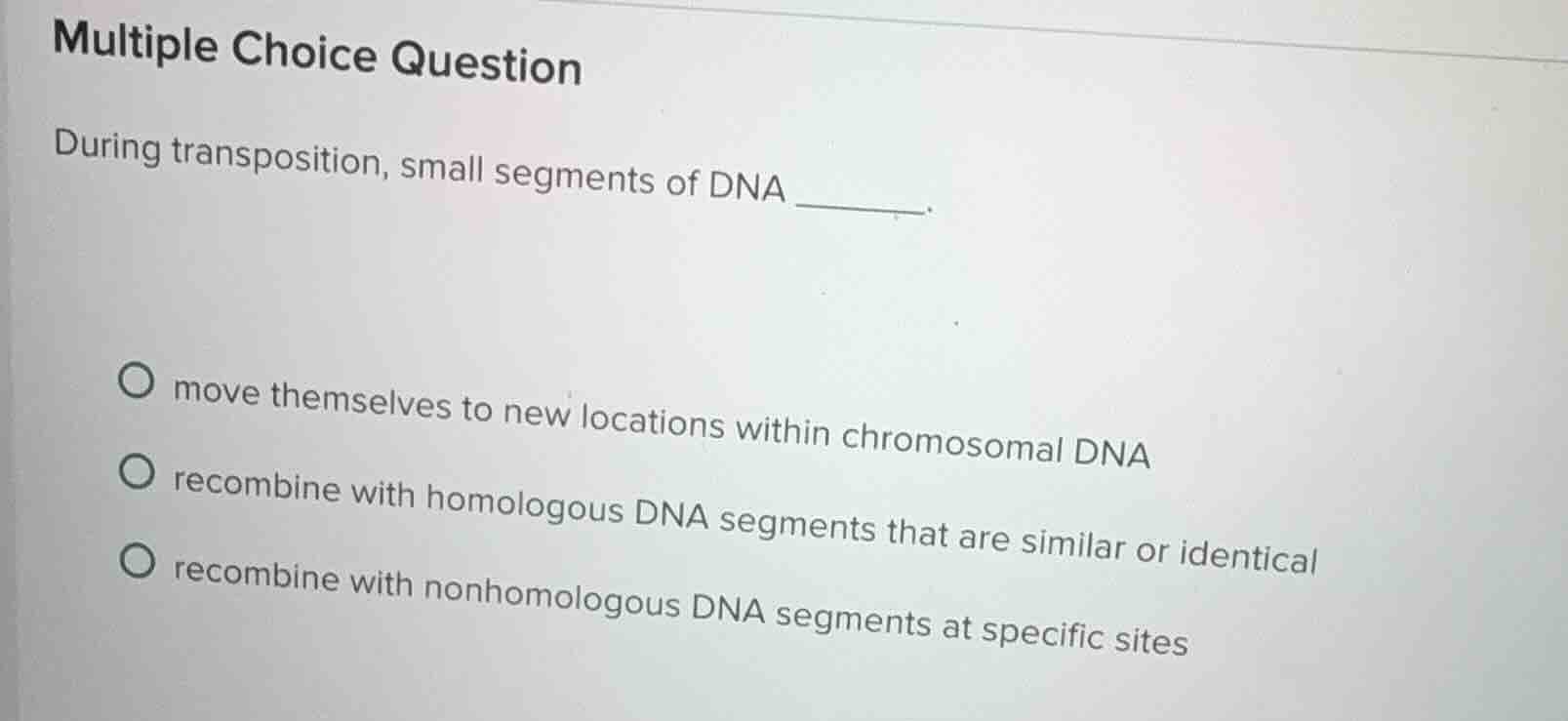
during transposition, small segments of dna ______.
move themselves to new locations within chromosomal dna
recombine with homologous dna segments that are similar or identical
recombine with nonhomologous dna segments at specific sites
Define transposition
Transposition is the process by which specific segments of DNA, known as transposons or "jumping genes," physically move or copy themselves from one location to another within or between genomes (such as chromosomes, plasmids, or viral genomes).
Analyze the mechanism
Unlike homologous recombination, transposition does not require sequence homology between the transposable element and the target site, nor does it typically rely on classical site-specific recombination machinery at highly conserved target sequences. Instead, transposons encode their own enzyme (transposase) to facilitate movement to new, often random or semi-random locations.
Evaluate the options
- Option 1: "move themselves to new locations within chromosomal DNA" accurately describes the fundamental defining characteristic of transposition.
- Option 2: "recombine with homologous DNA segments..." describes homologous recombination, not transposition.
- Option 3: "recombine with nonhomologous DNA segments at specific sites" describes site-specific recombination (such as bacteriophage integration), which is distinct from transposition.

Snap & solve any problem in the app
Get step-by-step solutions on Sovi AI
Photo-based solutions with guided steps
Explore more problems and detailed explanations
- move themselves to new locations within chromosomal DNA (Correct answer)
- recombine with homologous DNA segments that are similar or identical
- recombine with nonhomologous DNA segments at specific sites