QUESTION IMAGE
Question
multiple choice question
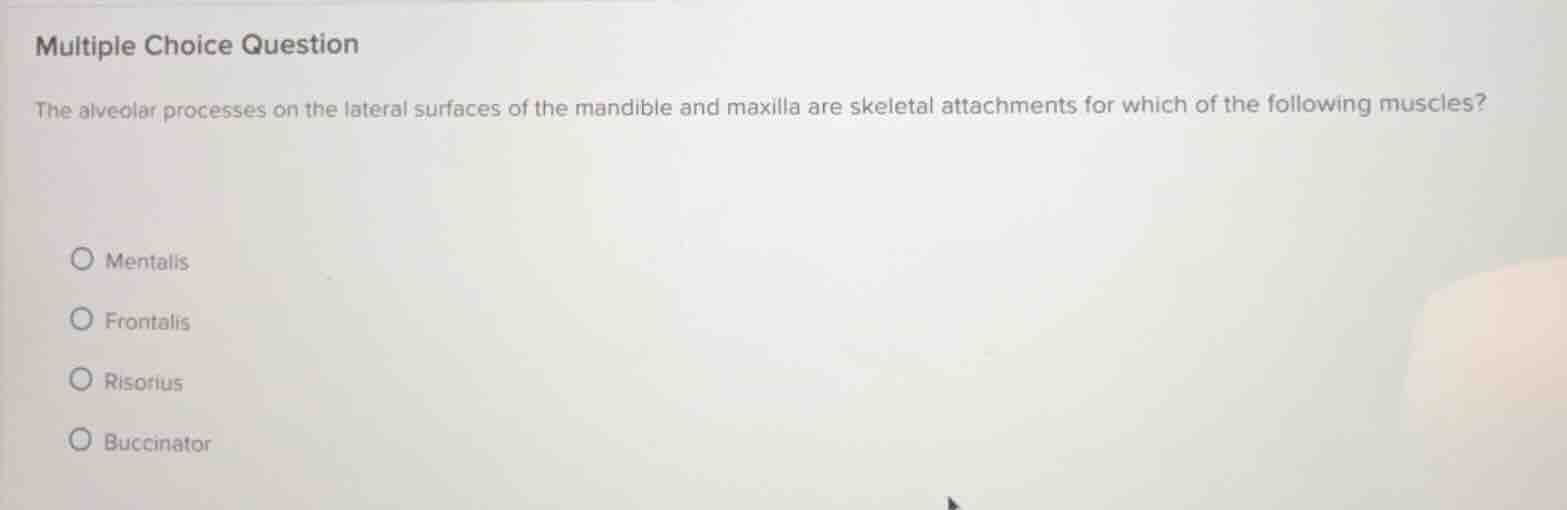
the alveolar processes on the lateral surfaces of the mandible and maxilla are skeletal attachments for which of the following muscles?
mentalis
frontalis
risorius
buccinator
Identify the target anatomical structures
The question asks for the muscle that attaches to the alveolar processes on the lateral surfaces of both the mandible and the maxilla. The alveolar processes are the thickened ridges of bone containing the tooth sockets.
Analyze the muscle options
- Mentalis: This muscle originates on the anterior mandible (near the incisive fossa) and inserts into the skin of the chin. It does not attach to the lateral alveolar processes of both bones.
- Frontalis: This is part of the occipitofrontalis muscle on the forehead, inserting into the skin of the eyebrows and nose. It has no attachment to the jaw bones.
- Risorius: This muscle arises from the fascia over the masseter muscle and inserts into the skin at the corner of the mouth (modiolus). It does not attach directly to the alveolar processes.
- Buccinator: The buccinator is the principal muscle of the cheek. It originates from the alveolar processes on the lateral surfaces of the maxilla and mandible (adjacent to the molar teeth), as well as the pterygomandibular raphe, and inserts into the fibers of the orbicularis oris at the angle of the mouth.
Relate to muscle attachment concepts
Using the Muscle Attachment knowledge point, we identify the origin of the buccinator muscle as the outer (lateral) surfaces of the alveolar processes of the maxilla and mandible. This anatomical relationship allows the buccinator to compress the cheeks against the teeth, aiding in mastication and blowing.

Snap & solve any problem in the app
Get step-by-step solutions on Sovi AI
Photo-based solutions with guided steps
Explore more problems and detailed explanations
- Mentalis
- Frontalis
- Risorius
- Buccinator (Correct answer)