QUESTION IMAGE
Question
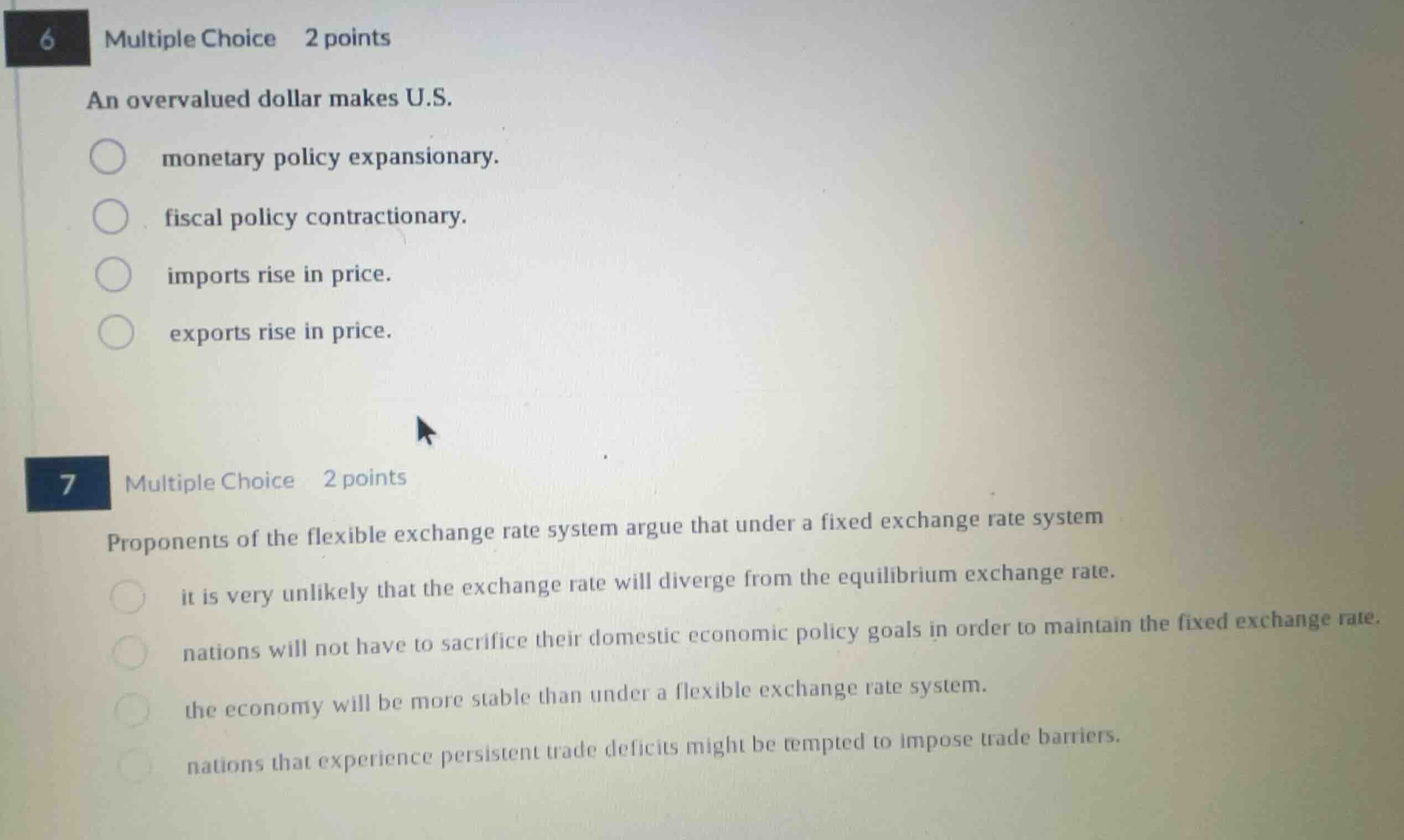
6 multiple choice 2 points
an overvalued dollar makes u.s.
monetary policy expansionary.
fiscal policy contractionary.
imports rise in price.
exports rise in price.
7 multiple choice 2 points
proponents of the flexible exchange rate system argue that under a fixed exchange rate system
it is very unlikely that the exchange rate will diverge from the equilibrium exchange rate.
nations will not have to sacrifice their domestic economic policy goals in order to maintain the fixed exchange rate.
the economy will be more stable than under a flexible exchange rate system.
nations that experience persistent trade deficits might be tempted to impose trade barriers.
Analyze effects of an overvalued dollar
An overvalued currency means its foreign exchange value is higher than its market-clearing equilibrium level. Using the Exchange Rate Adjustment concept, when the U.S. dollar is overvalued, it takes more foreign currency to purchase one dollar. Consequently, U.S. goods become more expensive for foreign buyers, meaning exports rise in price. Conversely, foreign goods become cheaper for U.S. consumers, so imports fall in price.
Evaluate options for Question 6
- "monetary policy expansionary": Overvaluation is not a direct cause of expansionary monetary policy.
- "fiscal policy contractionary": Overvaluation does not make fiscal policy contractionary.
- "imports rise in price": Incorrect, imports become cheaper.
- "exports rise in price": Correct, because foreign buyers must pay more in their local currency to buy U.S. goods.
Analyze arguments for flexible exchange rates
Proponents of flexible exchange rates argue that fixed exchange rate systems force nations to intervene in foreign exchange markets. To maintain a fixed rate, central banks must buy or sell foreign reserves, which often requires adjusting domestic interest rates and monetary policy, thereby sacrificing domestic economic goals (like inflation or employment targets). Under a fixed system, nations with persistent deficits may also resort to trade barriers to protect reserves. Thus, proponents of flexible rates argue that under a fixed system, nations might be tempted to impose trade barriers to correct imbalances.
Evaluate options for Question 7
- "it is very unlikely that the exchange rate will diverge...": Incorrect, fixed rates frequently diverge from equilibrium.
- "nations will not have to sacrifice...": Incorrect, they often must sacrifice domestic goals to defend the peg.
- "the economy will be more stable...": This is a disputed claim, not a primary argument against fixed systems by flexible rate proponents.
- "nations that experience persistent trade deficits might be tempted to impose trade barriers": Correct, because they cannot let the currency depreciate to correct the deficit, they may resort to protectionist trade barriers to restrict imports.

Snap & solve any problem in the app
Get step-by-step solutions on Sovi AI
Photo-based solutions with guided steps
Explore more problems and detailed explanations
Question 6
- (A) monetary policy expansionary.
- (B) fiscal policy contractionary.
- (C) imports rise in price.
- (D) exports rise in price. (Correct answer)
Question 7
- (A) it is very unlikely that the exchange rate will diverge from the equilibrium exchange rate.
- (B) nations will not have to sacrifice their domestic economic policy goals in order to maintain the fixed exchange rate.
- (C) the economy will be more stable than under a flexible exchange rate system.
- (D) nations that experience persistent trade deficits might be tempted to impose trade barriers. (Correct answer)