QUESTION IMAGE
Question
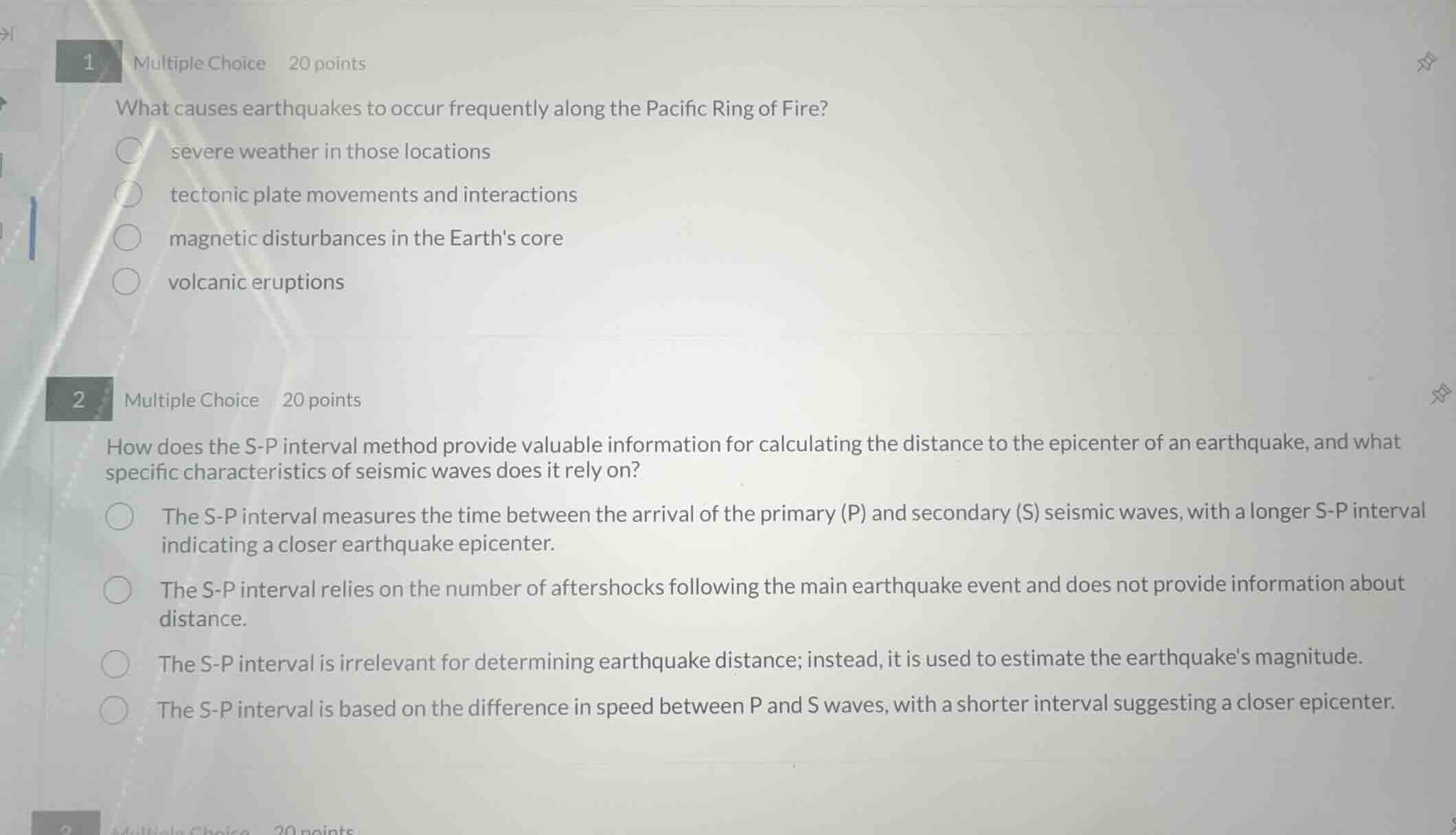
1 multiple choice 20 points
what causes earthquakes to occur frequently along the pacific ring of fire?
severe weather in those locations
tectonic plate movements and interactions
magnetic disturbances in the earths core
volcanic eruptions
2 multiple choice 20 points
how does the s-p interval method provide valuable information for calculating the distance to the epicenter of an earthquake, and what specific characteristics of seismic waves does it rely on?
the s-p interval measures the time between the arrival of the primary (p) and secondary (s) seismic waves, with a longer s-p interval indicating a closer earthquake epicenter.
the s-p interval relies on the number of aftershocks following the main earthquake event and does not provide information about distance.
the s-p interval is irrelevant for determining earthquake distance; instead, it is used to estimate the earthquakes magnitude.
the s-p interval is based on the difference in speed between p and s waves, with a shorter interval suggesting a closer epicenter.
Analyze Question 1
The Pacific Ring of Fire is a major area in the basin of the Pacific Ocean where many earthquakes and volcanic eruptions occur. This high level of seismic activity is primarily driven by the movement, collision, and subduction of tectonic plates along its boundaries.
Analyze Question 2
The S-P interval is the time difference between the arrival of the fast primary (P) waves and the slower secondary (S) waves. Because P-waves travel faster than S-waves, the gap between their arrival times increases the further they travel from the epicenter. Therefore, a shorter S-P interval indicates that the recording station is closer to the epicenter, while a longer interval indicates it is farther away.

Snap & solve any problem in the app
Get step-by-step solutions on Sovi AI
Photo-based solutions with guided steps
Explore more problems and detailed explanations
Question 1
- severe weather in those locations
- tectonic plate movements and interactions (Correct answer)
- magnetic disturbances in the Earth's core
- volcanic eruptions
Question 2
- The S-P interval measures the time between the arrival of the primary (P) and secondary (S) seismic waves, with a longer S-P interval indicating a closer earthquake epicenter.
- The S-P interval relies on the number of aftershocks following the main earthquake event and does not provide information about distance.
- The S-P interval is irrelevant for determining earthquake distance; instead, it is used to estimate the earthquake's magnitude.
- The S-P interval is based on the difference in speed between P and S waves, with a shorter interval suggesting a closer epicenter. (Correct answer)