QUESTION IMAGE
Question
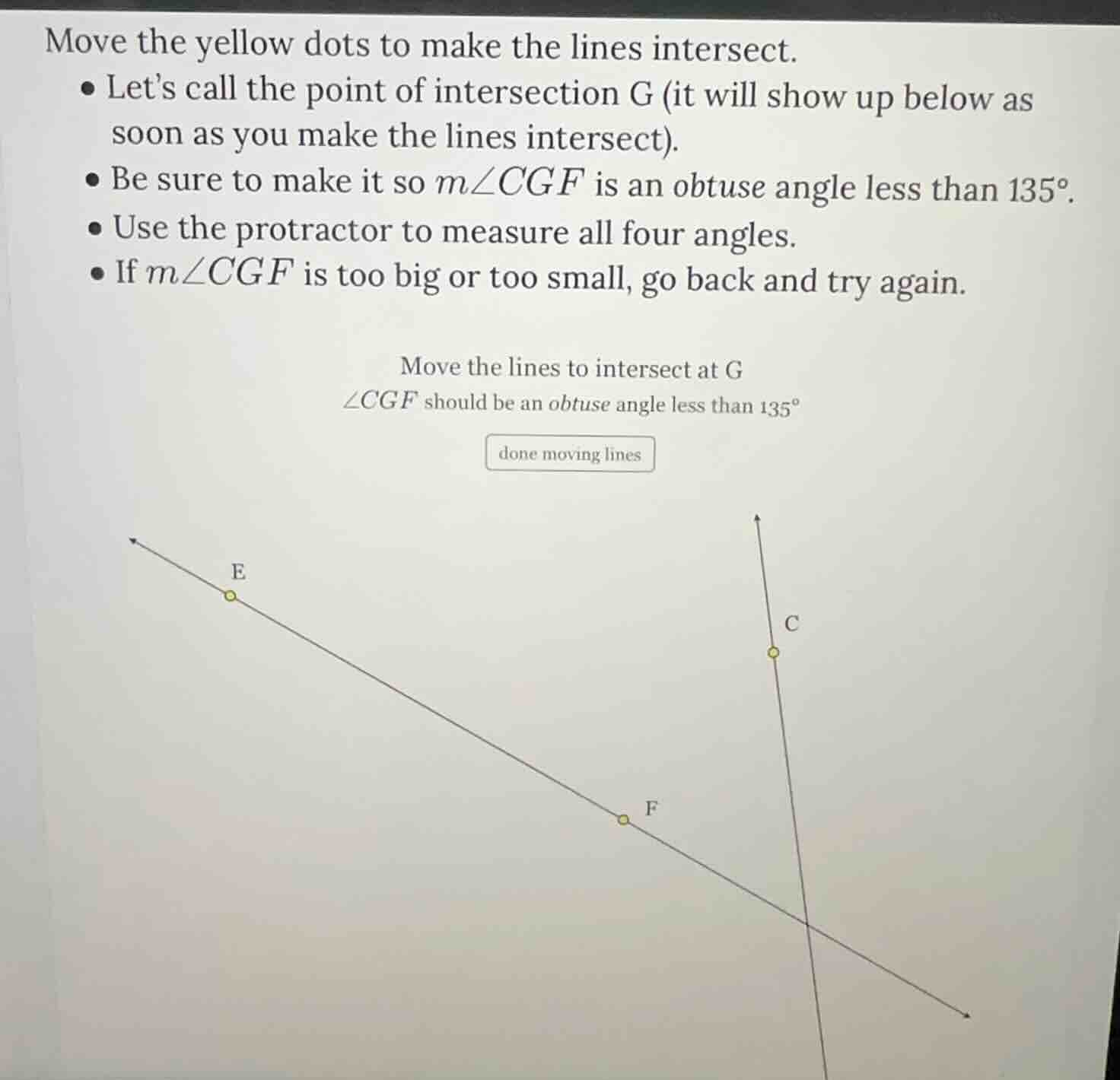
move the yellow dots to make the lines intersect.
- lets call the point of intersection g (it will show up below as soon as you make the lines intersect).
- be sure to make it so \\(m\angle cgf\\) is an obtuse angle less than \\(135^\circ\\).
- use the protractor to measure all four angles.
- if \\(m\angle cgf\\) is too big or too small, go back and try again.
move the lines to intersect at g
\\(\angle cgf\\) should be an obtuse angle less than \\(135^\circ\\)
Identify the target angle
The goal is to make the lines intersect at a point \(G\) such that the measure of angle \(CGF\) is an obtuse angle less than \(135^\circ\). An obtuse angle is strictly greater than \(90^\circ\) and less than \(180^\circ\). Therefore, we need:
Analyze the points and lines
The two lines are:
- Line \(EF\), passing through points \(E\) and \(F\).
- Line \(C\), passing through point \(C\) and intersecting line \(EF\) at point \(G\).
The point of intersection is \(G\). The angle \(\angle CGF\) is formed by the ray \(GC\) (along the vertical line) and the ray \(GF\) (along the line going down and to the right).
Determine the required movement
Currently, the line through \(C\) is nearly vertical, and the line through \(E\) and \(F\) goes downwards from left to right.
- Point \(C\) is on the upper part of the vertical line.
- Point \(F\) is on the lower-right part of the line \(EF\).
- The intersection point \(G\) is currently below and to the right of \(C\), and to the right of \(F\).
- The angle \(\angle CGF\) is the angle between the upward-pointing ray \(GC\) and the downward-right-pointing ray \(GF\). In the current configuration, this angle is obtuse but appears very large (close to \(150^\circ\)).
To decrease the measure of \(\angle CGF\) so that it is less than \(135^\circ\) but remains obtuse (greater than \(90^\circ\)):
- We can rotate the line \(EF\) counterclockwise by moving the yellow dot \(F\) upwards or dot \(E\) downwards.
- Alternatively, we can tilt the line through \(C\) to the left (counterclockwise) by moving the yellow dot \(C\) to the left.
- This brings the ray \(GF\) closer to being perpendicular to \(GC\), reducing the angle \(m\angle CGF\) into the desired range of \((90^\circ, 135^\circ)\).

Snap & solve any problem in the app
Get step-by-step solutions on Sovi AI
Photo-based solutions with guided steps
Explore more problems and detailed explanations
To satisfy the conditions:
- Move the yellow dots to adjust the lines so they intersect at point \(G\).
- Ensure that the angle \(\angle CGF\) (the angle between the upward ray towards \(C\) and the downward-right ray towards \(F\)) measures between \(90^\circ\) and \(135^\circ\).
- Use the on-screen protractor tool to verify that:
- Once the angle is within this range, click the "done moving lines" button.