QUESTION IMAGE
Question
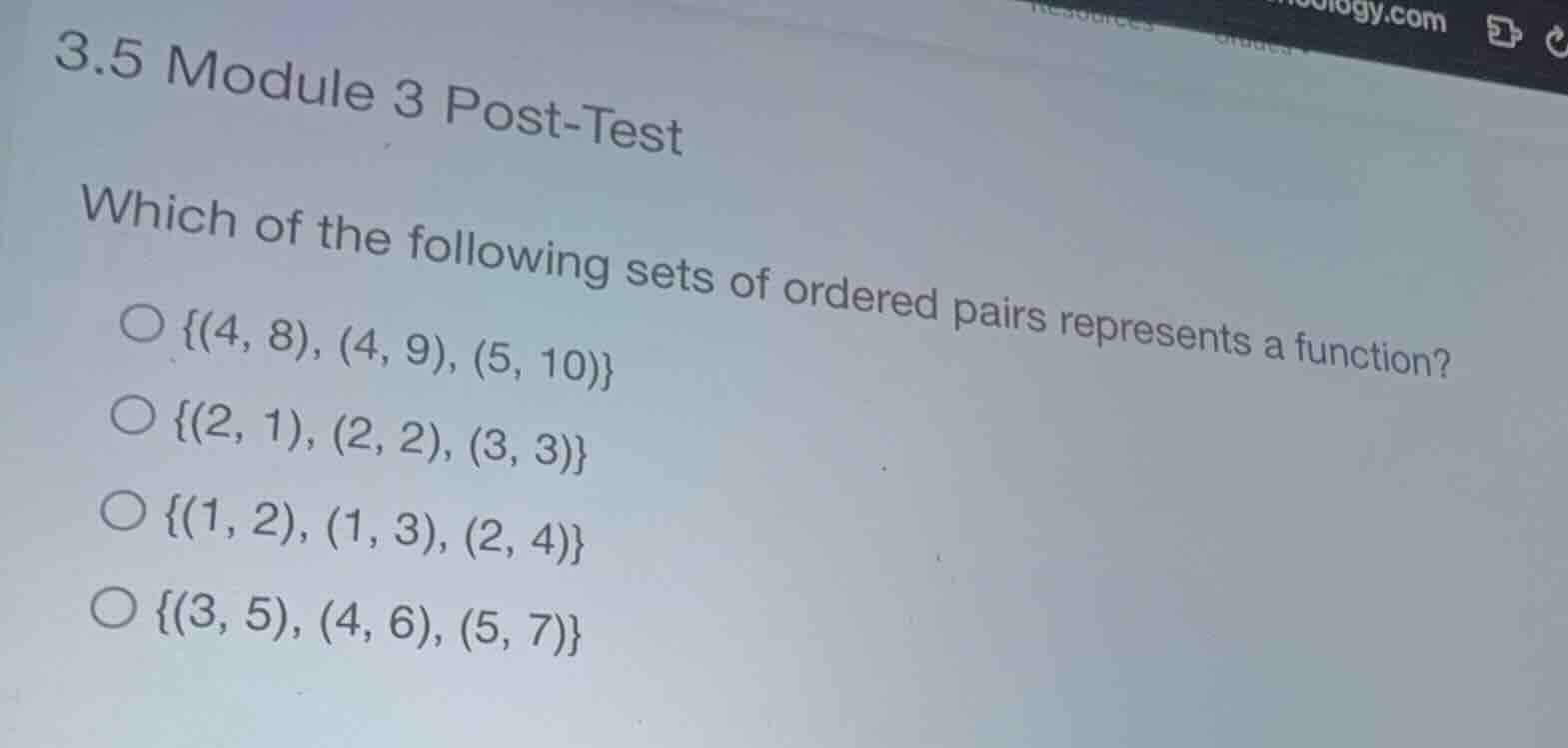
3.5 module 3 post-test
which of the following sets of ordered pairs represents a function?
\\( \bigcirc \\{(4, 8), (4, 9), (5, 10)\\} \\)
\\( \bigcirc \\{(2, 1), (2, 2), (3, 3)\\} \\)
\\( \bigcirc \\{(1, 2), (1, 3), (2, 4)\\} \\)
\\( \bigcirc \\{(3, 5), (4, 6), (5, 7)\\} \\)
Define the mathematical rule for a function
A relation represented by a set of ordered pairs \((x, y)\) is a function if and only if each input value \(x\) is mapped to exactly one output value \(y\). If any \(x\)-value repeats with different \(y\)-values, the relation is not a function.
Analyze the first set of ordered pairs
Consider the set:
The input value \(x = 4\) is paired with two different output values, \(y = 8\) and \(y = 9\). Therefore, this set does not represent a function.
Analyze the second set of ordered pairs
Consider the set:
The input value \(x = 2\) is paired with two different output values, \(y = 1\) and \(y = 2\). Therefore, this set does not represent a function.
Analyze the third set of ordered pairs
Consider the set:
The input value \(x = 1\) is paired with two different output values, \(y = 2\) and \(y = 3\). Therefore, this set does not represent a function.
Analyze the fourth set of ordered pairs
Consider the set:
The input values are \(3\), \(4\), and \(5\). Each input value is unique and maps to exactly one output value:
- \(3
ightarrow 5\)
- \(4
ightarrow 6\)
- \(5
ightarrow 7\)
Since no \(x\)-value repeats with a different \(y\)-value, this set represents a function.

Snap & solve any problem in the app
Get step-by-step solutions on Sovi AI
Photo-based solutions with guided steps
Explore more problems and detailed explanations
- (A) \(\{(4, 8), (4, 9), (5, 10)\}\)
- (B) \(\{(2, 1), (2, 2), (3, 3)\}\)
- (C) \(\{(1, 2), (1, 3), (2, 4)\}\)
- (D) \(\{(3, 5), (4, 6), (5, 7)\}\) (Correct answer)