QUESTION IMAGE
Question
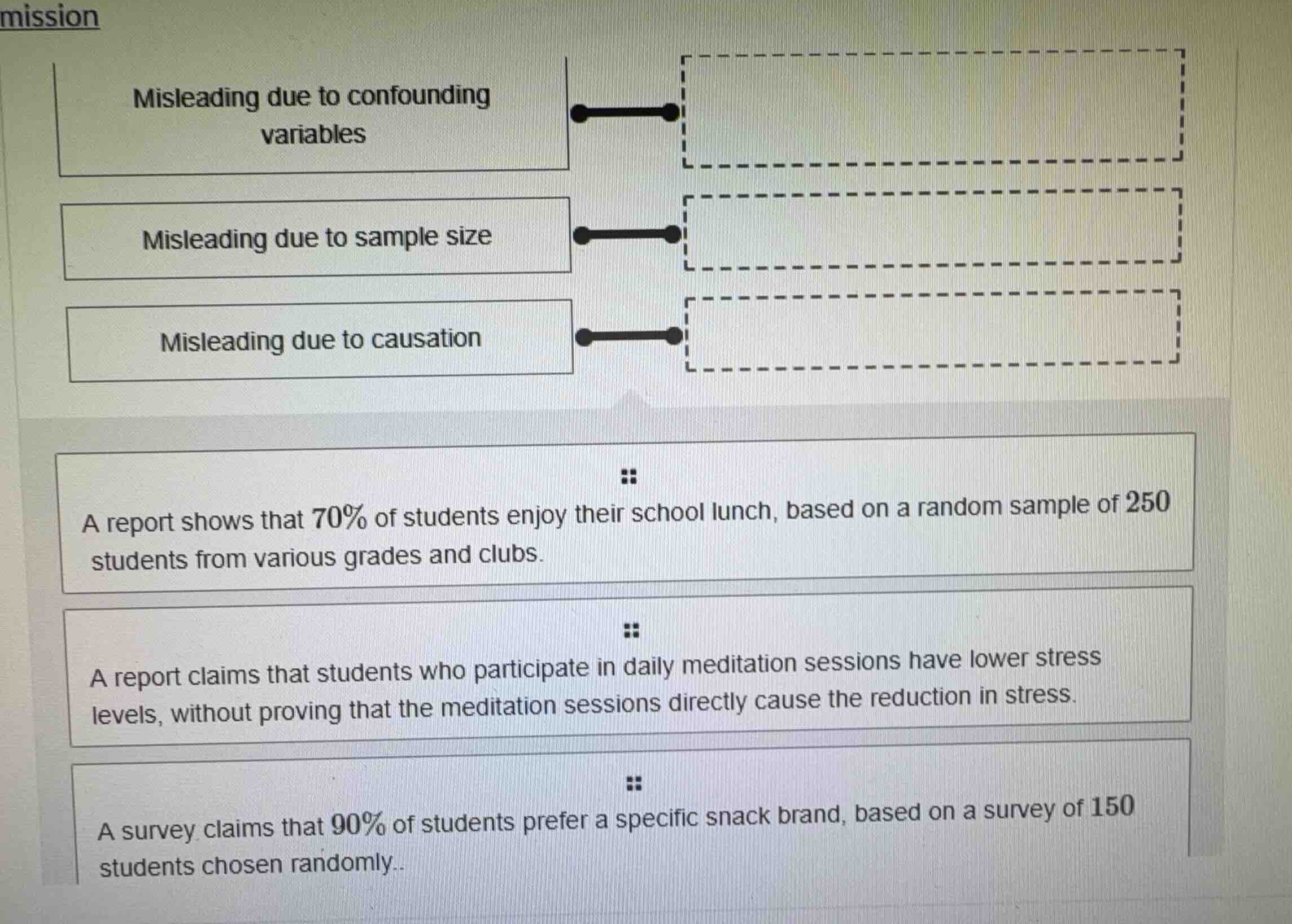
misleading due to confounding variables
misleading due to sample size
misleading due to causation
a report shows that 70% of students enjoy their school lunch, based on a random sample of 250 students from various grades and clubs.
a report claims that students who participate in daily meditation sessions have lower stress levels, without proving that the meditation sessions directly cause the reduction in stress.
a survey claims that 90% of students prefer a specific snack brand, based on a survey of 150 students chosen randomly.
Analyze the first scenario
The first scenario states: "A report shows that 70% of students enjoy their school lunch, based on a random sample of 250 students from various grades and clubs."
- This scenario uses a reasonably sized random sample (\(n = 250\)) representing different groups.
- However, "grades and clubs" can introduce confounding variables. Students in certain clubs or specific grades might have different lunch periods, access to different food options, or different dietary preferences, which could confound the overall satisfaction rate if not controlled.
Analyze the second scenario
The second scenario states: "A report claims that students who participate in daily meditation sessions have lower stress levels, without proving that the meditation sessions directly cause the reduction in stress."
- This scenario directly addresses a claim of cause-and-effect (meditation causing lower stress) without establishing a direct causal link.
- Therefore, this is misleading due to causation (confusing correlation with causation).
Analyze the third scenario
The third scenario states: "A survey claims that 90% of students prefer a specific snack brand, based on a survey of 150 students chosen randomly."
- While 150 is a random sample, in the context of these three options, we must match each description to its best fit.
- Let's re-evaluate the first and third scenarios to find the most accurate pairings.
- Confounding variables: The first scenario explicitly mentions "various grades and clubs," which are external factors (confounding variables) that could influence lunch enjoyment. Thus, "Misleading due to confounding variables" matches the first scenario.
- Causation: The second scenario explicitly mentions "without proving that the meditation sessions directly cause...", which matches "Misleading due to causation".
- Sample size: The third scenario involves a claim about a general population ("students") based on a relatively small sample of 150 students for a specific brand preference, or it is the remaining best fit for "Misleading due to sample size".
Finalize the matches
- Misleading due to confounding variables \(
ightarrow\) "A report shows that 70% of students enjoy their school lunch, based on a random sample of 250 students from various grades and clubs."
- Misleading due to sample size \(
ightarrow\) "A survey claims that 90% of students prefer a specific snack brand, based on a survey of 150 students chosen randomly."
- Misleading due to causation \(
ightarrow\) "A report claims that students who participate in daily meditation sessions have lower stress levels, without proving that the meditation sessions directly cause the reduction in stress."

Snap & solve any problem in the app
Get step-by-step solutions on Sovi AI
Photo-based solutions with guided steps
Explore more problems and detailed explanations
- Misleading due to confounding variables: "A report shows that 70% of students enjoy their school lunch, based on a random sample of 250 students from various grades and clubs."
- Misleading due to sample size: "A survey claims that 90% of students prefer a specific snack brand, based on a survey of 150 students chosen randomly."
- Misleading due to causation: "A report claims that students who participate in daily meditation sessions have lower stress levels, without proving that the meditation sessions directly cause the reduction in stress."