QUESTION IMAGE
Question
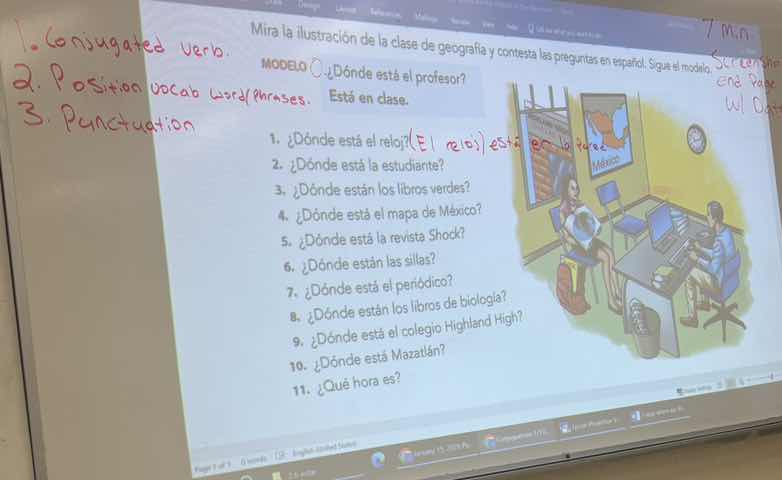
mira la ilustración de la clase de geografía y contesta las preguntas en español. sigue el modelo. modelo ¿dónde está el profesor? está en clase. 1. ¿dónde está el reloj? (el reloj) está en la pared. 2. ¿dónde está la estudiante? 3. ¿dónde están los libros verdes? 4. ¿dónde está el mapa de méxico? 5. ¿dónde está la revista shock? 6. ¿dónde están las sillas? 7. ¿dónde está el periódico? 8. ¿dónde están los libros de biología? 9. ¿dónde está el colegio highland high? 10. ¿dónde está mazatlán? 11. ¿qué hora es?
To solve these Spanish location - related questions, we analyze each one by looking at the illustration (even though we can infer some common classroom setups) and use the correct Spanish verb conjugation (estar) and prepositions to describe the location.
Question 1: ¿Dónde está el reloj?
Step 1: Identify the subject and verb
The subject is "el reloj" (the clock) and the verb is "estar" (to be). We need to conjugate "estar" for the third - person singular, which is "está".
Step 2: Determine the location
From the illustration (or typical classroom knowledge), the clock is on the wall. In Spanish, "on the wall" is "en la pared". So the answer is "El reloj está en la pared."
Question 2: ¿Dónde está la estudiante?
Step 1: Subject and verb
The subject is "la estudiante" (the student) and the verb "estar" is conjugated as "está" (third - person singular, feminine).
Step 2: Location
Looking at the illustration, the student is sitting (probably in a chair or at a desk). Let's assume she is in a chair. "In a chair" in Spanish is "en una silla". So the answer is "La estudiante está en una silla (o en su puesto de clase, según la ilustración)."
Question 3: ¿Dónde están los libros verdes?
Step 1: Subject and verb
The subject is "los libros verdes" (the green books), which is plural, so we conjugate "estar" as "están" (third - person plural).
Step 2: Location
Assuming from a typical classroom, books can be on a desk or a shelf. Let's say on a desk. "On the desk" in Spanish is "en el escritorio". So the answer is "Los libros verdes están en el escritorio (o en un estante, según la ilustración)."
Question 4: ¿Dónde está el mapa de México?
Step 1: Subject and verb
Subject: "el mapa de México" (the map of Mexico), verb "estar" conjugated as "está" (third - person singular).
Step 2: Location
Maps are often on the wall in a classroom. So "El mapa de México está en la pared."
Question 5: ¿Dónde está la revista Shock?
Step 1: Subject and verb
Subject: "la revista Shock" (the Shock magazine), verb "estar" conjugated as "está".
Step 2: Location
Magazines can be on a desk or a table. Let's say on a desk. "En el escritorio" is "on the desk". So "La revista Shock está en el escritorio (o en una mesa, según la ilustración)."
Question 6: ¿Dónde están las sillas?
Step 1: Subject and verb
Subject: "las sillas" (the chairs), plural, so "estar" is "están".
Step 2: Location
Chairs are usually in the classroom, around desks or in rows. "En la clase" (in the classroom) or "alrededor de los escritorios" (around the desks). So "Las sillas están en la clase (o alrededor de los escritorios, según la ilustración)."
Question 7: ¿Dónde está el periódico?
Step 1: Subject and verb
Subject: "el periódico" (the newspaper), verb "estar" conjugated as "está".
Step 2: Location
Newspapers can be on a desk or a table. Let's assume on a desk. "En el escritorio" is the location. So "El periódico está en el escritorio (o en una mesa, según la ilustración)."
Question 8: ¿Dónde están los libros de biología?
Step 1: Subject and verb
Subject: "los libros de biología" (the biology books), plural, so "estar" is "están".
Step 2: Location
Biology books are likely in a backpack, on a desk, or on a shelf. Let's say in a backpack. "In a backpack" in Spanish is "en la mochila". So "Los libros de biología están en la mochila (o en un estante de libros, según la ilustración)."
Question 9: ¿Dónde está el colegio Highland High?
Step 1: Subject and verb
Subject: "el colegio Highland High" (Highland High Schoo…

Snap & solve any problem in the app
Get step-by-step solutions on Sovi AI
Photo-based solutions with guided steps
Explore more problems and detailed explanations
To solve these Spanish location - related questions, we analyze each one by looking at the illustration (even though we can infer some common classroom setups) and use the correct Spanish verb conjugation (estar) and prepositions to describe the location.
Question 1: ¿Dónde está el reloj?
Step 1: Identify the subject and verb
The subject is "el reloj" (the clock) and the verb is "estar" (to be). We need to conjugate "estar" for the third - person singular, which is "está".
Step 2: Determine the location
From the illustration (or typical classroom knowledge), the clock is on the wall. In Spanish, "on the wall" is "en la pared". So the answer is "El reloj está en la pared."
Question 2: ¿Dónde está la estudiante?
Step 1: Subject and verb
The subject is "la estudiante" (the student) and the verb "estar" is conjugated as "está" (third - person singular, feminine).
Step 2: Location
Looking at the illustration, the student is sitting (probably in a chair or at a desk). Let's assume she is in a chair. "In a chair" in Spanish is "en una silla". So the answer is "La estudiante está en una silla (o en su puesto de clase, según la ilustración)."
Question 3: ¿Dónde están los libros verdes?
Step 1: Subject and verb
The subject is "los libros verdes" (the green books), which is plural, so we conjugate "estar" as "están" (third - person plural).
Step 2: Location
Assuming from a typical classroom, books can be on a desk or a shelf. Let's say on a desk. "On the desk" in Spanish is "en el escritorio". So the answer is "Los libros verdes están en el escritorio (o en un estante, según la ilustración)."
Question 4: ¿Dónde está el mapa de México?
Step 1: Subject and verb
Subject: "el mapa de México" (the map of Mexico), verb "estar" conjugated as "está" (third - person singular).
Step 2: Location
Maps are often on the wall in a classroom. So "El mapa de México está en la pared."
Question 5: ¿Dónde está la revista Shock?
Step 1: Subject and verb
Subject: "la revista Shock" (the Shock magazine), verb "estar" conjugated as "está".
Step 2: Location
Magazines can be on a desk or a table. Let's say on a desk. "En el escritorio" is "on the desk". So "La revista Shock está en el escritorio (o en una mesa, según la ilustración)."
Question 6: ¿Dónde están las sillas?
Step 1: Subject and verb
Subject: "las sillas" (the chairs), plural, so "estar" is "están".
Step 2: Location
Chairs are usually in the classroom, around desks or in rows. "En la clase" (in the classroom) or "alrededor de los escritorios" (around the desks). So "Las sillas están en la clase (o alrededor de los escritorios, según la ilustración)."
Question 7: ¿Dónde está el periódico?
Step 1: Subject and verb
Subject: "el periódico" (the newspaper), verb "estar" conjugated as "está".
Step 2: Location
Newspapers can be on a desk or a table. Let's assume on a desk. "En el escritorio" is the location. So "El periódico está en el escritorio (o en una mesa, según la ilustración)."
Question 8: ¿Dónde están los libros de biología?
Step 1: Subject and verb
Subject: "los libros de biología" (the biology books), plural, so "estar" is "están".
Step 2: Location
Biology books are likely in a backpack, on a desk, or on a shelf. Let's say in a backpack. "In a backpack" in Spanish is "en la mochila". So "Los libros de biología están en la mochila (o en un estante de libros, según la ilustración)."
Question 9: ¿Dónde está el colegio Highland High?
Step 1: Subject and verb
Subject: "el colegio Highland High" (Highland High School), verb "estar" conjugated as "está".
Step 2: Location
Schools are in a city or a town. But since this is a more general question, we can say it's in a place (we might need more context, but assuming a general answer) "El colegio Highland High está en una ciudad (o en un lugar específico, pero sin más datos, podemos dar una respuesta general como 'El colegio Highland High está en un área urbana' o similar)."
Question 10: ¿Dónde está Mazatlán?
Step 1: Subject and verb
Subject: "Mazatlán" (a city), verb "estar" conjugated as "está".
Step 2: Location
Mazatlán is a city in Mexico, in the state of Sinaloa. So "Mazatlán está en México, en el estado de Sinaloa."
Question 11: ¿Qué hora es?
Step 1: Recognize the question type
This is a question about the time. We need to tell the time. Let's assume from the clock in the illustration (if we can see it, but since we don't have the exact time, we can give a sample). For example, if the clock shows 10:15, we say "Son las diez y cuarto." If it shows 2:30, we say "Son las dos y media."
Final Answers (for each question):
- El reloj está en la pared.
- La estudiante está en una silla (o en su puesto de clase).
- Los libros verdes están en el escritorio (o en un estante).
- El mapa de México está en la pared.
- La revista Shock está en el escritorio (o en una mesa).
- Las sillas están en la clase (o alrededor de los escritorios).
- El periódico está en el escritorio (o en una mesa).
- Los libros de biología están en la mochila (o en un estante de libros).
- El colegio Highland High está en una ciudad (o en un lugar específico, más contexto necesario).
- Mazatlán está en México, en el estado de Sinaloa.
- (Depende de la hora en la ilustración, por ejemplo) Son las diez y media (o la hora que marque el reloj en la ilustración).