QUESTION IMAGE
Question
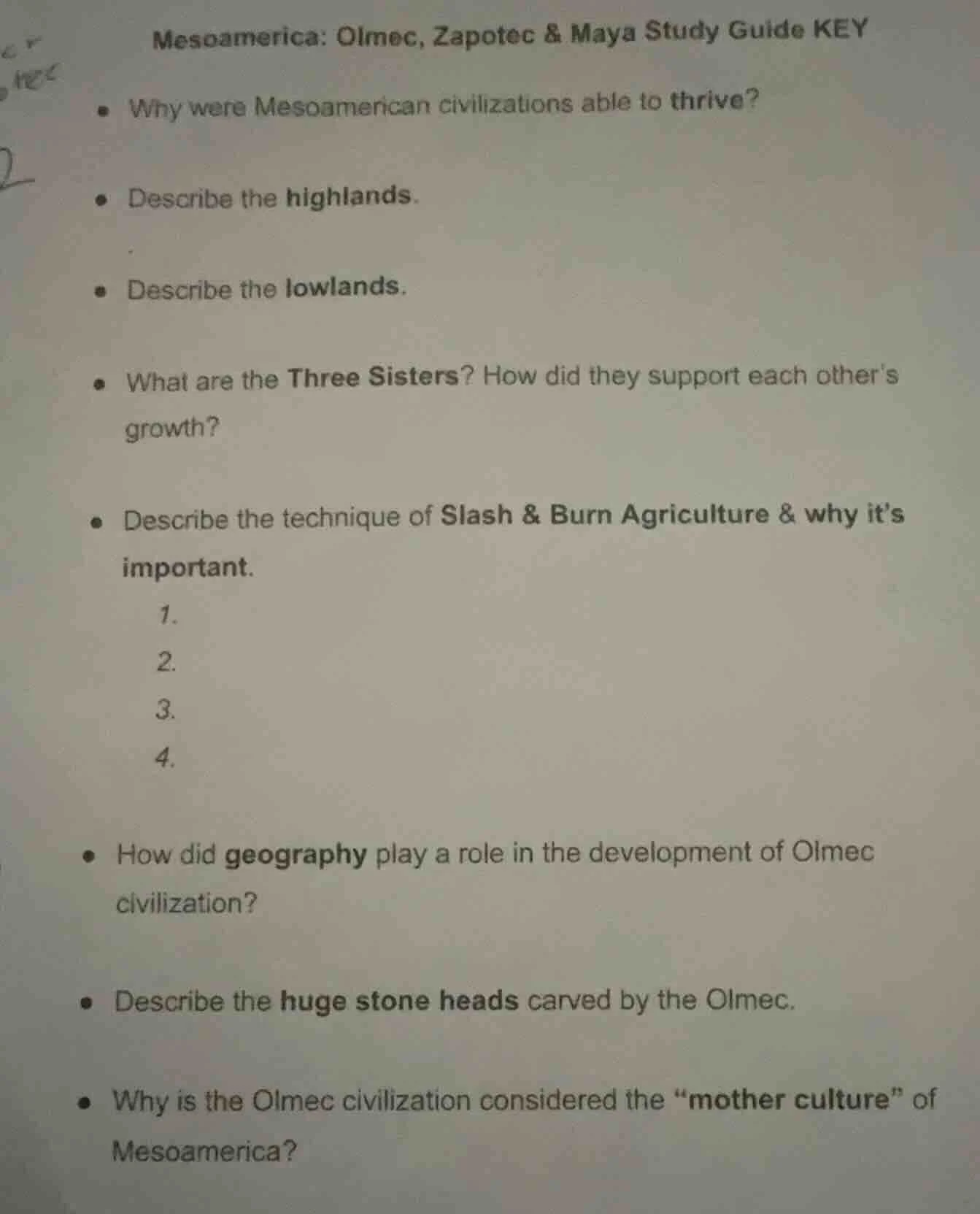
mesoamerica: olmec, zapotec & maya study guide key
- why were mesoamerican civilizations able to thrive?
- describe the highlands.
- describe the lowlands.
- what are the three sisters? how did they support each others growth?
- describe the technique of slash & burn agriculture & why its important.
1.
2.
3.
4.
- how did geography play a role in the development of olmec civilization?
- describe the huge stone heads carved by the olmec.
- why is the olmec civilization considered the \mother culture\ of mesoamerica?
- Why were Mesoamerican civilizations able to thrive?
Favorable diverse geography provided fertile land, water sources, and climate for agriculture; innovative farming techniques supported stable food supplies; and shared cultural practices allowed for trade and social organization.
- Describe the highlands.
Mountainous, cooler regions with fertile volcanic soil, suitable for crops like maize; home to civilizations like the Zapotec; had access to mineral resources.
- Describe the lowlands.
Warm, humid, tropical regions with dense forests, rivers, and swamps; fertile alluvial soil from annual floods; home to the Maya and Olmec; supported diverse agriculture and trade via waterways.
- What are the Three Sisters? How did they support each other's growth?
The Three Sisters are maize, beans, and squash. Maize provides a stalk for beans to climb for sunlight; beans fix nitrogen in the soil to fertilize maize and squash; squash's large leaves shade the soil, retain moisture, and suppress weeds.
- Describe the technique of Slash & Burn Agriculture & why it's important.
- Clear land by cutting trees/vegetation
- Dry cut vegetation for several weeks
- Burn debris to release soil nutrients
- Plant crops in the fertilized soil, then abandon the plot when soil fertility declines
It was important because it allowed farmers to cultivate nutrient-poor tropical soils, supported small-scale, sustainable food production for Mesoamerican communities with limited tools.
- How did geography play a role in the development of Olmec civilization?
The Olmec settled in coastal lowlands with fertile alluvial soil from river floods, supporting agriculture; access to rivers enabled trade for resources like jade and basalt; dense forests provided wood for fuel and construction.
- Describe the huge stone heads carved by the Olmec.
Colossal basalt heads (up to 3 meters tall), depicting individual male figures with distinct facial features, likely rulers; carved from distant basalt quarries, requiring complex transport; they reflect Olmec craftsmanship and political/social hierarchy.
- Why is the Olmec civilization considered the "mother culture" of Mesoamerica?
They established foundational cultural practices adopted by later Mesoamerican civilizations, including ceremonial centers, ballgames, writing systems, and artistic styles; their agricultural and social innovations provided a blueprint for subsequent societies like the Maya and Zapotec.

Snap & solve any problem in the app
Get step-by-step solutions on Sovi AI
Photo-based solutions with guided steps
Explore more problems and detailed explanations
- Mesoamerican civilizations thrived due to favorable geography, innovative farming, and shared cultural/trade systems that supported stable food supplies and social organization.
- Highlands are mountainous, cool regions with fertile volcanic soil, mineral resources, and were home to groups like the Zapotec.
- Lowlands are warm, humid tropical regions with dense forests, river systems, fertile alluvial soil, and were home to the Olmec and Maya, supporting agriculture and waterborne trade.
- The Three Sisters are maize, beans, and squash. Maize provides a climbing stalk for beans; beans fertilize the soil; squash shades soil to retain moisture and suppress weeds.
- Slash & Burn steps:
- Cut vegetation to clear land
- Dry cut plant matter
- Burn debris to enrich soil
- Farm until soil fertility drops, then abandon
It was important for cultivating nutrient-poor tropical soils sustainably with limited tools.
- Olmec geography provided fertile floodplains for agriculture, rivers for trade and water, and forests for resources, enabling their settlement and growth.
- Olmec stone heads are massive basalt carvings (up to 3m tall) of distinct male rulers, carved from distant quarries, showcasing advanced craftsmanship and social hierarchy.
- The Olmec are the "mother culture" because they developed foundational cultural, agricultural, and artistic practices adopted by later Mesoamerican civilizations like the Maya and Zapotec.