QUESTION IMAGE
Question
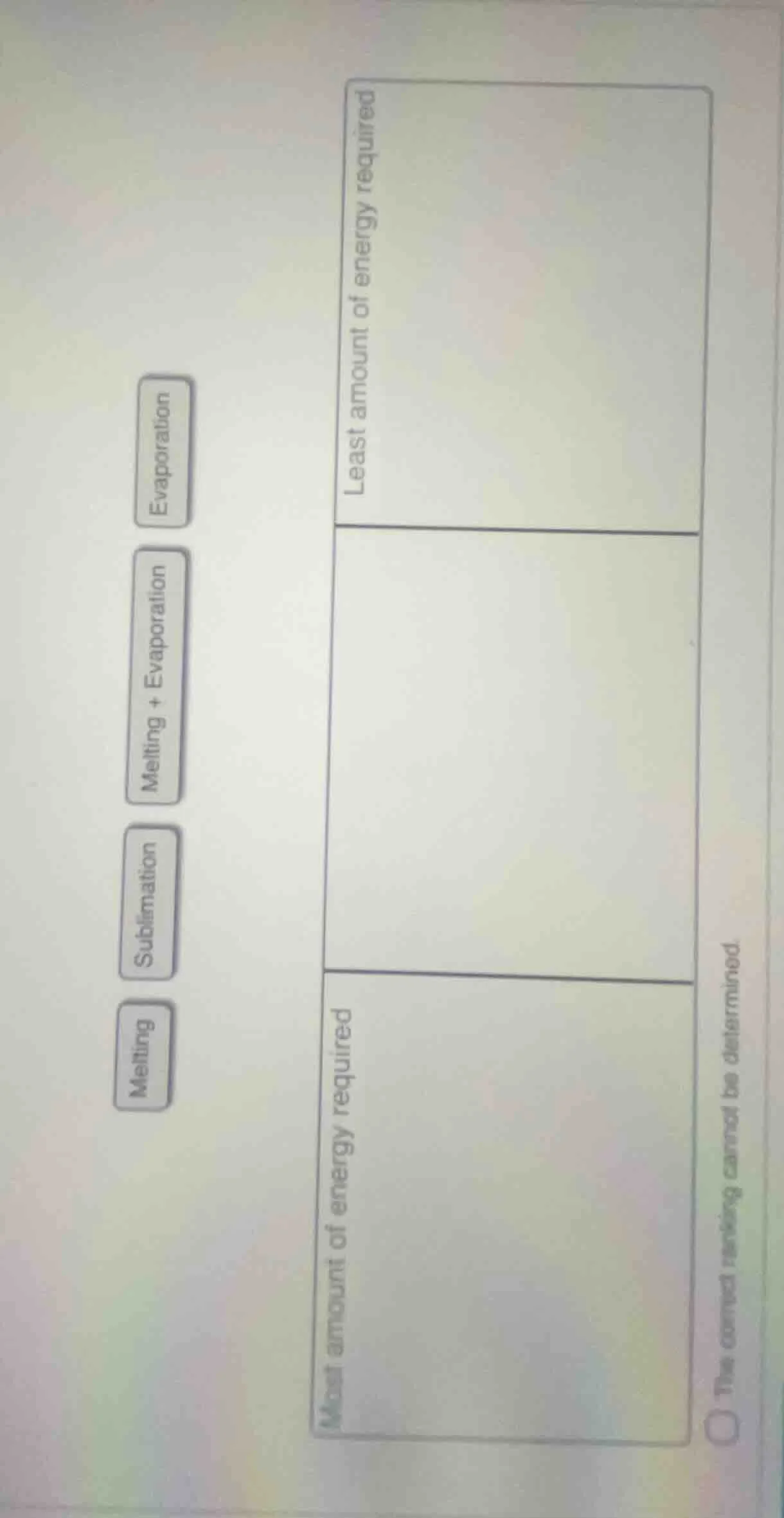
melting
sublimation
melting + evaporation
evaporation
most amount of energy required
least amount of energy required
the correct ranking cannot be determined.
To solve this, we analyze the energy required for each phase change:
Step 1: Understand Phase Change Energies
- Melting: Solid → Liquid (needs energy, but less than vaporization/sublimation).
- Evaporation: Liquid → Gas (needs more energy than melting, as it breaks intermolecular forces more).
- Melting + Evaporation: Sum of melting and evaporation energies (more than either alone).
- Sublimation: Solid → Gas (skips liquid phase; requires energy for both solid→liquid and liquid→gas, so more than melting or evaporation alone).
Step 2: Categorize by Energy
- Most energy required: Sublimation (solid→gas, combines melting + evaporation energy) and Melting + Evaporation (sum of two processes). Among these, Sublimation and Melting + Evaporation have high energy, but Sublimation is a single process with equivalent energy to melting + evaporation. However, if we consider the options:
- Sublimation and Melting + Evaporation require the most energy.
- Melting requires the least energy (only solid→liquid).
Final Categorization (Typical for Phase Change Energy):
- Most amount of energy required: Sublimation, Melting + Evaporation
- Least amount of energy required: Melting
(Note: If the table requires placing each process:
- Most energy: Sublimation, Melting + Evaporation
- Least energy: Melting
- Evaporation is between melting and the combined/ sublimation.)

Snap & solve any problem in the app
Get step-by-step solutions on Sovi AI
Photo-based solutions with guided steps
Explore more problems and detailed explanations
- Most amount of energy required: Sublimation, Melting + Evaporation
- Least amount of energy required: Melting
(Adjust based on the exact table structure, but this is the energy hierarchy for these phase changes.)