QUESTION IMAGE
Question
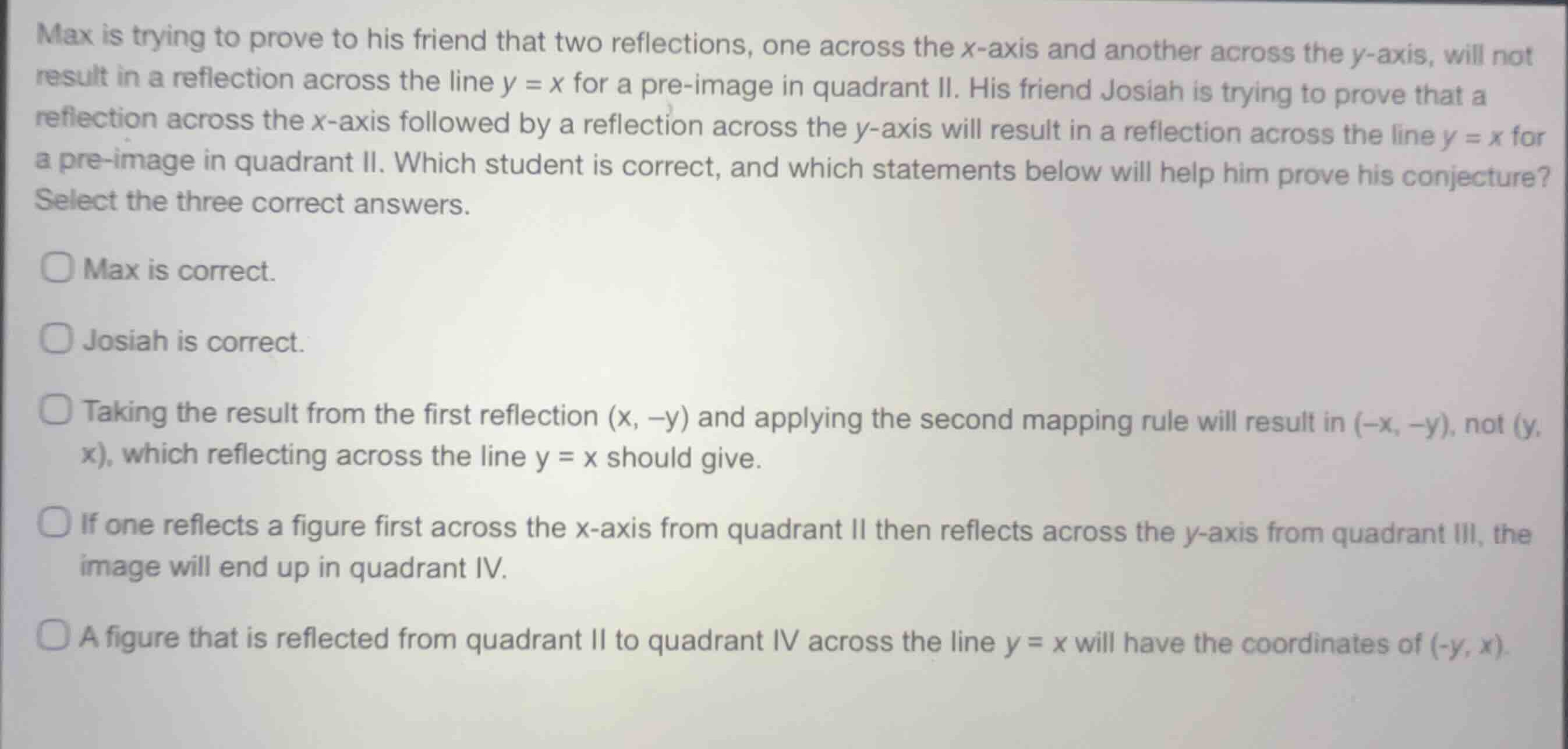
max is trying to prove to his friend that two reflections, one across the (x)-axis and another across the (y)-axis, will not result in a reflection across the line (y = x) for a pre-image in quadrant ii. his friend josiah is trying to prove that a reflection across the (x)-axis followed by a reflection across the (y)-axis will result in a reflection across the line (y = x) for a pre-image in quadrant ii. which student is correct, and which statements below will help him prove his conjecture? select the three correct answers.
max is correct.
josiah is correct.
taking the result from the first reflection ((x, -y)) and applying the second mapping rule will result in ((-x, -y)), not ((y, x)), which reflecting across the line (y = x) should give.
if one reflects a figure first across the (x)-axis from quadrant ii then reflects across the (y)-axis from quadrant iii, the image will end up in quadrant iv.
a figure that is reflected from quadrant ii to quadrant iv across the line (y = x) will have the coordinates of ((-y, x)).
Analyze the transformation rules
Using the Reflections in the Coordinate Plane knowledge point
Evaluate the students' claims
Since the composition of reflections across the \(x\)-axis and then the \(y\)-axis yields \((-x, -y)\), which is not equal to \((y, x)\), Max is correct.
Determine the supporting statements
We analyze the remaining options to find the statements that support Max's proof:
- Statement 3: "Taking the result from the first reflection \((x, -y)\) and applying the second mapping rule will result in \((-x, -y)\), not \((y, x)\), which reflecting across the line \(y = x\) should give." This is mathematically correct and supports Max.
- Statement 4: "If one reflects a figure first across the \(x\)-axis from quadrant II then reflects across the \(y\)-axis from quadrant III, the image will end up in quadrant IV."
- Quadrant II: \((-, +)\)
- Reflect across \(x\)-axis: \((-, -)\) (Quadrant III)
- Reflect across \(y\)-axis: \((+, -)\) (Quadrant IV)
This is correct and supports the quadrant analysis.
- Statement 5: "A figure that is reflected from quadrant II to quadrant IV across the line \(y = x\) will have the coordinates of \((-y, x)\)."
- For a point \((x, y)\) in Quadrant II, \(x < 0\) and \(y > 0\).
- Reflecting across \(y = x\) yields \((y, x)\). Since \(y > 0\) and \(x < 0\), the coordinates are \((+, -)\) in Quadrant IV.
- The statement claims the coordinates will be \((-y, x)\), which is incorrect because the rule for reflection across \(y = x\) is \((y, x)\).

Snap & solve any problem in the app
Get step-by-step solutions on Sovi AI
Photo-based solutions with guided steps
Explore more problems and detailed explanations
- Max is correct. (Correct answer)
- Josiah is correct.
- Taking the result from the first reflection (x, -y) and applying the second mapping rule will result in (-x, -y), not (y, x), which reflecting across the line y = x should give. (Correct answer)
- If one reflects a figure first across the x-axis from quadrant II then reflects across the y-axis from quadrant III, the image will end up in quadrant IV. (Correct answer)
- A figure that is reflected from quadrant II to quadrant IV across the line y = x will have the coordinates of (-y, x).