QUESTION IMAGE
Question
mathematics questions
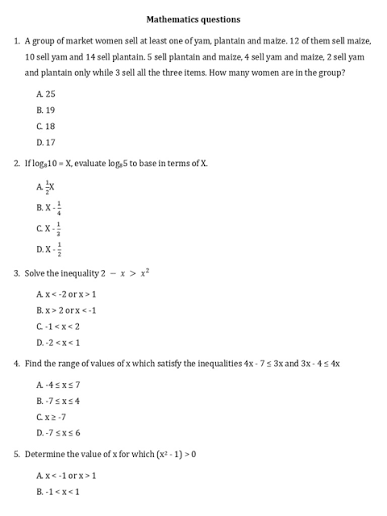
- a group of market women sell at least one of yam, plantain and maize. 12 of them sell maize, 10 sell yam and 14 sell plantain. 5 sell plantain and maize, 4 sell yam and maize, 2 sell yam and plantain only while 3 sell all the three items. how many women are in the group?
a. 25
b. 19
c. 18
d. 17
- if \\(\log_{8}10 = x\\), evaluate \\(\log_{8}5\\) to base in terms of \\(x\\).
a. \\(\frac{1}{2}x\\)
b. \\(x - \frac{1}{4}\\)
c. \\(x - \frac{1}{2}\\)
d. \\(x - \frac{1}{3}\\)
- solve the inequality \\(2 - x > x^2\\)
a. \\(x < -2\\) or \\(x > 1\\)
b. \\(x > 2\\) or \\(x < -1\\)
c. \\(-1 < x < 2\\)
d. \\(-2 < x < 1\\)
- find the range of values of \\(x\\) which satisfy the inequalities \\(4x - 7 \le 3x\\) and \\(3x - 4 \le 4x\\)
a. \\(-4 \le x \le 7\\)
b. \\(-7 \le x \le 4\\)
c. \\(x \ge -7\\)
d. \\(-7 \le x \le 6\\)
- determine the value of \\(x\\) for which \\((x^2 - 1) > 0\\)
a. \\(x < -1\\) or \\(x > 1\\)
b. \\(-1 < x < 1\\)
🆕 New Concept Discovered: Three-Set Venn Diagrams
Using overlapping circles to organize and count items in three categories.
Step 1: Identify the given information
Let the three sets of market women be:
- \( M \): women who sell maize
- \( Y \): women who sell yam
- \( P \): women who sell plantain
From the problem, we have the following data:
- Total maize sellers, \( n(M) = 12 \)
- Total yam sellers, \( n(Y) = 10 \)
- Total plantain sellers, \( n(P) = 14 \)
- Sell plantain and maize, \( n(P \cap M) = 5 \)
- Sell yam and maize, \( n(Y \cap M) = 4 \)
- Sell all three items, \( n(Y \cap P \cap M) = 3 \)
- Sell yam and plantain only, \( n(Y \cap P \cap M') = 2 \)
Step 2: Determine the size of each overlapping region
To find the total number of women, we can break the Venn diagram down into 7 disjoint (non-overlapping) regions:
- All three items:
- Yam and Plantain only:
Given directly as:
- Yam and Maize only:
We are given that 4 women sell yam and maize in total. This includes those who sell all three.
- Plantain and Maize only:
We are given that 5 women sell plantain and maize in total. This includes those who sell all three.
- Yam only:
The total number of yam sellers is 10. We subtract the overlapping regions containing yam:
- Maize only:
The total number of maize sellers is 12. We subtract the overlapping regions containing maize:
- Plantain only:
The total number of plantain sellers is 14. We subtract the overlapping regions containing plantain:
Step 3: Sum all disjoint regions to find the total number of women
Now, we add all 7 mutually exclusive regions together:

Snap & solve any problem in the app
Get step-by-step solutions on Sovi AI
Photo-based solutions with guided steps
Explore more problems and detailed explanations
A. 25