QUESTION IMAGE
Question
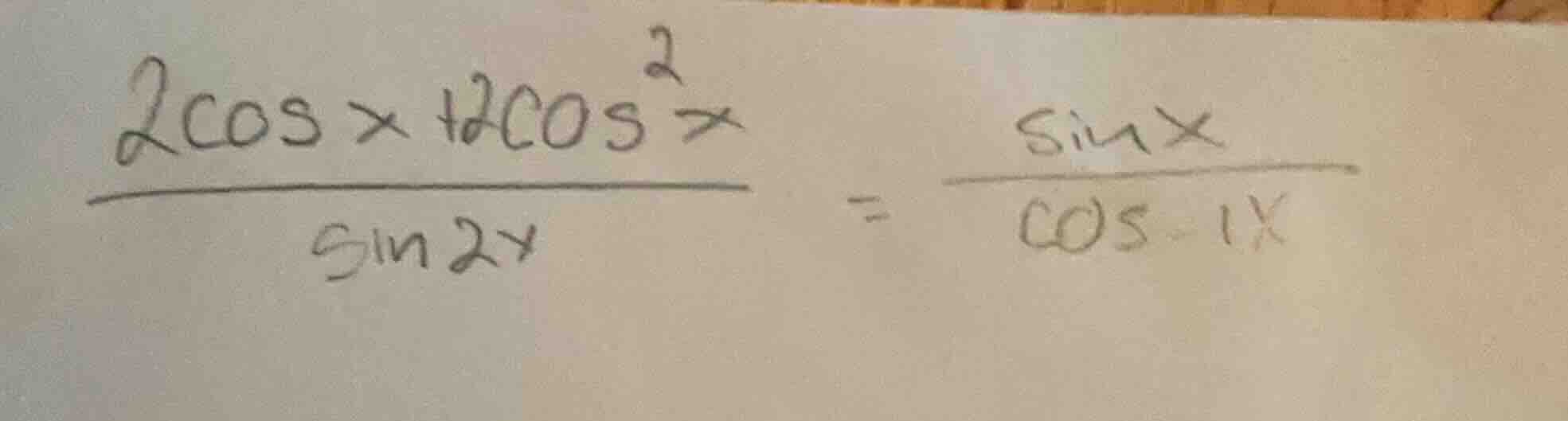
\\\frac{2\cos x + 2\cos^2 x}{\sin 2x} = \frac{\sin x}{\cos x - 1}\\
Identify the equation and domain restrictions
We are given the trigonometric equation:
First, we must identify the values of \(x\) for which the expressions are defined. The denominators cannot be zero:
- \(\sin 2x
eq 0 \implies 2x
eq k\pi \implies x
eq \frac{k\pi}{2}\) for any integer \(k\). This means \(\sin x
eq 0\) and \(\cos x
eq 0\).
- \(\cos x - 1
eq 0 \implies \cos x
eq 1 \implies x
eq 2k\pi\).
Simplify the left-hand side
Using the double-angle identity \(\sin 2x = 2\sin x \cos x\), we rewrite the denominator of the left-hand side:
Since \(\cos x
eq 0\), we can cancel the common terms \(2\cos x\) from the numerator and the denominator:
Equate the simplified sides
Now, substitute the simplified left-hand side back into the original equation:
Cross-multiply to solve for \(x\):
Solve the simplified equation
Using the Pythagorean identity \(\sin^2 x = 1 - \cos^2 x\), we substitute this into the equation:
Rearranging the terms gives:
This yields two possible sets of solutions:
Check against domain restrictions
Let's analyze the solutions:
- If \(\cos x = 1\), this violates the restriction \(\cos x - 1
eq 0\) (the denominator on the right-hand side would be zero). Thus, \(\cos x = 1\) is extraneous.
- If \(\cos x = -1\), then \(\sin x = 0\). However, our domain restrictions require \(\sin 2x
eq 0\), which means \(\sin x
eq 0\). Thus, \(\cos x = -1\) is also extraneous because it makes the denominator \(\sin 2x = 2\sin x\cos x = 0\).
Since all potential solutions are extraneous, the equation has no solution.

Snap & solve any problem in the app
Get step-by-step solutions on Sovi AI
Photo-based solutions with guided steps
Explore more problems and detailed explanations
No solution