QUESTION IMAGE
Question
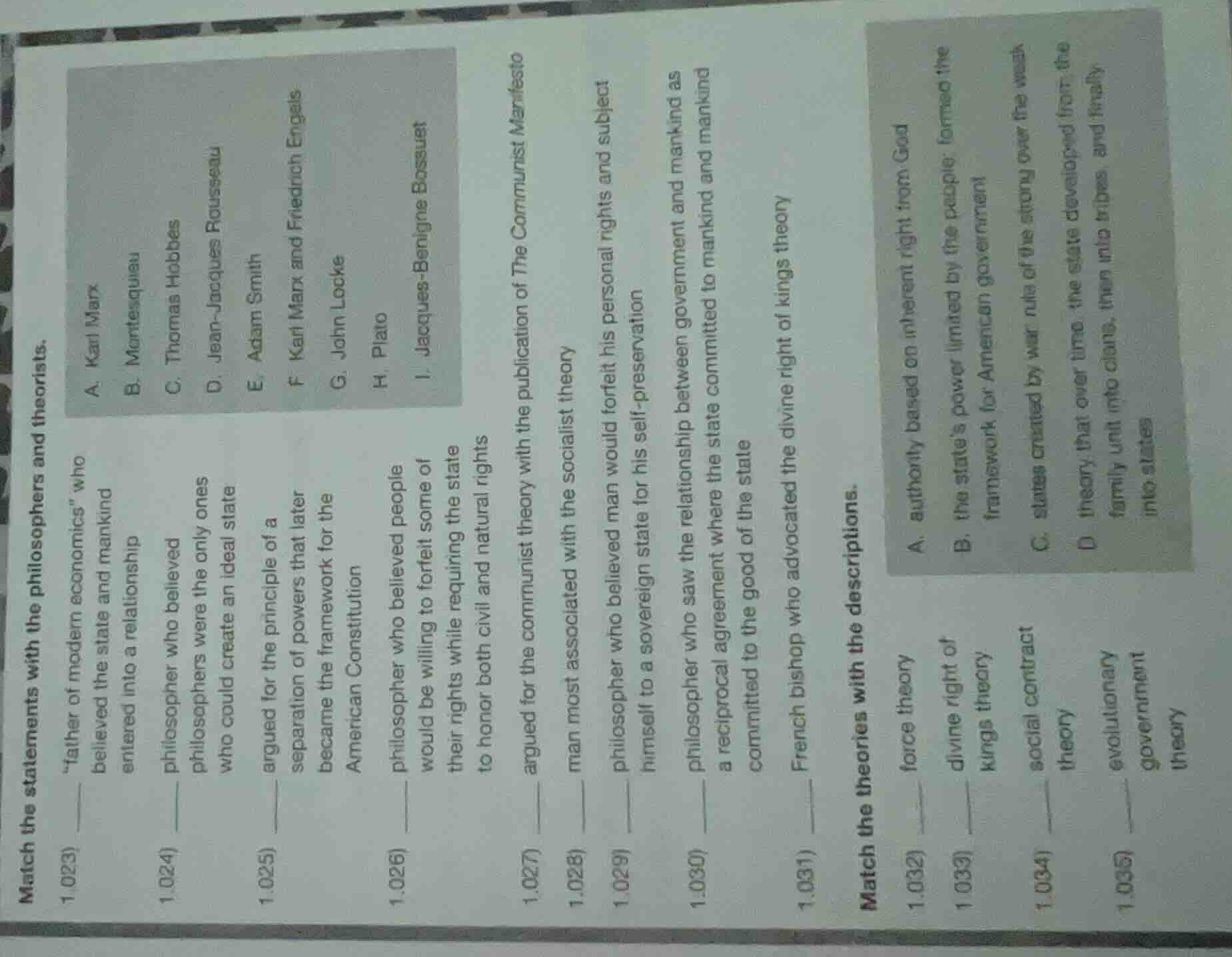
match the statements with the philosophers and theorists.
a. karl marx
b. montesquieu
c. thomas hobbes
d. jean-jacques rousseau
e. adam smith
f. karl marx and friedrich engels
g. john locke
h. plato
i. jacques-benigne bossuet
1.023) ______ \father of modern economics\ who believed the state and mankind entered into a relationship
1.024) ______ philosopher who believed philosophers were the only ones who could create an ideal state
1.025) ______ argued for the principle of a separation of powers that later became the framework for the american constitution
1.026) ______ philosopher who believed people would be willing to forfeit some of their rights while requiring the state to honor both civil and natural rights
1.027) ______ argued for the communist theory with the publication of the communist manifesto
1.028) ______ man most associated with the socialist theory
1.029) ______ philosopher who believed man would forfeit his personal rights and subject himself to a sovereign state for his self-preservation
1.030) ______ philosopher who saw the relationship between government and mankind as a reciprocal agreement where the state committed to mankind and mankind committed to the good of the state
1.031) ______ french bishop who advocated the divine right of kings theory
match the theories with the descriptions.
a. authority based on inherent right from god
b. the states power limited by the people; formed the framework for american government
c. states created by war; rule of the strong over the weak
d. theory that over time, the state developed from the family unit into clans, then into tribes, and finally into states
1.032) ______ force theory
1.033) ______ divine right of kings theory
1.034) ______ social contract theory
1.035) ______ evolutionary government theory
Analyze philosopher and theorist matches (1.023 - 1.031)
- 1.023: "Father of modern economics" who believed the state and mankind entered into a relationship. This refers to Adam Smith (E).
- 1.024: Philosopher who believed philosophers were the only ones who could create an ideal state. This refers to Plato (H).
- 1.025: Argued for the principle of a separation of powers that later became the framework for the American Constitution. This refers to Montesquieu (B).
- 1.026: Philosopher who believed people would be willing to forfeit some of their rights while requiring the state to honor both civil and natural rights. This refers to John Locke (G).
- 1.027: Argued for the communist theory with the publication of The Communist Manifesto. This refers to Karl Marx and Friedrich Engels (F).
- 1.028: Man most associated with the socialist theory. This refers to Karl Marx (A).
- 1.029: Philosopher who believed man would forfeit his personal rights and subject himself to a sovereign state for his self-preservation. This refers to Thomas Hobbes (C).
- 1.030: Philosopher who saw the relationship between government and mankind as a reciprocal agreement where the state committed to mankind and mankind committed to the good of the state. This refers to Jean-Jacques Rousseau (D).
- 1.031: French bishop who advocated the divine right of kings theory. This refers to Jacques-Bénigne Bossuet (I).
Analyze theory matches (1.032 - 1.035)
- 1.032: Force theory. Matches description C: "states created by war rule of the strong over the weak".
- 1.033: Divine right of kings theory. Matches description A: "authority based on inherent right from God".
- 1.034: Social contract theory. Matches description B: "the state's power limited by the people; formed the framework for American government".
- 1.035: Evolutionary government theory. Matches description D: "theory that over time, the state developed from the family unit into clans, then into tribes, and finally into states".

Snap & solve any problem in the app
Get step-by-step solutions on Sovi AI
Photo-based solutions with guided steps
Explore more problems and detailed explanations
| No. | Answer |
|---|---|
| 1.024 | H |
| 1.025 | B |
| 1.026 | G |
| 1.027 | F |
| 1.028 | A |
| 1.029 | C |
| 1.030 | D |
| 1.031 | I |
| 1.032 | C |
| 1.033 | A |
| 1.034 | B |
| 1.035 | D |