QUESTION IMAGE
Question
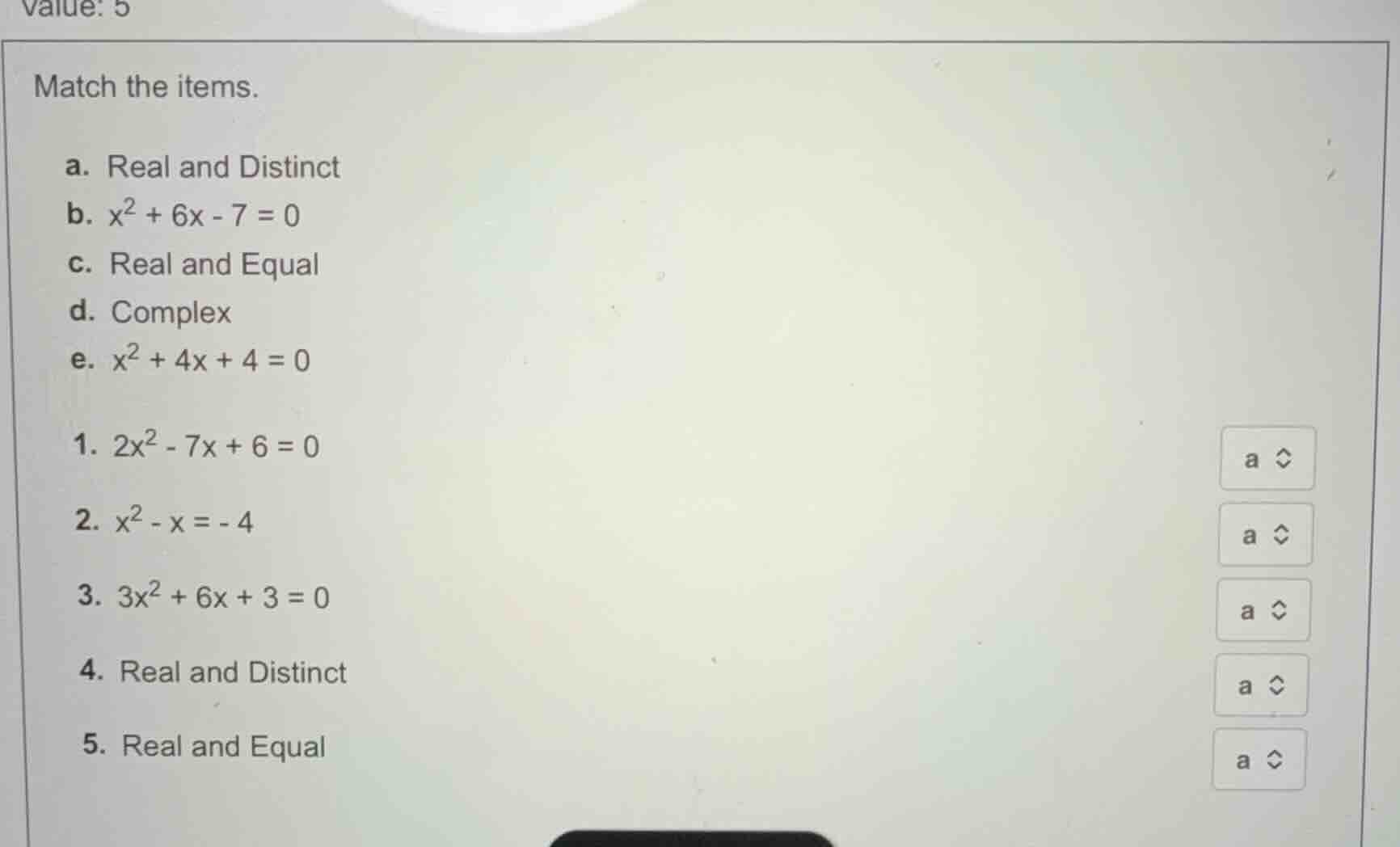
match the items.
a. real and distinct
b. \\(x^2 + 6x - 7 = 0\\)
c. real and equal
d. complex
e. \\(x^2 + 4x + 4 = 0\\)
- \\(2x^2 - 7x + 6 = 0\\)
- \\(x^2 - x = -4\\)
- \\(3x^2 + 6x + 3 = 0\\)
- real and distinct
- real and equal
<pre_analysis>
{
"quality": "clear",
"question_count": 5,
"skills_matched": [
"step_cot",
"table_formatter",
"explain_then_answer",
"quick"
],
"needs_drawing": false,
"concepts_used": [
"Discriminant of Quadratic",
"Quadratic Equations"
],
"new_concepts": [],
"current_concepts": [
"Discriminant of Quadratic",
"Quadratic Equations",
"Number of Real Solutions"
]
}
</pre_analysis>
<reasoning>
Analyze the discriminant of the first equation
Using the discriminant formula \(\Delta = b^2 - 4ac\) for \(2x^2 - 7x + 6 = 0\):
\[
\Delta = (-7)^2 - 4(2)(6) = 49 - 48 = 1 > 0
\]
Since \(\Delta > 0\), the roots are real and distinct.
Analyze the discriminant of the second equation
Rewrite \(x^2 - x = -4\) as \(x^2 - x + 4 = 0\):
\[
\Delta = (-1)^2 - 4(1)(4) = 1 - 16 = -15 < 0
\]
Since \(\Delta < 0\), the roots are complex.
Analyze the discriminant of the third equation
For \(3x^2 + 6x + 3 = 0\):
\[
\Delta = 6^2 - 4(3)(3) = 36 - 36 = 0
\]
Since \(\Delta = 0\), the roots are real and equal.
Match the remaining items
For item 4, "Real and Distinct" matches the equation \(x^2 + 6x - 7 = 0\) (since \(\Delta = 6^2 - 4(1)(-7) = 64 > 0\)), which is option b.
For item 5, "Real and Equal" matches the equation \(x^2 + 4x + 4 = 0\) (since \(\Delta = 4^2 - 4(1)(4) = 0\)), which is option e.
</reasoning>
<answer>
| No. | Answer |
|---|---|
| 2 | d. Complex |
| 3 | c. Real and Equal |
| 4 | b. \(x^2 + 6x - 7 = 0\) |
| 5 | e. \(x^2 + 4x + 4 = 0\) |
</answer>
<post_analysis>
{
"subject": "Mathematics",
"question_type": "Fill-in-the-blank",
"knowledge_point": [
"Mathematics",
"Algebra",
"Discriminant of Quadratic"
]
}
</post_analysis>
Snap & solve any problem in the app
Get step-by-step solutions on Sovi AI
Photo-based solutions with guided steps
Explore more problems and detailed explanations
<pre_analysis>
{
"quality": "clear",
"question_count": 5,
"skills_matched": [
"step_cot",
"table_formatter",
"explain_then_answer",
"quick"
],
"needs_drawing": false,
"concepts_used": [
"Discriminant of Quadratic",
"Quadratic Equations"
],
"new_concepts": [],
"current_concepts": [
"Discriminant of Quadratic",
"Quadratic Equations",
"Number of Real Solutions"
]
}
</pre_analysis>
<reasoning>
Analyze the discriminant of the first equation
Using the discriminant formula \(\Delta = b^2 - 4ac\) for \(2x^2 - 7x + 6 = 0\):
\[
\Delta = (-7)^2 - 4(2)(6) = 49 - 48 = 1 > 0
\]
Since \(\Delta > 0\), the roots are real and distinct.
Analyze the discriminant of the second equation
Rewrite \(x^2 - x = -4\) as \(x^2 - x + 4 = 0\):
\[
\Delta = (-1)^2 - 4(1)(4) = 1 - 16 = -15 < 0
\]
Since \(\Delta < 0\), the roots are complex.
Analyze the discriminant of the third equation
For \(3x^2 + 6x + 3 = 0\):
\[
\Delta = 6^2 - 4(3)(3) = 36 - 36 = 0
\]
Since \(\Delta = 0\), the roots are real and equal.
Match the remaining items
For item 4, "Real and Distinct" matches the equation \(x^2 + 6x - 7 = 0\) (since \(\Delta = 6^2 - 4(1)(-7) = 64 > 0\)), which is option b.
For item 5, "Real and Equal" matches the equation \(x^2 + 4x + 4 = 0\) (since \(\Delta = 4^2 - 4(1)(4) = 0\)), which is option e.
</reasoning>
<answer>
| No. | Answer |
|---|---|
| 2 | d. Complex |
| 3 | c. Real and Equal |
| 4 | b. \(x^2 + 6x - 7 = 0\) |
| 5 | e. \(x^2 + 4x + 4 = 0\) |
</answer>
<post_analysis>
{
"subject": "Mathematics",
"question_type": "Fill-in-the-blank",
"knowledge_point": [
"Mathematics",
"Algebra",
"Discriminant of Quadratic"
]
}
</post_analysis>