QUESTION IMAGE
Question
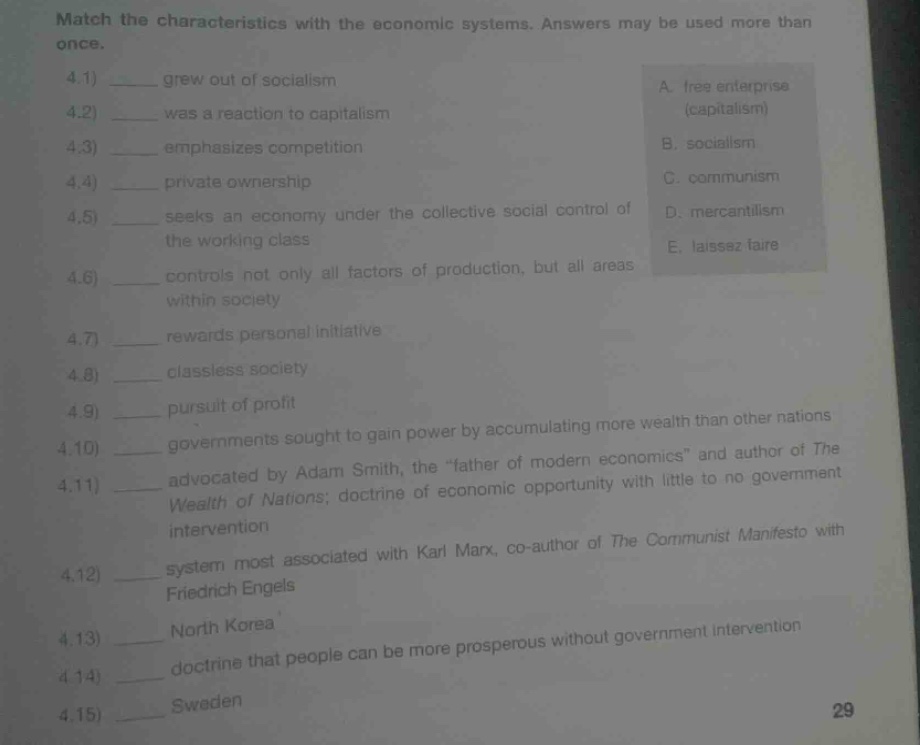
match the characteristics with the economic systems. answers may be used more than once.
4.1) ______ grew out of socialism
4.2) ______ was a reaction to capitalism
4.3) ______ emphasizes competition
4.4) ______ private ownership
4.5) ______ seeks an economy under the collective social control of the working class
4.6) ______ controls not only all factors of production, but all areas within society
4.7) ______ rewards personal initiative
4.8) ______ classless society
4.9) ______ pursuit of profit
4.10) ______ governments sought to gain power by accumulating more wealth than other nations
4.11) ______ advocated by adam smith, the \father of modern economics\ and author of the wealth of nations; doctrine of economic opportunity with little to no government intervention
4.12) ______ system most associated with karl marx, co-author of the communist manifesto with friedrich engels
4.13) ______ north korea
4.14) ______ doctrine that people can be more prosperous without government intervention
4.15) ______ sweden
a. free enterprise (capitalism)
b. socialism
c. communism
d. mercantilism
e. laissez faire
Match characteristics 4.1 to 4.5
- 4.1: Communism grew out of socialism as a more radical, revolutionary form. (C)
- 4.2: Socialism emerged as a direct reaction to the social and economic inequalities of industrial capitalism. (B)
- 4.3: Free enterprise (capitalism) relies heavily on market competition to drive efficiency and innovation. (A)
- 4.4: Free enterprise (capitalism) is fundamentally characterized by the private ownership of assets and resources. (A)
- 4.5: Communism, in its Marxist definition, seeks to place the economy under the collective social control of the working class (proletariat). (C)
Match characteristics 4.6 to 4.10
- 4.6: Communism (specifically in its authoritarian state forms) controls all factors of production and all areas of social life. (C)
- 4.7: Free enterprise (capitalism) rewards personal initiative, risk-taking, and individual effort through financial gain. (A)
- 4.8: Communism aims to establish a classless, stateless society where class distinctions are abolished. (C)
- 4.9: Free enterprise (capitalism) is driven by the pursuit of profit as the primary economic incentive. (A)
- 4.10: Mercantilism is the economic system where governments sought to accumulate national wealth (especially gold and silver) to gain power relative to other nations. (D)
Match characteristics 4.11 to 4.15
- 4.11: Laissez-faire is the doctrine of economic opportunity with little to no government intervention, famously advocated by Adam Smith. (E)
- 4.12: Communism is the system most associated with Karl Marx and Friedrich Engels, authors of The Communist Manifesto. (C)
- 4.13: North Korea is a modern-day example of a highly centralized, state-controlled communist command economy. (C)
- 4.14: Laissez-faire is the specific doctrine stating that people can be more prosperous without government intervention in economic affairs. (E)
- 4.15: Sweden is widely recognized as a democratic socialist or social democratic nation, combining a market economy with extensive social welfare (socialism). (B)

Snap & solve any problem in the app
Get step-by-step solutions on Sovi AI
Photo-based solutions with guided steps
Explore more problems and detailed explanations
| No. | Answer |
|---|---|
| 4.2 | B |
| 4.3 | A |
| 4.4 | A |
| 4.5 | C |
| 4.6 | C |
| 4.7 | A |
| 4.8 | C |
| 4.9 | A |
| 4.10 | D |
| 4.11 | E |
| 4.12 | C |
| 4.13 | C |
| 4.14 | E |
| 4.15 | B |