QUESTION IMAGE
Question
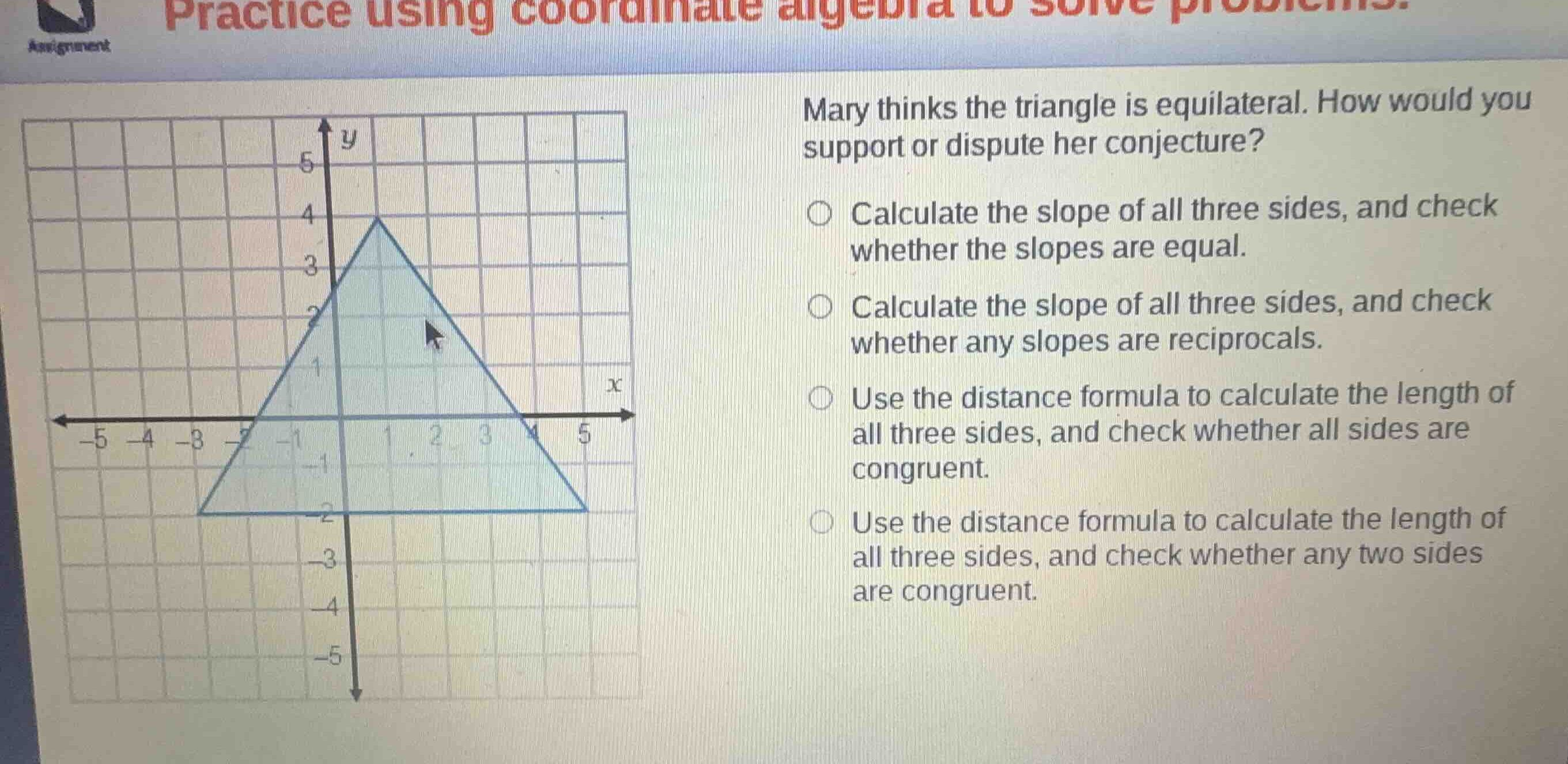
mary thinks the triangle is equilateral. how would you support or dispute her conjecture?
calculate the slope of all three sides, and check whether the slopes are equal.
calculate the slope of all three sides, and check whether any slopes are reciprocals.
use the distance formula to calculate the length of all three sides, and check whether all sides are congruent.
use the distance formula to calculate the length of all three sides, and check whether any two sides are congruent.
<pre_analysis>
{
"quality": "clear",
"question_count": 1,
"skills_matched": [
"step_cot",
"multiple_choice_formatter",
"explain_then_answer",
"tutor",
"mastery_adaptive_brevity"
],
"needs_drawing": false,
"concepts_used": [
"Equilateral Triangle Properties"
],
"new_concepts": [
"Coordinate Geometry Proofs",
"Distance Formula"
],
"current_concepts": [
"Equilateral Triangle Properties",
"Coordinate Geometry Proofs",
"Distance Formula"
]
}
</pre_analysis>
<reasoning>
Define the conjecture
Using the Equilateral Triangle Properties knowledge point
An equilateral triangle is defined as a triangle in which all three sides are equal in length (congruent). To support or dispute Mary's conjecture that the given triangle is equilateral, we must determine whether all three side lengths are equal.
Identify the coordinate method
To find and compare the lengths of the sides of a triangle plotted on a coordinate plane, we use the distance formula:
\[d = \sqrt{(x_2 - x_1)^2 + (y_2 - y_1)^2}\]
Checking if all three calculated side lengths are congruent will directly support or dispute the conjecture.
Evaluate the given options
- Option 1 suggests checking if slopes are equal, which would indicate parallel lines, not side lengths.
- Option 2 suggests checking if slopes are reciprocals, which relates to perpendicularity (negative reciprocals), not side lengths.
- Option 3 suggests using the distance formula to calculate all three side lengths and checking if all three sides are congruent. This matches the definition of an equilateral triangle.
- Option 4 suggests checking if only two sides are congruent, which would test for an isosceles triangle rather than an equilateral triangle.
</reasoning>
<answer>
<mcq-option>Calculate the slope of all three sides, and check whether the slopes are equal.</mcq-option>
<mcq-option>Calculate the slope of all three sides, and check whether any slopes are reciprocals.</mcq-option>
<mcq-correct>Use the distance formula to calculate the length of all three sides, and check whether all sides are congruent.</mcq-correct>
<mcq-option>Use the distance formula to calculate the length of all three sides, and check whether any two sides are congruent.</mcq-option>
</answer>
<post_analysis>
{
"subject": "Mathematics",
"question_type": "Multiple Choice",
"knowledge_point": [
"Mathematics",
"Geometry",
"Coordinate Geometry Proofs"
]
}
</post_analysis>
Snap & solve any problem in the app
Get step-by-step solutions on Sovi AI
Photo-based solutions with guided steps
Explore more problems and detailed explanations
<pre_analysis>
{
"quality": "clear",
"question_count": 1,
"skills_matched": [
"step_cot",
"multiple_choice_formatter",
"explain_then_answer",
"tutor",
"mastery_adaptive_brevity"
],
"needs_drawing": false,
"concepts_used": [
"Equilateral Triangle Properties"
],
"new_concepts": [
"Coordinate Geometry Proofs",
"Distance Formula"
],
"current_concepts": [
"Equilateral Triangle Properties",
"Coordinate Geometry Proofs",
"Distance Formula"
]
}
</pre_analysis>
<reasoning>
Define the conjecture
Using the Equilateral Triangle Properties knowledge point
An equilateral triangle is defined as a triangle in which all three sides are equal in length (congruent). To support or dispute Mary's conjecture that the given triangle is equilateral, we must determine whether all three side lengths are equal.
Identify the coordinate method
To find and compare the lengths of the sides of a triangle plotted on a coordinate plane, we use the distance formula:
\[d = \sqrt{(x_2 - x_1)^2 + (y_2 - y_1)^2}\]
Checking if all three calculated side lengths are congruent will directly support or dispute the conjecture.
Evaluate the given options
- Option 1 suggests checking if slopes are equal, which would indicate parallel lines, not side lengths.
- Option 2 suggests checking if slopes are reciprocals, which relates to perpendicularity (negative reciprocals), not side lengths.
- Option 3 suggests using the distance formula to calculate all three side lengths and checking if all three sides are congruent. This matches the definition of an equilateral triangle.
- Option 4 suggests checking if only two sides are congruent, which would test for an isosceles triangle rather than an equilateral triangle.
</reasoning>
<answer>
<mcq-option>Calculate the slope of all three sides, and check whether the slopes are equal.</mcq-option>
<mcq-option>Calculate the slope of all three sides, and check whether any slopes are reciprocals.</mcq-option>
<mcq-correct>Use the distance formula to calculate the length of all three sides, and check whether all sides are congruent.</mcq-correct>
<mcq-option>Use the distance formula to calculate the length of all three sides, and check whether any two sides are congruent.</mcq-option>
</answer>
<post_analysis>
{
"subject": "Mathematics",
"question_type": "Multiple Choice",
"knowledge_point": [
"Mathematics",
"Geometry",
"Coordinate Geometry Proofs"
]
}
</post_analysis>