QUESTION IMAGE
Question
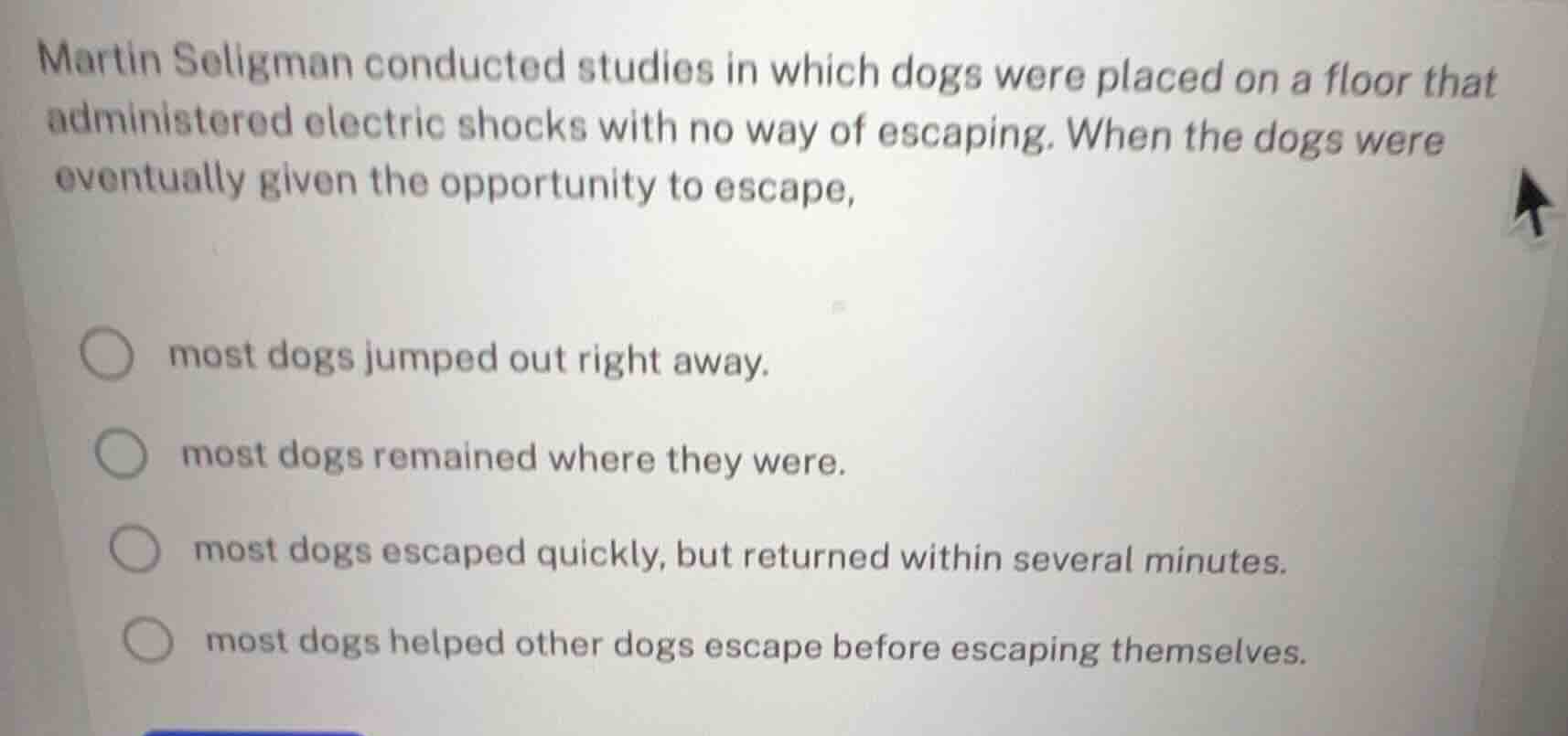
martin seligman conducted studies in which dogs were placed on a floor that administered electric shocks with no way of escaping. when the dogs were eventually given the opportunity to escape,
most dogs jumped out right away.
most dogs remained where they were.
most dogs escaped quickly, but returned within several minutes.
most dogs helped other dogs escape before escaping themselves.
<pre_analysis>
{
"quality": "clear",
"question_count": 1,
"skills_matched": [
"direct_cot",
"multiple_choice_formatter",
"explain_then_answer",
"tutor",
"mastery_adaptive_brevity"
],
"needs_drawing": false,
"concepts_used": [
"Martin Seligman Theory"
],
"new_concepts": [
"Learned Helplessness"
],
"current_concepts": [
"Martin Seligman Theory",
"Learned Helplessness",
"Coping Mechanisms"
]
}
</pre_analysis>
<reasoning>
Identify the core psychological experiment
Using the Martin Seligman Theory knowledge point, we analyze his famous 1967 research on classical conditioning and operant behavior in dogs.
Analyze the behavioral outcome
When dogs were subjected to inescapable electric shocks, they learned that their actions had no effect on the outcome. When later placed in a shuttle box where escaping the shock was as simple as jumping over a low barrier, the dogs did not try to escape. Instead, they whimpered and passively accepted the painful stimulus.
Connect to the correct option
This passive behavior is the classic demonstration of learned helplessness. Therefore, when given the opportunity to escape, most of the dogs remained where they were rather than attempting to jump to safety.
</reasoning>
<answer>
<mcq-option>(A) most dogs jumped out right away.</mcq-option>
<mcq-correct>(B) most dogs remained where they were.</mcq-correct>
<mcq-option>(C) most dogs escaped quickly, but returned within several minutes.</mcq-option>
<mcq-option>(D) most dogs helped other dogs escape before escaping themselves.</mcq-option>
</answer>
<post_analysis>
{
"subject": "Social Science",
"question_type": "Multiple Choice",
"knowledge_point": [
"Social Science",
"Psychology",
"Learned Helplessness"
]
}
</post_analysis>
Snap & solve any problem in the app
Get step-by-step solutions on Sovi AI
Photo-based solutions with guided steps
Explore more problems and detailed explanations
<pre_analysis>
{
"quality": "clear",
"question_count": 1,
"skills_matched": [
"direct_cot",
"multiple_choice_formatter",
"explain_then_answer",
"tutor",
"mastery_adaptive_brevity"
],
"needs_drawing": false,
"concepts_used": [
"Martin Seligman Theory"
],
"new_concepts": [
"Learned Helplessness"
],
"current_concepts": [
"Martin Seligman Theory",
"Learned Helplessness",
"Coping Mechanisms"
]
}
</pre_analysis>
<reasoning>
Identify the core psychological experiment
Using the Martin Seligman Theory knowledge point, we analyze his famous 1967 research on classical conditioning and operant behavior in dogs.
Analyze the behavioral outcome
When dogs were subjected to inescapable electric shocks, they learned that their actions had no effect on the outcome. When later placed in a shuttle box where escaping the shock was as simple as jumping over a low barrier, the dogs did not try to escape. Instead, they whimpered and passively accepted the painful stimulus.
Connect to the correct option
This passive behavior is the classic demonstration of learned helplessness. Therefore, when given the opportunity to escape, most of the dogs remained where they were rather than attempting to jump to safety.
</reasoning>
<answer>
<mcq-option>(A) most dogs jumped out right away.</mcq-option>
<mcq-correct>(B) most dogs remained where they were.</mcq-correct>
<mcq-option>(C) most dogs escaped quickly, but returned within several minutes.</mcq-option>
<mcq-option>(D) most dogs helped other dogs escape before escaping themselves.</mcq-option>
</answer>
<post_analysis>
{
"subject": "Social Science",
"question_type": "Multiple Choice",
"knowledge_point": [
"Social Science",
"Psychology",
"Learned Helplessness"
]
}
</post_analysis>