QUESTION IMAGE
Question
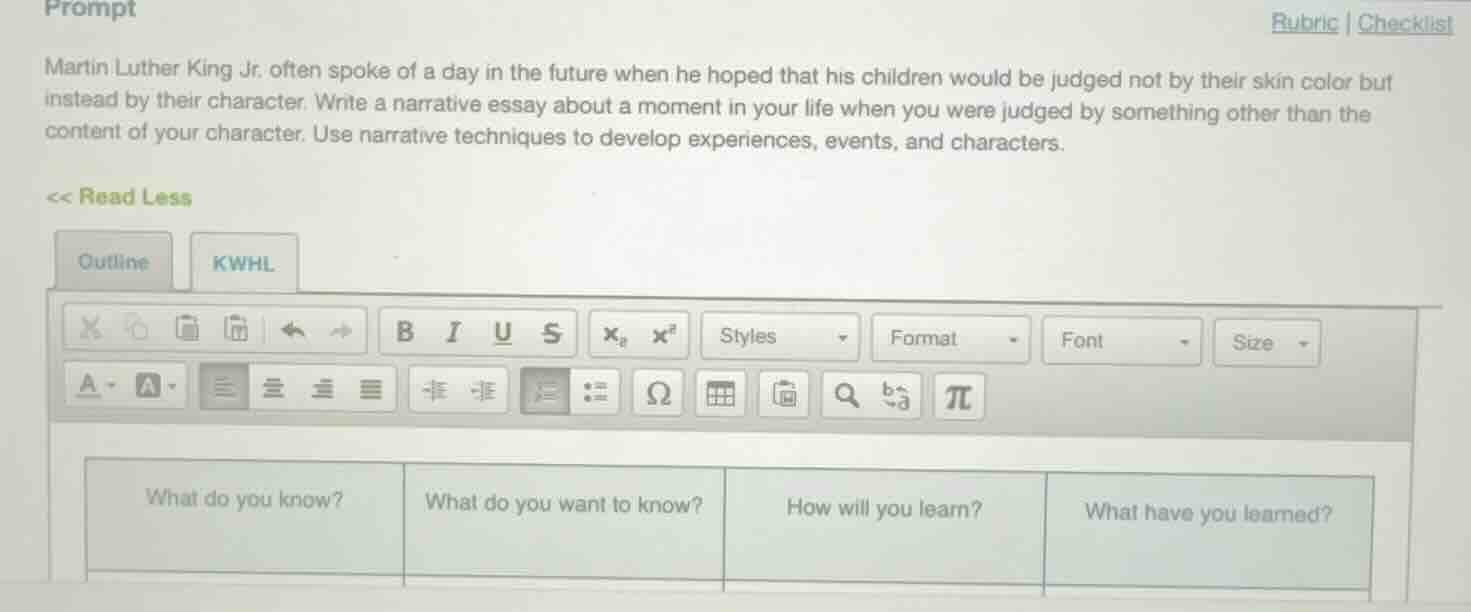
martin luther king jr. often spoke of a day in the future when he hoped that his children would be judged not by their skin color but instead by their character. write a narrative essay about a moment in your life when you were judged by something other than the content of your character. use narrative techniques to develop experiences, events, and characters.
Analyze the writing prompt
The prompt asks for a narrative essay about a moment when you were judged by something other than the content of your character, inspired by Martin Luther King Jr.'s speech. This requires applying Writing Prompt Analysis to identify the key task: writing a personal narrative focusing on an experience of unfair judgment and the personal growth or realization that followed.
Structure the narrative plan
To write an effective essay, we must utilize Narrative Essay Elements such as setting, character development, plot (exposition, rising action, climax, falling action, resolution), and sensory details. We will structure a plan that outlines these elements clearly to guide the writing process.
Utilize the KWHL framework
The interface shows a KWHL Chart tab ("What do you know?", "What do you want to know?", "How will you learn?", "What have you learned?"). We will fill out this chart specifically tailored to this narrative writing prompt to help organize thoughts before drafting.
Draft the narrative essay
We will write a cohesive, engaging personal narrative based on the structured plan. The story will focus on a relatable high school experience—such as being judged based on physical appearance or an assumption about an extracurricular interest—and show how character ultimately proved those assumptions wrong.

Snap & solve any problem in the app
Get step-by-step solutions on Sovi AI
Photo-based solutions with guided steps
Explore more problems and detailed explanations
To help you complete this writing assignment, here is a structured guide using your KWHL Chart followed by a complete, high-quality model narrative essay.
---
KWHL Chart Organizer
| What do you know? | What do you want to know? | How will you learn? | What have you learned? |
|---|
---
Model Narrative Essay: Beyond the Cover
The heavy scent of sawdust and motor oil always filled Room 114, the school’s robotics lab. It was a sanctuary of metal, wires, and brilliant minds. However, on my first day walking into the club as a sophomore, the room felt less like a sanctuary and more like an exclusive club where I did not belong.
I stood at the doorway clutching my notebook, wearing my bright purple varsity cheerleading jacket. Instantly, the chatter died down. A group of older boys huddled around a half-assembled chassis looked up, their eyes scanning me from my glittery hair bow down to my sneakers. One of them, the team captain, smirked slightly and pointed toward the hallway. "The pep rally committee meets in the gym, you know," he said, turning back to his laptop. The others chuckled. They had looked at my uniform and instantly decided that my intellect was as light as the pom-poms I held on Friday nights.
A hot wave of embarrassment rushed to my face, but instead of turning around, I took a deep breath and walked straight to an empty workbench. I knew who I was. I loved the rhythm of cheer choreography, but I also loved the logic of Python programming. My character was not defined by a single interest, and I was determined to prove it.
For the next three weeks, I kept my head down and worked. I volunteered for the tedious task of debugging the autonomous navigation code—a job the older members avoided. While they argued over mechanical designs, I sat quietly in the corner, typing away, translating complex sensor data into smooth, executable commands. I didn't argue with their assumptions; I let my work speak for itself.
The true test came two days before our first regional competition. The robot’s primary arm sensor failed, causing the machine to spin aimlessly during test runs. Panic erupted in the lab. The captain frantically swapped out hardware, but the error persisted. The clock was ticking, and frustration hung thick in the air.
"Let me look at the sensor calibration script," I said, stepping forward.
The captain looked at me, desperate enough to finally look past my jacket. "Go ahead, but we've checked the code twice."
I sat at the terminal, my fingers flying across the keyboard. I bypassed the main loop and isolated the input variables. There it was—a simple syntax error in the library update that overrode the gyroscope's zero-point. I corrected the line, compiled the code, and uploaded it to the robot.
"Try it now," I said.
The captain pressed the start button. The robot initialized, paused, and then smoothly extended its arm to grab the target object with perfect precision. The lab went completely silent.
The captain looked from the robot to me, his face softening with genuine respect. "I'm sorry," he said quietly. "I completely misjudged you. We wouldn't be ready for competition without your help."
I smiled, feeling a deep sense of pride. I had not changed my outfit, nor had I given up my love for cheerleading. But by standing my ground and letting my dedication and skills show my true capabilities, I had dismantled their shallow assumptions. I learned that day that while people may judge you by your cover, your character is the story you write yourself through your actions.