QUESTION IMAGE
Question
2
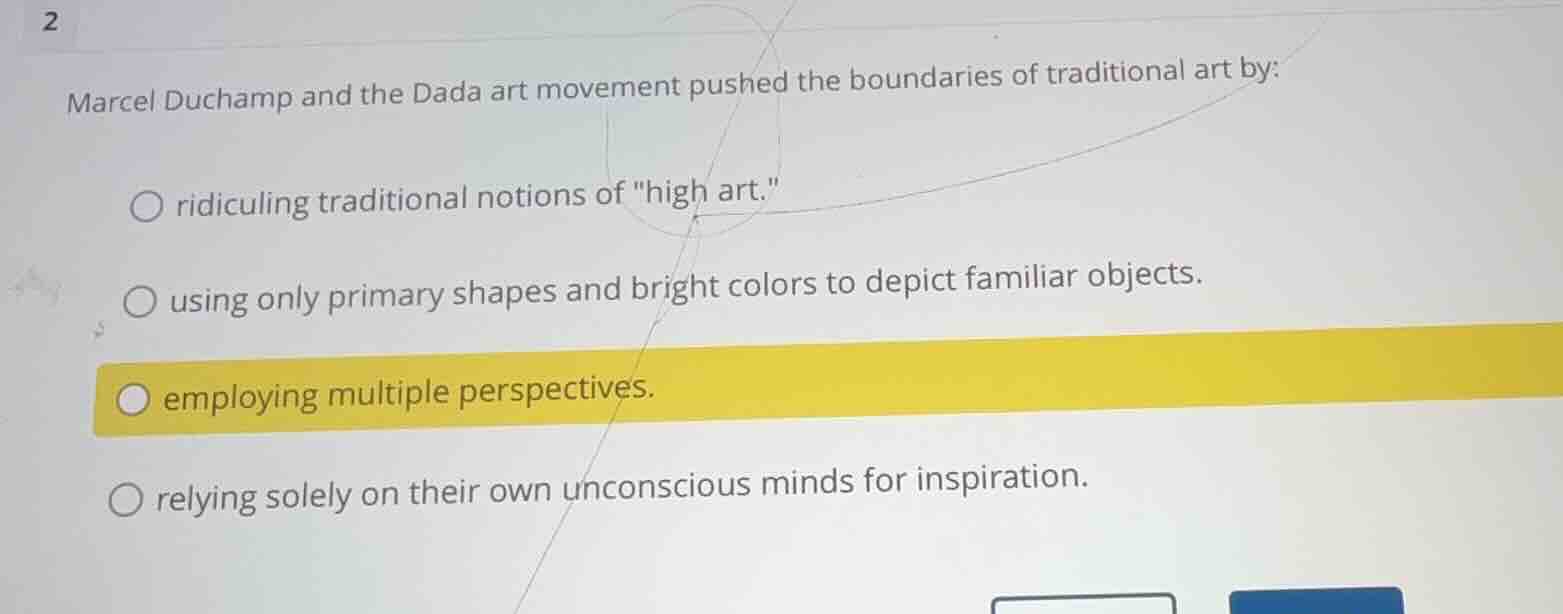
marcel duchamp and the dada art movement pushed the boundaries of traditional art by:
ridiculing traditional notions of \high art.\
using only primary shapes and bright colors to depict familiar objects.
employing multiple perspectives.
relying solely on their own unconscious minds for inspiration.
🆕 New Concept Discovered: Art History Movements and Philosophy
Understanding how historical art movements challenged societal norms.
Step 1: Analyze the Dada movement and Marcel Duchamp
The Dada movement arose in the early 20th century as a reaction to the horrors of World War I. Dadaists believed that traditional social, political, and aesthetic values had led to the war, so they sought to reject and subvert those values.
Marcel Duchamp, a prominent figure in the movement, introduced "readymades"—ordinary, manufactured objects that he selected and designated as art (such as a urinal titled Fountain). This act directly mocked and challenged the traditional, elitist definitions of what constitutes "high art."
Step 2: Evaluate the given options
- ridiculing traditional notions of "high art."
This aligns perfectly with Dada's anti-art philosophy and Duchamp's use of readymades to question the value, authority, and definition of traditional art.
- using only primary shapes and bright colors to depict familiar objects.
This describes styles more closely associated with movements like De Stijl (e.g., Piet Mondrian) or Pop Art, not Dada.
- employing multiple perspectives.
This is a defining characteristic of Cubism (e.g., Pablo Picasso), which broke objects down into geometric forms viewed from multiple angles simultaneously.
- relying solely on their own unconscious minds for inspiration.
This describes Surrealism, which focused on dreams and the subconscious (often influenced by Sigmund Freud's theories).

Snap & solve any problem in the app
Get step-by-step solutions on Sovi AI
Photo-based solutions with guided steps
Explore more problems and detailed explanations
ridiculing traditional notions of "high art."