QUESTION IMAGE
Question
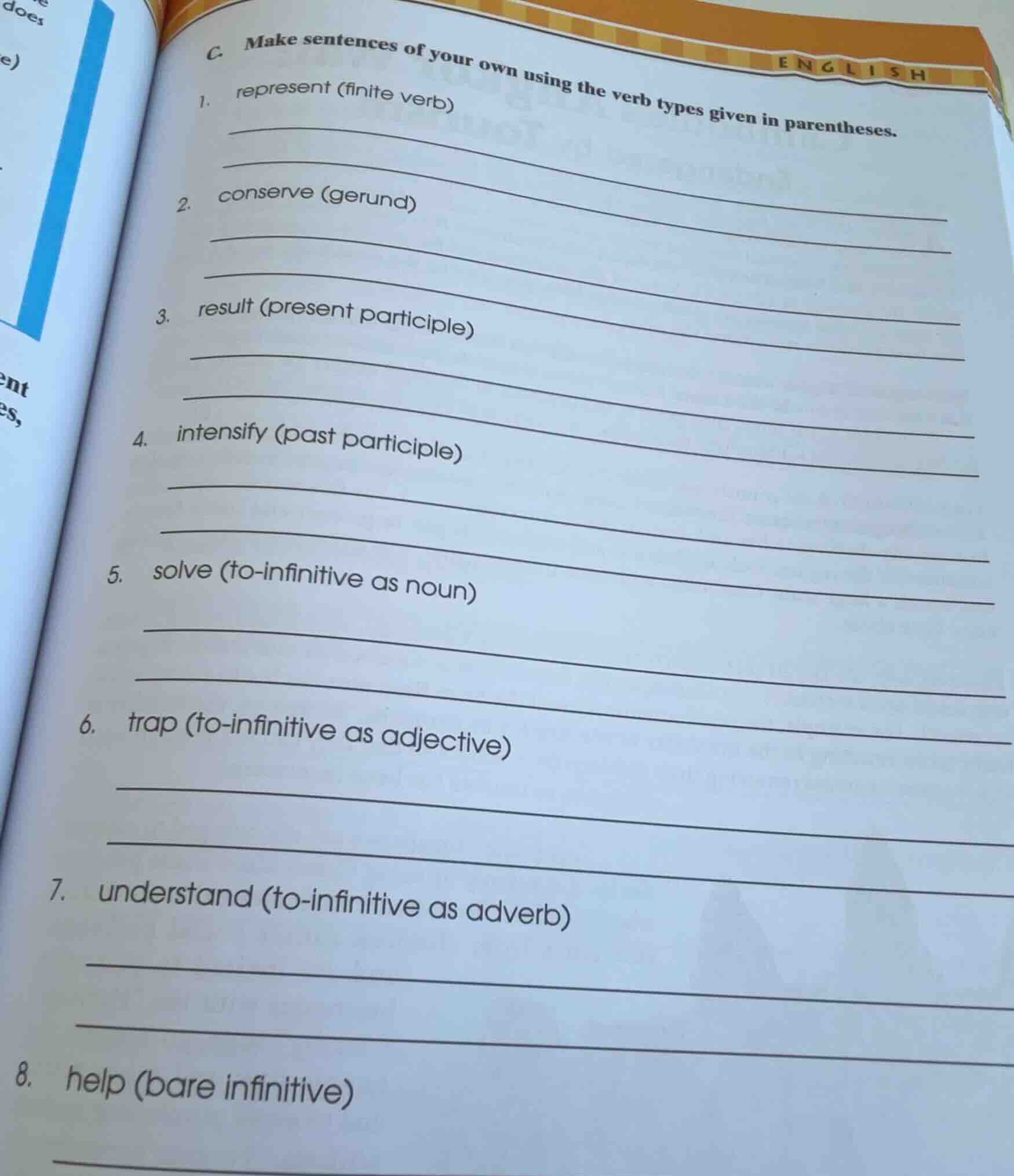
c. make sentences of your own using the verb types given in parentheses.
- represent (finite verb)
- conserve (gerund)
- result (present participle)
- intensify (past participle)
- solve (to-infinitive as noun)
- trap (to-infinitive as adjective)
- understand (to-infinitive as adverb)
- help (bare infinitive)
Analyze finite verb requirements
Using the Finite Verbs knowledge point, we need a sentence where "represent" acts as the main verb showing tense, person, and number.
- Word: represent
- Form: finite verb (e.g., "represent" or "represents")
- Sentence: These symbols represent peace.
Analyze gerund requirements
Using the Verbals and Non-Finite Verbs knowledge points, a gerund is an "-ing" verb form functioning as a noun.
- Word: conserve
- Form: conserving (gerund)
- Sentence: Conserving water is essential during a drought.
Analyze present participle requirements
Using the Non-Finite Verbs knowledge point, a present participle is an "-ing" verb form functioning as an adjective or part of a continuous verb tense.
- Word: result
- Form: resulting (present participle acting as an adjective)
- Sentence: The heavy rains and the resulting floods caused damage.
Analyze past participle requirements
Using the Non-Finite Verbs knowledge point, a past participle is an "-ed" or irregular verb form functioning as an adjective or part of a perfect tense.
- Word: intensify
- Form: intensified (past participle acting as an adjective)
- Sentence: The intensified heat made it difficult to work outside.
Analyze infinitive requirements
Using the Non-Finite Verbs knowledge point, we construct infinitives acting as nouns, adjectives, adverbs, or bare infinitives.
- To-infinitive as noun (solve): "To solve this puzzle is difficult." (Subject)
- To-infinitive as adjective (trap): "They set a clever device to trap the mice." (Modifies "device")
- To-infinitive as adverb (understand): "She read the book to understand the topic." (Modifies "read")
- Bare infinitive (help): "She made him help with the chores." (Infinitive without "to" after "made")

Snap & solve any problem in the app
Get step-by-step solutions on Sovi AI
Photo-based solutions with guided steps
Explore more problems and detailed explanations
Question 1
represent (finite verb)
<blank>These symbols represent peace.</blank>
Question 2
conserve (gerund)
<blank>Conserving water is essential during a drought.</blank>
Question 3
result (present participle)
<blank>The heavy rains and the resulting floods caused damage.</blank>
Question 4
intensify (past participle)
<blank>The intensified heat made it difficult to work outside.</blank>
Question 5
solve (to-infinitive as noun)
<blank>To solve this puzzle requires a lot of patience.</blank>
Question 6
trap (to-infinitive as adjective)
<blank>They designed a clever device to trap the mice.</blank>
Question 7
understand (to-infinitive as adverb)
<blank>She read the textbook carefully to understand the concept.</blank>
Question 8
help (bare infinitive)
<blank>Our teacher made us help clean up the classroom.</blank>