QUESTION IMAGE
Question
- m4 15 lesson 5
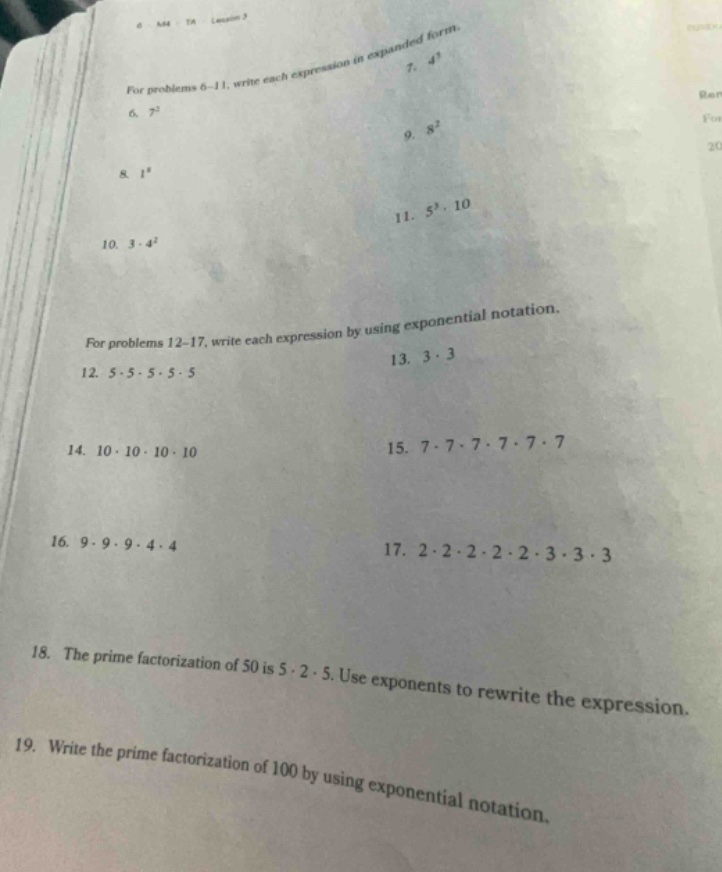
for problems 6–11, write each expression in expanded form.
- $7^2$
- $4^3$
- $1^5$
- $8^2$
- $3 \cdot 4^2$
- $5^3 \cdot 10$
for problems 12–17, write each expression by using exponential notation.
- $5 \cdot 5 \cdot 5 \cdot 5 \cdot 5$
- $3 \cdot 3$
- $10 \cdot 10 \cdot 10 \cdot 10$
- $7 \cdot 7 \cdot 7 \cdot 7 \cdot 7$
- $9 \cdot 9 \cdot 9 \cdot 4 \cdot 4$
- $2 \cdot 2 \cdot 2 \cdot 2 \cdot 2 \cdot 3 \cdot 3 \cdot 3$
- the prime factorization of 50 is $5 \cdot 2 \cdot 5$. use exponents to rewrite the expression.
- write the prime factorization of 100 by using exponential notation.
Problem 6: \(7^2\)
Step1: Recall exponent definition
An exponent \(a^n\) means \(a\) multiplied by itself \(n\) times. Here, base is \(7\), exponent is \(2\).
Step2: Expand the expression
\(7^2 = 7\times7\)
Step1: Recall exponent definition
For \(a^n\), \(a\) is base, \(n\) is exponent (number of multiplications). Here, base \(4\), exponent \(3\).
Step2: Expand the expression
\(4^3=4\times4\times4\)
Step1: Recall exponent definition
\(a^n\) is \(a\) multiplied \(n\) times. Base \(1\), exponent \(5\).
Step2: Expand the expression
\(1^5 = 1\times1\times1\times1\times1\)

Snap & solve any problem in the app
Get step-by-step solutions on Sovi AI
Photo-based solutions with guided steps
Explore more problems and detailed explanations
\(7\times7\)