QUESTION IMAGE
Question
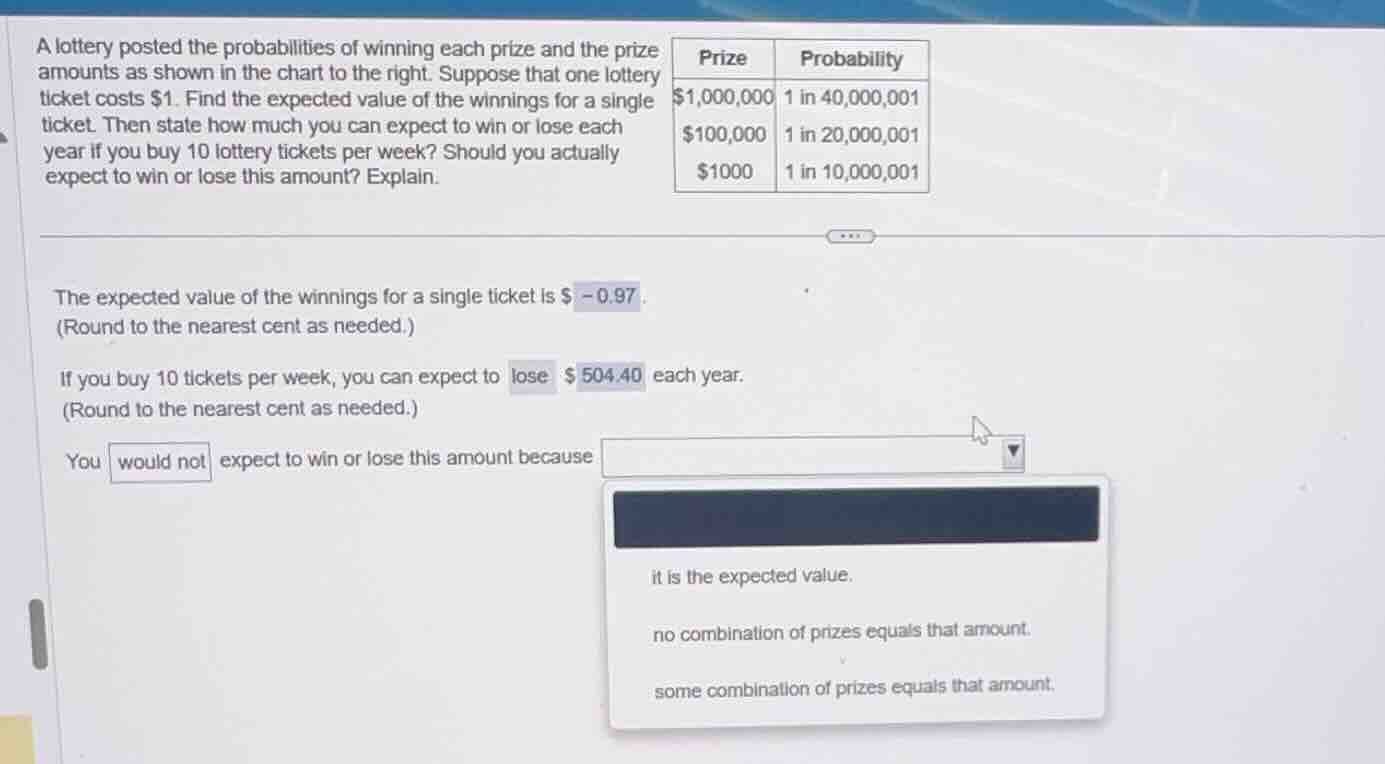
a lottery posted the probabilities of winning each prize and the prize amounts as shown in the chart to the right. suppose that one lottery ticket costs \\$1. find the expected value of the winnings for a single ticket. then state how much you can expect to win or lose each year if you buy 10 lottery tickets per week? should you actually expect to win or lose this amount? explain.
\
the expected value of the winnings for a single ticket is \\$ -0.97.
(round to the nearest cent as needed.)
if you buy 10 tickets per week, you can expect to lose \\$ 504.40 each year.
(round to the nearest cent as needed.)
you would not expect to win or lose this amount because
- it is the expected value.
- no combination of prizes equals that amount.
- some combination of prizes equals that amount.
Calculate single ticket expected value
Using the Lottery Expected Value and Expected Value knowledge points
Calculate annual expected loss
Using the Expected Value knowledge point
Analyze long-term expectation vs actual outcome
Using the Law of Large Numbers knowledge point
The expected value represents the long-term average outcome if one plays the lottery an infinite number of times. For any single year with a finite number of tickets (such as 520), the actual outcome is highly likely to be different because the probability of winning any prize is extremely small. Therefore, you would not expect to win or lose exactly this amount because the expected value is a statistical average, and no individual combination of actual lottery outcomes (either losing \$1 per ticket or winning a large prize) will result in a net loss of exactly \$504.40.

Snap & solve any problem in the app
Get step-by-step solutions on Sovi AI
Photo-based solutions with guided steps
Explore more problems and detailed explanations
Question 1
- it is the expected value.
- no combination of prizes equals that amount. (Correct answer)
- some combination of prizes equals that amount.