QUESTION IMAGE
Question
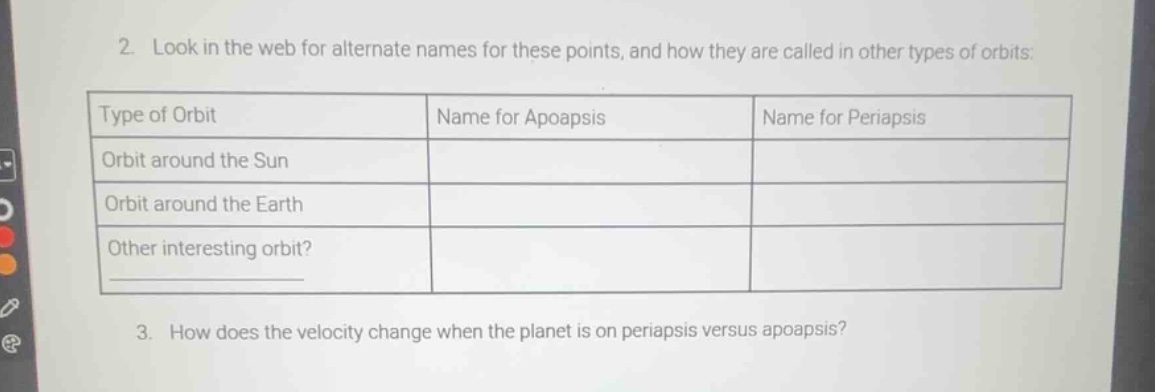
- look in the web for alternate names for these points, and how they are called in other types of orbits:
\
$$\begin{tabular}{|l|l|l|}
\\hline
type of orbit & name for apoapsis & name for periapsis \\\\
\\hline
orbit around the sun & & \\\\
\\hline
orbit around the earth & & \\\\
\\hline
other interesting orbit? & & \\\\
\\hline
\\end{tabular}$$
- how does the velocity change when the planet is on periapsis versus apoapsis?
Identify specific orbital terminology for different central bodies
- Orbit around the Sun: Apohelion (Apoapsis) and Perihelion (Periapsis).
- Orbit around the Earth: Apogee (Apoapsis) and Perigee (Periapsis).
- Orbit around the Moon (other interesting orbit): Apolune / Aposelene (Apoapsis) and Perilune / Periselene (Periapsis).
Analyze orbital velocity changes at periapsis versus apoapsis
- Kepler's Second Law (conservation of angular momentum): \(v_{\text{periapsis}} \cdot r_{\text{periapsis}} = v_{\text{apoapsis}} \cdot r_{\text{apoapsis}}\).
- Since \(r_{\text{periapsis}} < r_{\text{apoapsis}}\), the velocity is at its maximum at periapsis and at its minimum at apoapsis.

Snap & solve any problem in the app
Get step-by-step solutions on Sovi AI
Photo-based solutions with guided steps
Explore more problems and detailed explanations
Question 2
| Type of Orbit | Name for Apoapsis | Name for Periapsis |
|---|---|---|
| Orbit around the Earth | Apogee | Perigee |
| Orbit around the Moon | Apolune / Aposelene | Perilune / Periselene |
Question 3
The velocity is at its maximum at periapsis (closest point to the central body) and at its minimum at apoapsis (farthest point from the central body).