QUESTION IMAGE
Question
look at the picture and read the caption from windows to the universe: revolutions in astronomy.
what is the purpose of the picture and caption?
to show how ancient astronomers used the moon to track time and organize their calendar
to highlight the beauty of the crescent moon in different cultures art and literature
to illustrate how modern astronomers study lunar visibility for scientific research
to explain the phases of the moon and their effect on tides
Analyze the visual and textual context
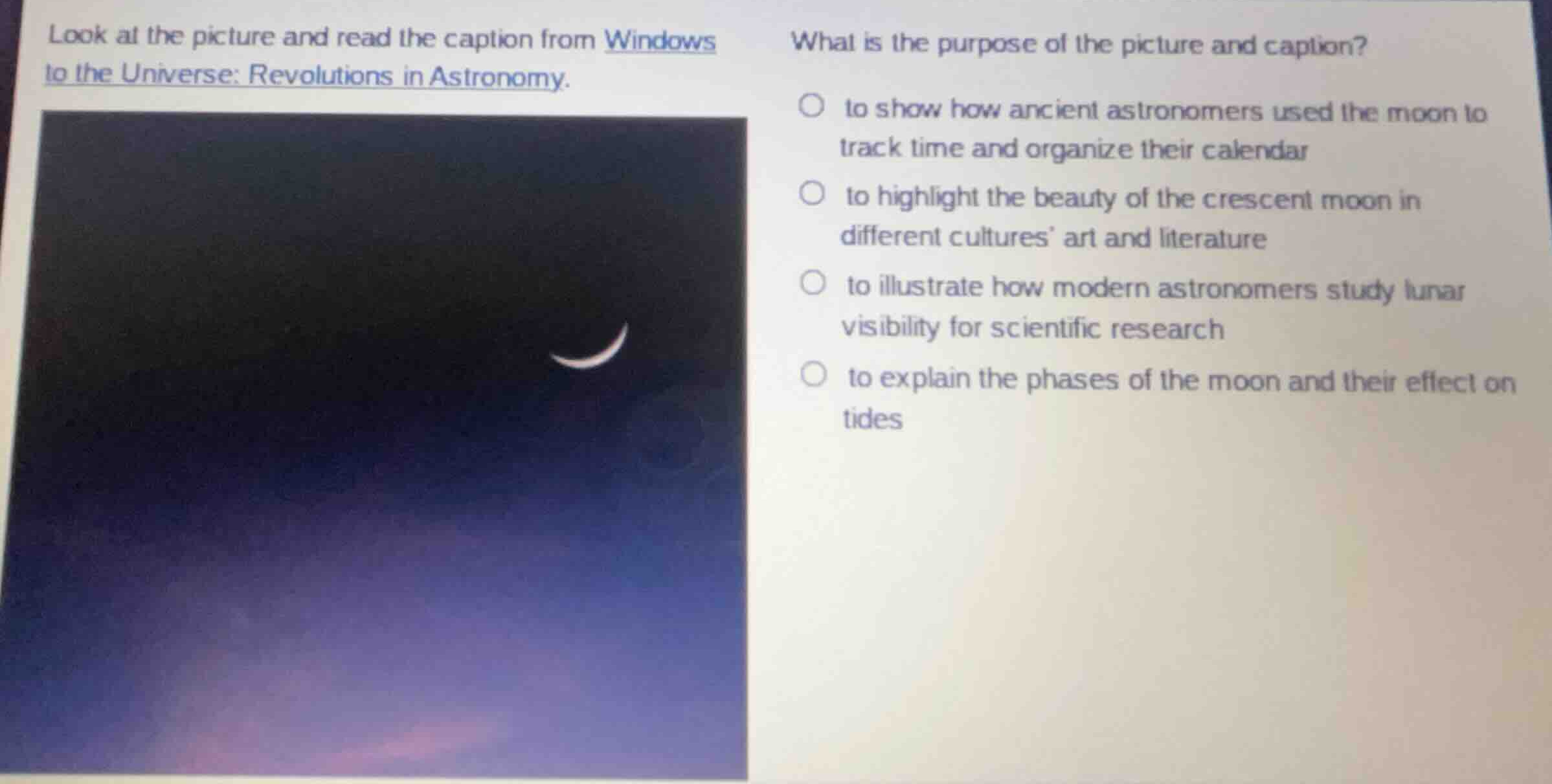
The image shows a thin crescent moon in a twilight sky. The prompt mentions a source titled "Windows to the Universe: Revolutions in Astronomy." The question asks for the purpose of the picture and caption.
Evaluate the options based on the source context
- Option 1: "to show how ancient astronomers used the moon to track time and organize their calendar" — This aligns with historical astronomical revolutions and how early civilizations tracked celestial bodies.
- Option 2: "to highlight the beauty..." — Too artistic/literary for an astronomy-focused educational source.
- Option 3: "to illustrate how modern astronomers study lunar visibility..." — Modern astronomy does not focus on basic crescent visibility for primary research.
- Option 4: "to explain the phases of the moon and their effect on tides" — A single crescent image does not explain the full cycle of phases or tidal mechanics.
Determine the most logical purpose
The most fitting purpose for an introductory astronomy resource showing a crescent moon is to demonstrate how early/ancient astronomers observed these regular lunar cycles to establish timekeeping systems and calendars.

Snap & solve any problem in the app
Get step-by-step solutions on Sovi AI
Photo-based solutions with guided steps
Explore more problems and detailed explanations
- (A) to show how ancient astronomers used the moon to track time and organize their calendar (Correct answer)
- (B) to highlight the beauty of the crescent moon in different cultures' art and literature
- (C) to illustrate how modern astronomers study lunar visibility for scientific research
- (D) to explain the phases of the moon and their effect on tides