QUESTION IMAGE
Question
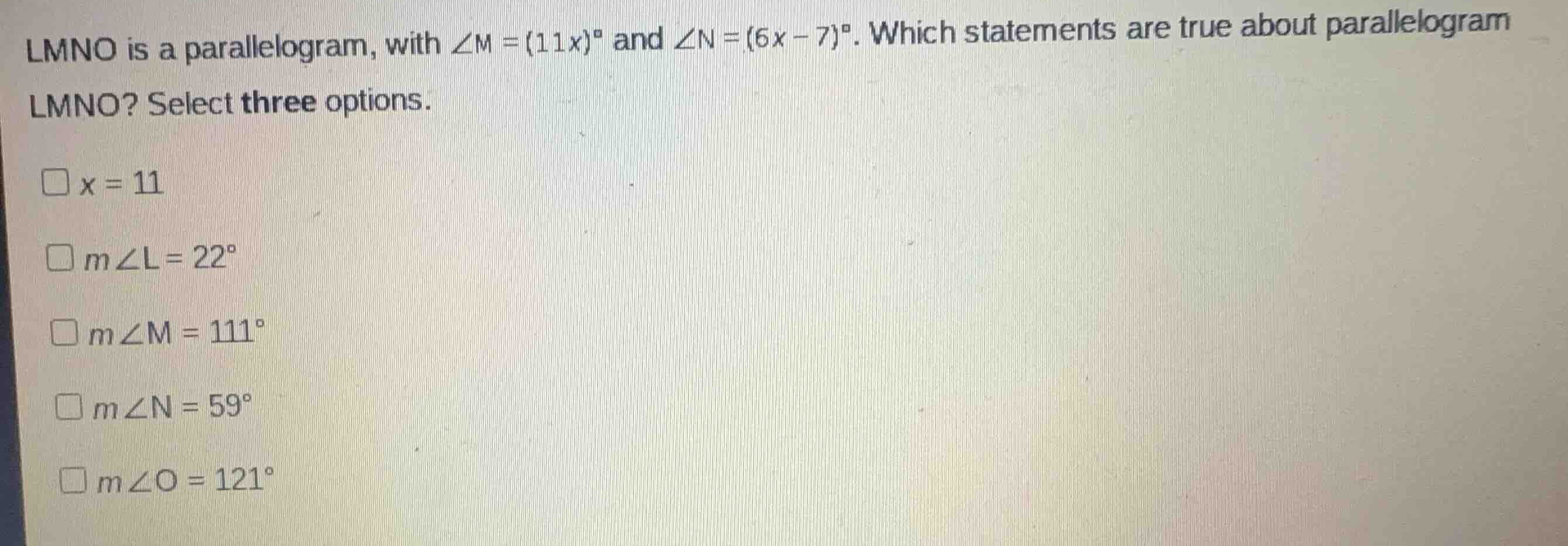
lmno is a parallelogram, with \\(\angle m = (11x)^\circ\\) and \\(\angle n = (6x - 7)^\circ\\). which statements are true about parallelogram lmno? select three options.
\\(x = 11\\)
\\(m\angle l = 22^\circ\\)
\\(m\angle m = 111^\circ\\)
\\(m\angle n = 59^\circ\\)
\\(m\angle o = 121^\circ\\)
<pre_analysis>
{
"quality": "clear",
"question_count": 1,
"skills_matched": [
"step_cot",
"multiple_choice_formatter",
"explain_then_answer",
"tutor",
"mastery_adaptive_brevity"
],
"needs_drawing": false,
"concepts_used": [
"Solving Linear Equations"
],
"new_concepts": [
"Parallelogram Angle Properties"
],
"current_concepts": [
"Solving Linear Equations",
"Parallelogram Angle Properties"
]
}
</pre_analysis>
<reasoning>
Set up the angle relationship
In a parallelogram \(LMNO\), consecutive angles are supplementary. Since \(M\) and \(N\) are consecutive vertices in the parallelogram \(LMNO\), their angles must add up to \(180^\circ\):
\[m\angle M + m\angle N = 180^\circ\]
Solve for x
Using the Solving Linear Equations knowledge point
\[
\]
Calculate the angle measures
Now we substitute \(x = 11\) back into the expressions for each angle:
- \(m\angle M = 11(11) = 121^\circ\)
- \(m\angle N = 6(11) - 7 = 66 - 7 = 59^\circ\)
In a parallelogram, opposite angles are equal:
- \(m\angle L = m\angle N = 59^\circ\)
- \(m\angle O = m\angle M = 121^\circ\)
Evaluate the given statements
Let's check each option against our calculated values:
- \(x = 11\): True.
- \(m\angle L = 22^\circ\): False (it is \(59^\circ\)).
- \(m\angle M = 111^\circ\): False (it is \(121^\circ\)).
- \(m\angle N = 59^\circ\): True.
- \(m\angle O = 121^\circ\): True.
</reasoning>
<answer>
<mcq-correct>\(x = 11\)</mcq-correct>
<mcq-option>\(m\angle L = 22^\circ\)</mcq-option>
<mcq-option>\(m\angle M = 111^\circ\)</mcq-option>
<mcq-correct>\(m\angle N = 59^\circ\)</mcq-correct>
<mcq-correct>\(m\angle O = 121^\circ\)</mcq-correct>
</answer>
<post_analysis>
{
"subject": "Mathematics",
"question_type": "Multiple Choice",
"knowledge_point": [
"Mathematics",
"Geometry",
"Parallelogram Angle Properties"
]
}
</post_analysis>
Snap & solve any problem in the app
Get step-by-step solutions on Sovi AI
Photo-based solutions with guided steps
Explore more problems and detailed explanations
<pre_analysis>
{
"quality": "clear",
"question_count": 1,
"skills_matched": [
"step_cot",
"multiple_choice_formatter",
"explain_then_answer",
"tutor",
"mastery_adaptive_brevity"
],
"needs_drawing": false,
"concepts_used": [
"Solving Linear Equations"
],
"new_concepts": [
"Parallelogram Angle Properties"
],
"current_concepts": [
"Solving Linear Equations",
"Parallelogram Angle Properties"
]
}
</pre_analysis>
<reasoning>
Set up the angle relationship
In a parallelogram \(LMNO\), consecutive angles are supplementary. Since \(M\) and \(N\) are consecutive vertices in the parallelogram \(LMNO\), their angles must add up to \(180^\circ\):
\[m\angle M + m\angle N = 180^\circ\]
Solve for x
Using the Solving Linear Equations knowledge point
\[
\]
Calculate the angle measures
Now we substitute \(x = 11\) back into the expressions for each angle:
- \(m\angle M = 11(11) = 121^\circ\)
- \(m\angle N = 6(11) - 7 = 66 - 7 = 59^\circ\)
In a parallelogram, opposite angles are equal:
- \(m\angle L = m\angle N = 59^\circ\)
- \(m\angle O = m\angle M = 121^\circ\)
Evaluate the given statements
Let's check each option against our calculated values:
- \(x = 11\): True.
- \(m\angle L = 22^\circ\): False (it is \(59^\circ\)).
- \(m\angle M = 111^\circ\): False (it is \(121^\circ\)).
- \(m\angle N = 59^\circ\): True.
- \(m\angle O = 121^\circ\): True.
</reasoning>
<answer>
<mcq-correct>\(x = 11\)</mcq-correct>
<mcq-option>\(m\angle L = 22^\circ\)</mcq-option>
<mcq-option>\(m\angle M = 111^\circ\)</mcq-option>
<mcq-correct>\(m\angle N = 59^\circ\)</mcq-correct>
<mcq-correct>\(m\angle O = 121^\circ\)</mcq-correct>
</answer>
<post_analysis>
{
"subject": "Mathematics",
"question_type": "Multiple Choice",
"knowledge_point": [
"Mathematics",
"Geometry",
"Parallelogram Angle Properties"
]
}
</post_analysis>