QUESTION IMAGE
Question
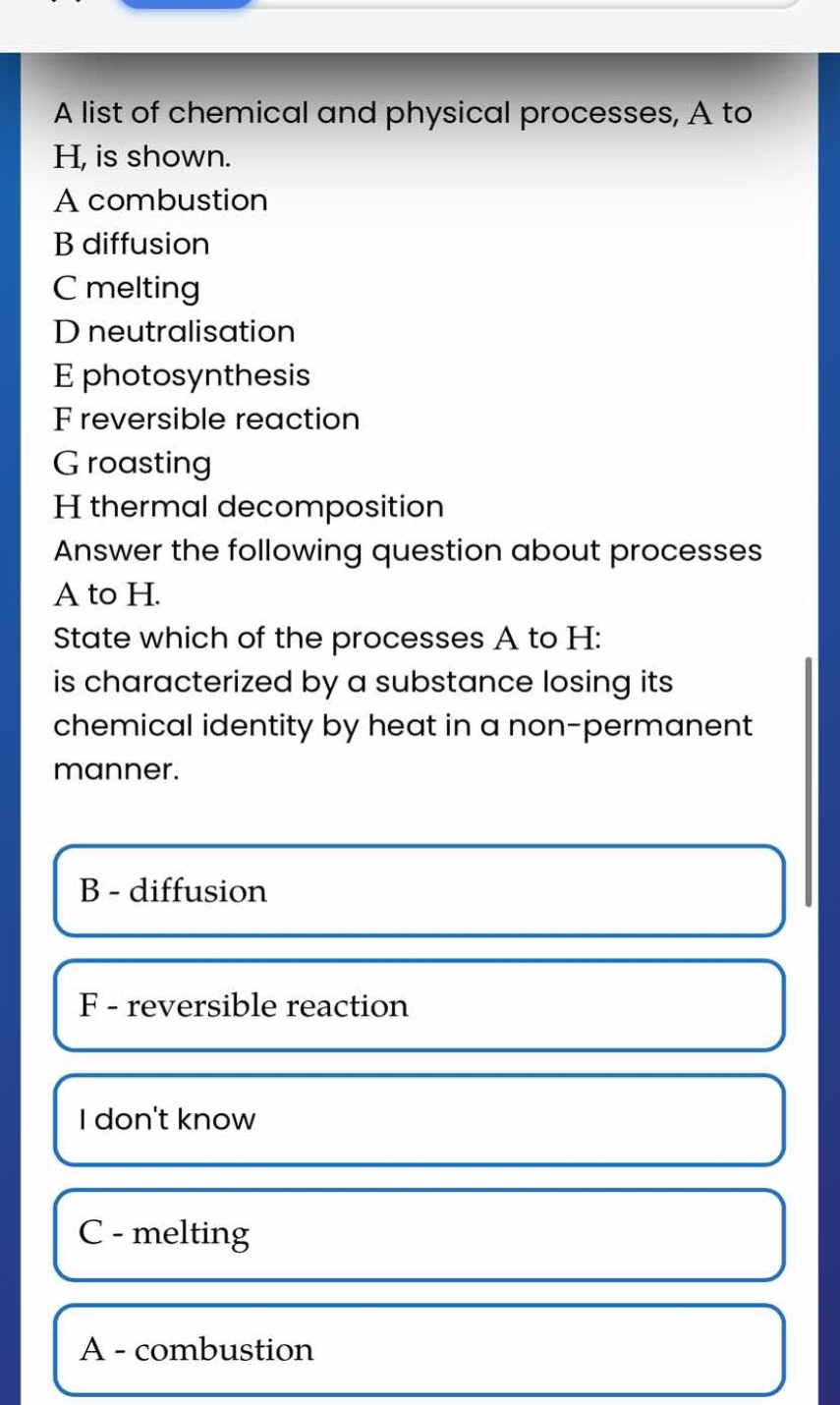
a list of chemical and physical processes, a to h, is shown.
a combustion
b diffusion
c melting
d neutralisation
e photosynthesis
f reversible reaction
g roasting
h thermal decomposition
answer the following question about processes a to h.
state which of the processes a to h:
is characterized by a substance losing its chemical identity by heat in a non-permanent manner.
<pre_analysis>
{
"quality": "clear",
"question_count": 1,
"skills_matched": [
"direct_cot",
"multiple_choice_formatter",
"explain_then_answer",
"quick"
],
"needs_drawing": false,
"concepts_used": [],
"new_concepts": [
"Reversible Reaction",
"Chemical Change"
],
"current_concepts": [
"Chemical Processes",
"Reversible Reaction",
"Thermal Decomposition"
]
}
</pre_analysis>
<reasoning>
Analyze the key terms in the prompt
The process requires a substance to lose its "chemical identity" (indicating a chemical reaction/change, which rules out physical changes like melting or diffusion) by "heat" (thermal action) in a "non-permanent manner" (indicating the reaction can be reversed).
Evaluate the given options
- B - diffusion: A physical transport process, not a chemical change.
- C - melting: A physical state change, not a chemical change.
- A - combustion: A permanent chemical change (irreversible).
- F - reversible reaction: A chemical change where reactants form products and products can react to reform the reactants, allowing the change of chemical identity to occur in a non-permanent (reversible) manner.
</reasoning>
<answer>
<mcq-option>B - diffusion</mcq-option>
<mcq-correct>F - reversible reaction</mcq-correct>
<mcq-option>I don't know</mcq-option>
<mcq-option>C - melting</mcq-option>
<mcq-option>A - combustion</mcq-option>
</answer>
<post_analysis>
{
"subject": "Natural Science",
"question_type": "Multiple Choice",
"knowledge_point": [
"Natural Science",
"Chemistry",
"Chemical Reactions"
]
}
</post_analysis>
Snap & solve any problem in the app
Get step-by-step solutions on Sovi AI
Photo-based solutions with guided steps
Explore more problems and detailed explanations
<pre_analysis>
{
"quality": "clear",
"question_count": 1,
"skills_matched": [
"direct_cot",
"multiple_choice_formatter",
"explain_then_answer",
"quick"
],
"needs_drawing": false,
"concepts_used": [],
"new_concepts": [
"Reversible Reaction",
"Chemical Change"
],
"current_concepts": [
"Chemical Processes",
"Reversible Reaction",
"Thermal Decomposition"
]
}
</pre_analysis>
<reasoning>
Analyze the key terms in the prompt
The process requires a substance to lose its "chemical identity" (indicating a chemical reaction/change, which rules out physical changes like melting or diffusion) by "heat" (thermal action) in a "non-permanent manner" (indicating the reaction can be reversed).
Evaluate the given options
- B - diffusion: A physical transport process, not a chemical change.
- C - melting: A physical state change, not a chemical change.
- A - combustion: A permanent chemical change (irreversible).
- F - reversible reaction: A chemical change where reactants form products and products can react to reform the reactants, allowing the change of chemical identity to occur in a non-permanent (reversible) manner.
</reasoning>
<answer>
<mcq-option>B - diffusion</mcq-option>
<mcq-correct>F - reversible reaction</mcq-correct>
<mcq-option>I don't know</mcq-option>
<mcq-option>C - melting</mcq-option>
<mcq-option>A - combustion</mcq-option>
</answer>
<post_analysis>
{
"subject": "Natural Science",
"question_type": "Multiple Choice",
"knowledge_point": [
"Natural Science",
"Chemistry",
"Chemical Reactions"
]
}
</post_analysis>