Sovi.AI - AI Math Tutor

Scan to solve math questions

QUESTION IMAGE

lets use the associative property to help us solve \\(5 \\times 18\\). …

Question

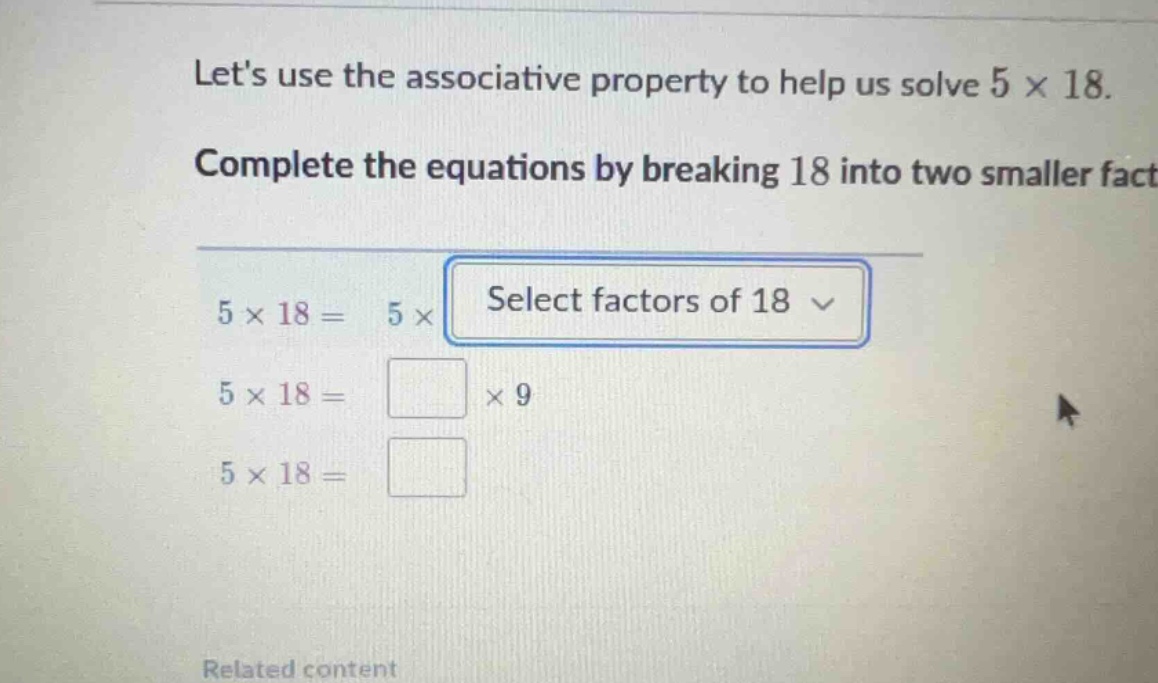
lets use the associative property to help us solve \\(5 \times 18\\).

complete the equations by breaking 18 into two smaller factors.

\\(5 \times 18 = 5 \times\\) select factors of 18
\\(5 \times 18 = \square \times 9\\)
\\(5 \times 18 = \square\\)

Explanation:

Response

<pre_analysis>
{
"quality": "clear",
"question_count": 1,
"skills_matched": [
"step_cot",
"blank_filling_formatter",
"explain_then_answer",
"tutor"
],
"needs_drawing": false,
"concepts_used": [
"Associative Property",
"Factoring Numbers"
],
"new_concepts": [],
"current_concepts": [
"Associative Property",
"Factoring Numbers",
"Basic Multiplication"
]
}
</pre_analysis>

<reasoning>

Factor the number 18

We break down \(18\) into two smaller factors.
Using Factoring Numbers:
\[
18 = 2 \times 9
\]
So, the first equation becomes:
\[
5 \times 18 = 5 \times (2 \times 9)
\]

Apply associative property

We regroup the factors.
Using Associative Property:
\[
5 \times (2 \times 9) = (5 \times 2) \times 9
\]
Calculating the product inside the parentheses:
\[
5 \times 2 = 10
\]
So, the second equation becomes:
\[
5 \times 18 = 10 \times 9
\]

Calculate final product

We find the final result.
Using Basic Multiplication:
\[
10 \times 9 = 90
\]
So, the third equation becomes:
\[
5 \times 18 = 90
\]
</reasoning>

<answer>
Let's use the associative property to help us solve \(5 \times 18\).

Complete the equations by breaking \(18\) into two smaller factors:
\(5 \times 18 = 5 \times\) <blank>\(2 \times 9\)</blank>
\(5 \times 18 =\) <blank>\(10\)</blank> \(\times 9\)
\(5 \times 18 =\) <blank>\(90\)</blank>
</answer>

<post_analysis>
{
"subject": "Mathematics",
"question_type": "Fill-in-the-blank",
"knowledge_point": [
"Mathematics",
"Algebra",
"Associative Property"
]
}
</post_analysis>

Answer:

<pre_analysis>
{
"quality": "clear",
"question_count": 1,
"skills_matched": [
"step_cot",
"blank_filling_formatter",
"explain_then_answer",
"tutor"
],
"needs_drawing": false,
"concepts_used": [
"Associative Property",
"Factoring Numbers"
],
"new_concepts": [],
"current_concepts": [
"Associative Property",
"Factoring Numbers",
"Basic Multiplication"
]
}
</pre_analysis>

<reasoning>

Factor the number 18

We break down \(18\) into two smaller factors.
Using Factoring Numbers:
\[
18 = 2 \times 9
\]
So, the first equation becomes:
\[
5 \times 18 = 5 \times (2 \times 9)
\]

Apply associative property

We regroup the factors.
Using Associative Property:
\[
5 \times (2 \times 9) = (5 \times 2) \times 9
\]
Calculating the product inside the parentheses:
\[
5 \times 2 = 10
\]
So, the second equation becomes:
\[
5 \times 18 = 10 \times 9
\]

Calculate final product

We find the final result.
Using Basic Multiplication:
\[
10 \times 9 = 90
\]
So, the third equation becomes:
\[
5 \times 18 = 90
\]
</reasoning>

<answer>
Let's use the associative property to help us solve \(5 \times 18\).

Complete the equations by breaking \(18\) into two smaller factors:
\(5 \times 18 = 5 \times\) <blank>\(2 \times 9\)</blank>
\(5 \times 18 =\) <blank>\(10\)</blank> \(\times 9\)
\(5 \times 18 =\) <blank>\(90\)</blank>
</answer>

<post_analysis>
{
"subject": "Mathematics",
"question_type": "Fill-in-the-blank",
"knowledge_point": [
"Mathematics",
"Algebra",
"Associative Property"
]
}
</post_analysis>