Sovi.AI - AI Math Tutor

Scan to solve math questions

QUESTION IMAGE

let us go, through certain half-deserted streets, the muttering retreat…

Question

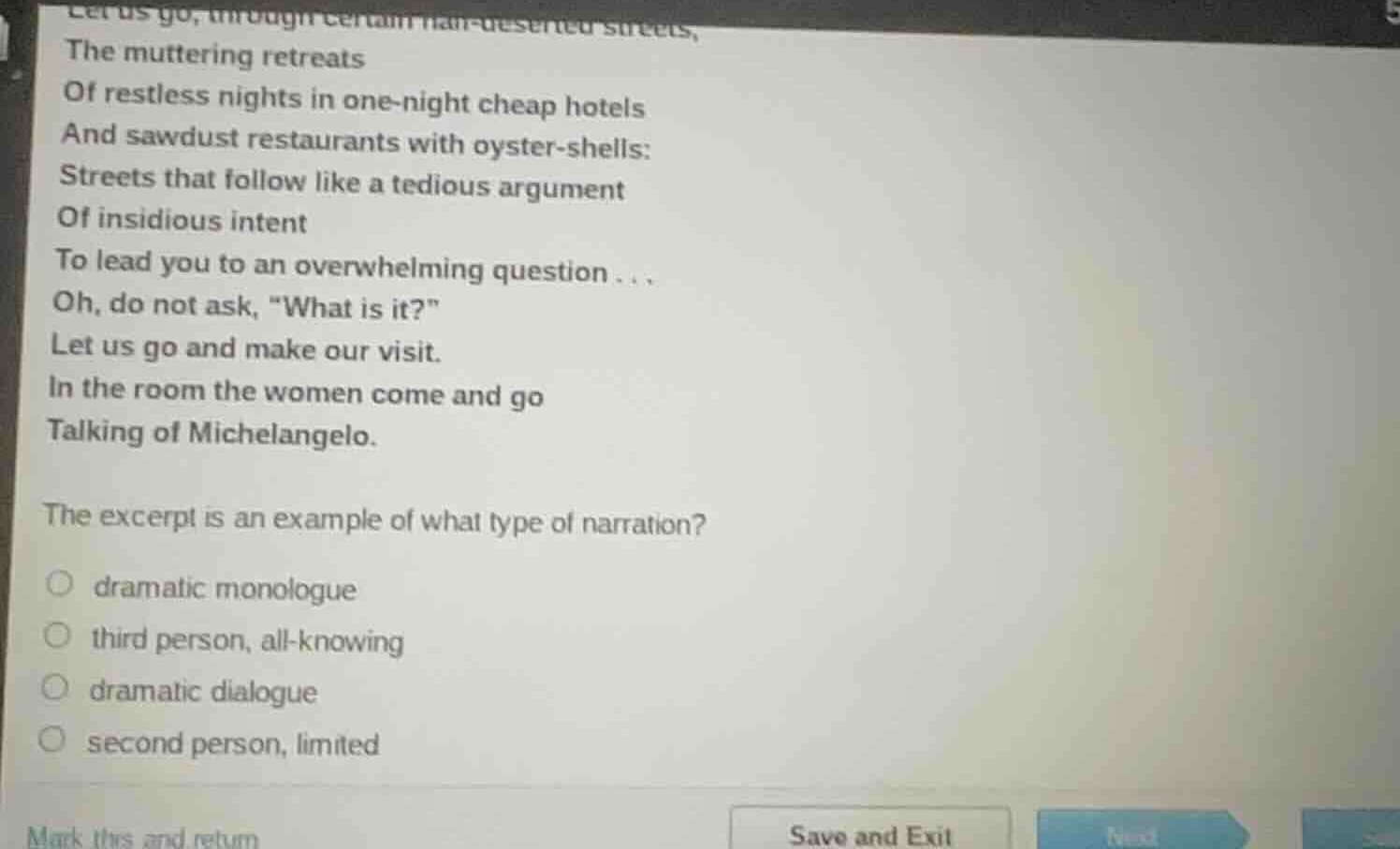
let us go, through certain half-deserted streets,
the muttering retreats
of restless nights in one-night cheap hotels
and sawdust restaurants with oyster-shells:
streets that follow like a tedious argument
of insidious intent
to lead you to an overwhelming question...
oh, do not ask, \what is it?\
let us go and make our visit.
in the room the women come and go
talking of michelangelo.

the excerpt is an example of what type of narration?

dramatic monologue
third person, all-knowing
dramatic dialogue
second person, limited

Explanation:

Response

<pre_analysis>
{
"quality": "clear",
"question_count": 1,
"skills_matched": [
"direct_cot",
"multiple_choice_formatter",
"explain_then_answer",
"quick"
],
"needs_drawing": false,
"concepts_used": [
"Dramatic Monologue",
"Narrative Style"
],
"new_concepts": [],
"current_concepts": [
"Dramatic Monologue",
"Narrative Style",
"Prufrock Analysis"
]
}
</pre_analysis>

<reasoning>

Identify the source text

The excerpt is from T.S. Eliot's poem "The Love Song of J. Alfred Prufrock," which begins with "Let us go then, you and I..." and features a single speaker addressing a silent listener.

Analyze the narrative style

A poem where a single character speaks to a silent audience, revealing their inner thoughts and character traits, is defined as a dramatic monologue.

Evaluate the given options

  • dramatic monologue: Correct, as the speaker (Prufrock) directly addresses an unspoken "you" in a theatrical, self-revealing speech.
  • third person, all-knowing: Incorrect, the narration uses first-person plural ("Let us go") and direct address.
  • dramatic dialogue: Incorrect, there is no conversational exchange between two active speakers.
  • second person, limited: Incorrect, this is not a standard second-person narrative format.

</reasoning>

<answer>
<mcq-correct>dramatic monologue</mcq-correct>
<mcq-option>third person, all-knowing</mcq-option>
<mcq-option>dramatic dialogue</mcq-option>
<mcq-option>second person, limited</mcq-option>
</answer>

<post_analysis>
{
"subject": "Arts",
"question_type": "Multiple Choice",
"knowledge_point": [
"Arts",
"Others",
"Dramatic Monologue"
]
}
</post_analysis>

Answer:

<pre_analysis>
{
"quality": "clear",
"question_count": 1,
"skills_matched": [
"direct_cot",
"multiple_choice_formatter",
"explain_then_answer",
"quick"
],
"needs_drawing": false,
"concepts_used": [
"Dramatic Monologue",
"Narrative Style"
],
"new_concepts": [],
"current_concepts": [
"Dramatic Monologue",
"Narrative Style",
"Prufrock Analysis"
]
}
</pre_analysis>

<reasoning>

Identify the source text

The excerpt is from T.S. Eliot's poem "The Love Song of J. Alfred Prufrock," which begins with "Let us go then, you and I..." and features a single speaker addressing a silent listener.

Analyze the narrative style

A poem where a single character speaks to a silent audience, revealing their inner thoughts and character traits, is defined as a dramatic monologue.

Evaluate the given options

  • dramatic monologue: Correct, as the speaker (Prufrock) directly addresses an unspoken "you" in a theatrical, self-revealing speech.
  • third person, all-knowing: Incorrect, the narration uses first-person plural ("Let us go") and direct address.
  • dramatic dialogue: Incorrect, there is no conversational exchange between two active speakers.
  • second person, limited: Incorrect, this is not a standard second-person narrative format.

</reasoning>

<answer>
<mcq-correct>dramatic monologue</mcq-correct>
<mcq-option>third person, all-knowing</mcq-option>
<mcq-option>dramatic dialogue</mcq-option>
<mcq-option>second person, limited</mcq-option>
</answer>

<post_analysis>
{
"subject": "Arts",
"question_type": "Multiple Choice",
"knowledge_point": [
"Arts",
"Others",
"Dramatic Monologue"
]
}
</post_analysis>