QUESTION IMAGE
Question
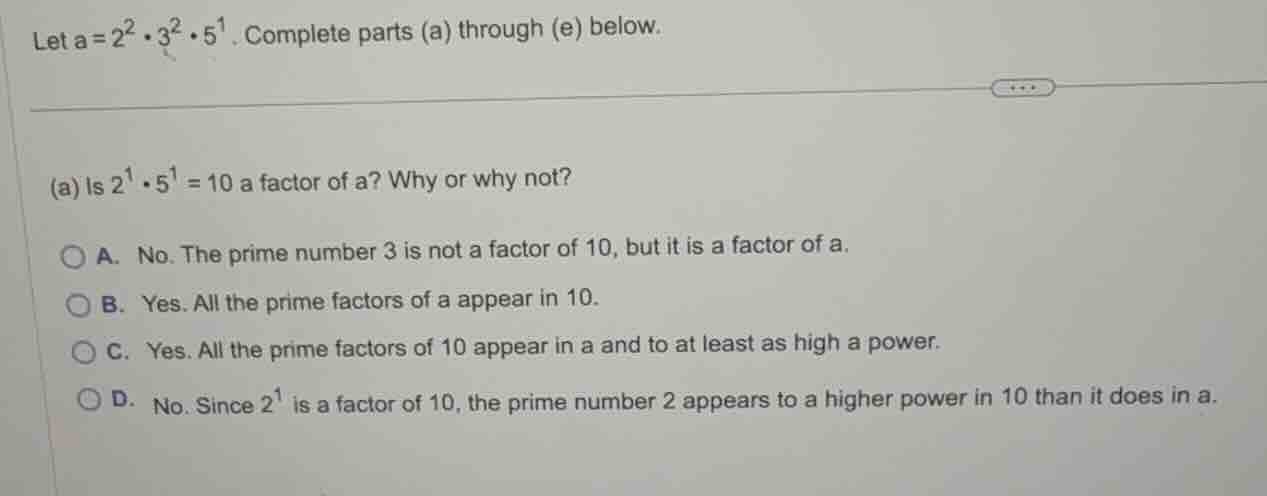
let \\(a = 2^2 \cdot 3^2 \cdot 5^1\\). complete parts (a) through (e) below.
(a) is \\(2^1 \cdot 5^1 = 10\\) a factor of \\(a\\)? why or why not?
a. no. the prime number 3 is not a factor of 10, but it is a factor of \\(a\\).
b. yes. all the prime factors of \\(a\\) appear in 10.
c. yes. all the prime factors of 10 appear in \\(a\\) and to at least as high a power.
d. no. since \\(2^1\\) is a factor of 10, the prime number 2 appears to a higher power in 10 than it does in \\(a\\).
Analyze the prime factorization of both numbers
We are given the prime factorization of \(a\):
We want to determine if \(10\) is a factor of \(a\). The prime factorization of \(10\) is:
Apply divisibility criteria using prime factors
For a number \(d\) to be a factor of \(a\), every prime factor in the prime factorization of \(d\) must also appear in the prime factorization of \(a\), and its exponent in \(d\) must be less than or equal to its exponent in \(a\).
Compare the exponents of the prime factors
Let's compare the exponents of the prime factors of \(10\) and \(a\):
- For the prime factor \(2\): The exponent in \(10\) is \(1\), and the exponent in \(a\) is \(2\). Since \(1 \le 2\), this condition is satisfied.
- For the prime factor \(5\): The exponent in \(10\) is \(1\), and the exponent in \(a\) is \(1\). Since \(1 \le 1\), this condition is satisfied.
Since all prime factors of \(10\) appear in \(a\) with exponents that are less than or equal to those in \(a\), \(10\) is indeed a factor of \(a\).
Match with the multiple-choice options
Let's evaluate the given choices:
- A: Incorrect. It concludes "No".
- B: Incorrect. It states "All the prime factors of a appear in 10", which is false because \(3\) is a prime factor of \(a\) but does not divide \(10\).
- C: Correct. It states "Yes. All the prime factors of 10 appear in a and to at least as high a power."
- D: Incorrect. It concludes "No".

Snap & solve any problem in the app
Get step-by-step solutions on Sovi AI
Photo-based solutions with guided steps
Explore more problems and detailed explanations
- A. No. The prime number 3 is not a factor of 10, but it is a factor of a.
- B. Yes. All the prime factors of a appear in 10.
- C. Yes. All the prime factors of 10 appear in a and to at least as high a power. (Correct answer)
- D. No. Since \(2^1\) is a factor of 10, the prime number 2 appears to a higher power in 10 than it does in a.