QUESTION IMAGE
Question
lesson 1.4: levels of consciousness
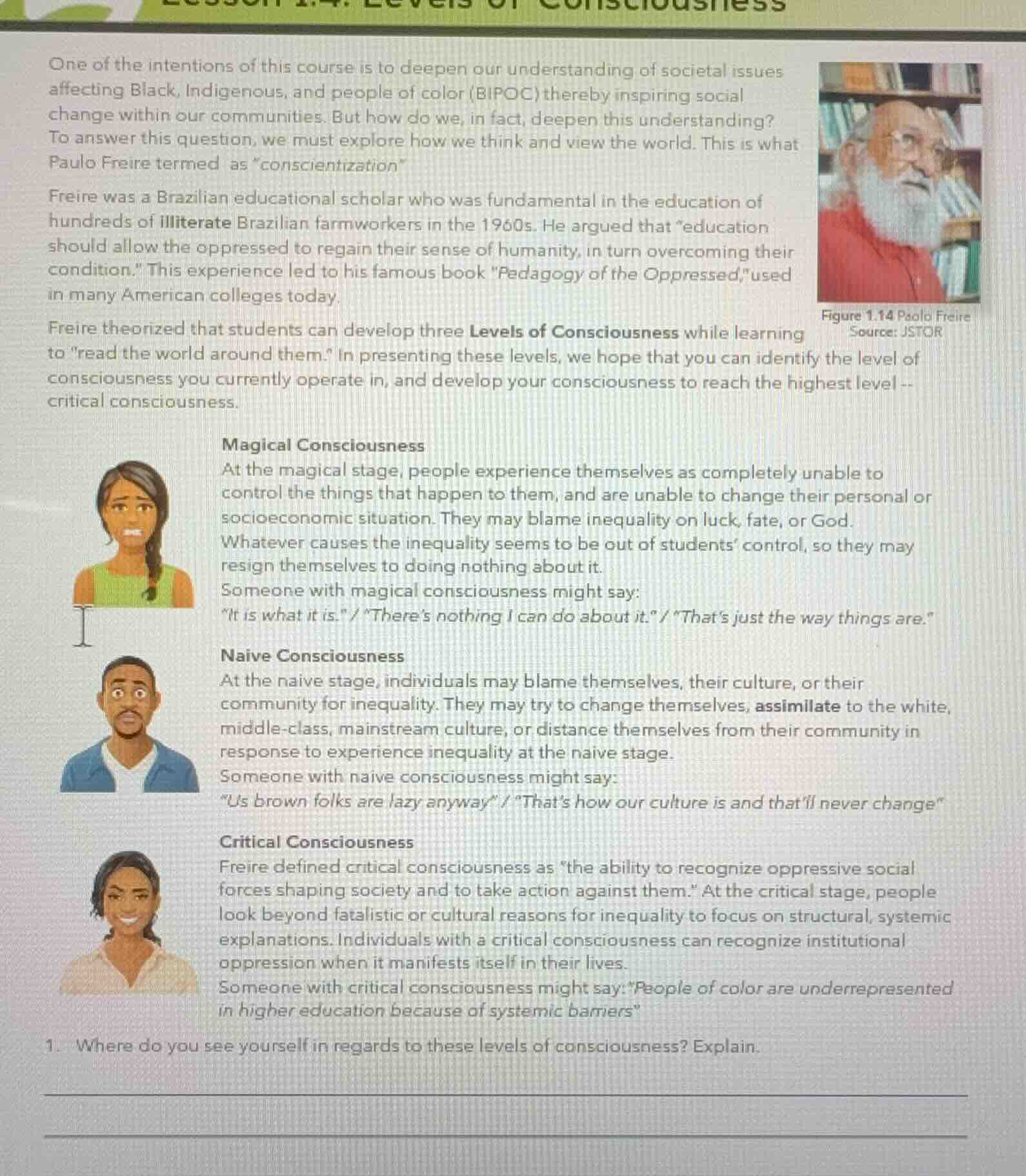
one of the intentions of this course is to deepen our understanding of societal issues affecting black, indigenous, and people of color (bipoc) thereby inspiring social change within our communities. but how do we, in fact, deepen this understanding? to answer this question, we must explore how we think and view the world. this is what paulo freire termed as \conscientization\
freire was a brazilian educational scholar who was fundamental in the education of hundreds of illiterate brazilian farmworkers in the 1960s. he argued that \education should allow the oppressed to regain their sense of humanity, in turn overcoming their condition.\ this experience led to his famous book \pedagogy of the oppressed,\ used in many american colleges today.
freire theorized that students can develop three levels of consciousness while learning to
ead the world around them.\ in presenting these levels, we hope that you can identify the level of consciousness you currently operate in, and develop your consciousness to reach the highest level -- critical consciousness.
magical consciousness
at the magical stage, people experience themselves as completely unable to control the things that happen to them, and are unable to change their personal or socioeconomic situation. they may blame inequality on luck, fate, or god. whatever causes the inequality seems to be out of students control, so they may resign themselves to doing nothing about it.
someone with magical consciousness might say:
\it is what it is.\ / \theres nothing i can do about it.\ / \thats just the way things are.\
naive consciousness
at the naive stage, individuals may blame themselves, their culture, or their community for inequality. they may try to change themselves, assimilate to the white, middle-class, mainstream culture, or distance themselves from their community in response to experience inequality at the naive stage.
someone with naive consciousness might say:
\us brown folks are lazy anyway\ / \thats how our culture is and thatll never change\
critical consciousness
freire defined critical consciousness as \the ability to recognize oppressive social forces shaping society and to take action against them.\ at the critical stage, people look beyond fatalistic or cultural reasons for inequality to focus on structural, systemic explanations. individuals with a critical consciousness can recognize institutional oppression when it manifests itself in their lives.
someone with critical consciousness might say: \people of color are underrepresented in higher education because of systemic barriers\
- where do you see yourself in regards to these levels of consciousness? explain.
Analyze the three levels of consciousness
The text defines three levels of consciousness:
- Magical Consciousness: Blaming inequality on luck, fate, or God, feeling unable to change anything.
- Naive Consciousness: Blaming oneself, one's culture, or community, leading to assimilation or distancing.
- Critical Consciousness: Recognizing systemic, structural barriers and taking action to address oppression.
Formulate a personal reflection
An incoming 10th grader studying social justice and the Wheel of Power and Privilege is likely transitioning into or operating within Critical Consciousness. They are learning to look past fatalistic or cultural explanations to identify systemic barriers and structural inequalities.

Snap & solve any problem in the app
Get step-by-step solutions on Sovi AI
Photo-based solutions with guided steps
Explore more problems and detailed explanations
I see myself operating within Critical Consciousness.
By studying tools like the Wheel of Power and Privilege, I am learning to look beyond individual or cultural explanations for inequality. Instead, I focus on identifying systemic, structural barriers and understanding how institutional oppression shapes different social identities, which helps me think about how to take meaningful action for social change.