QUESTION IMAGE
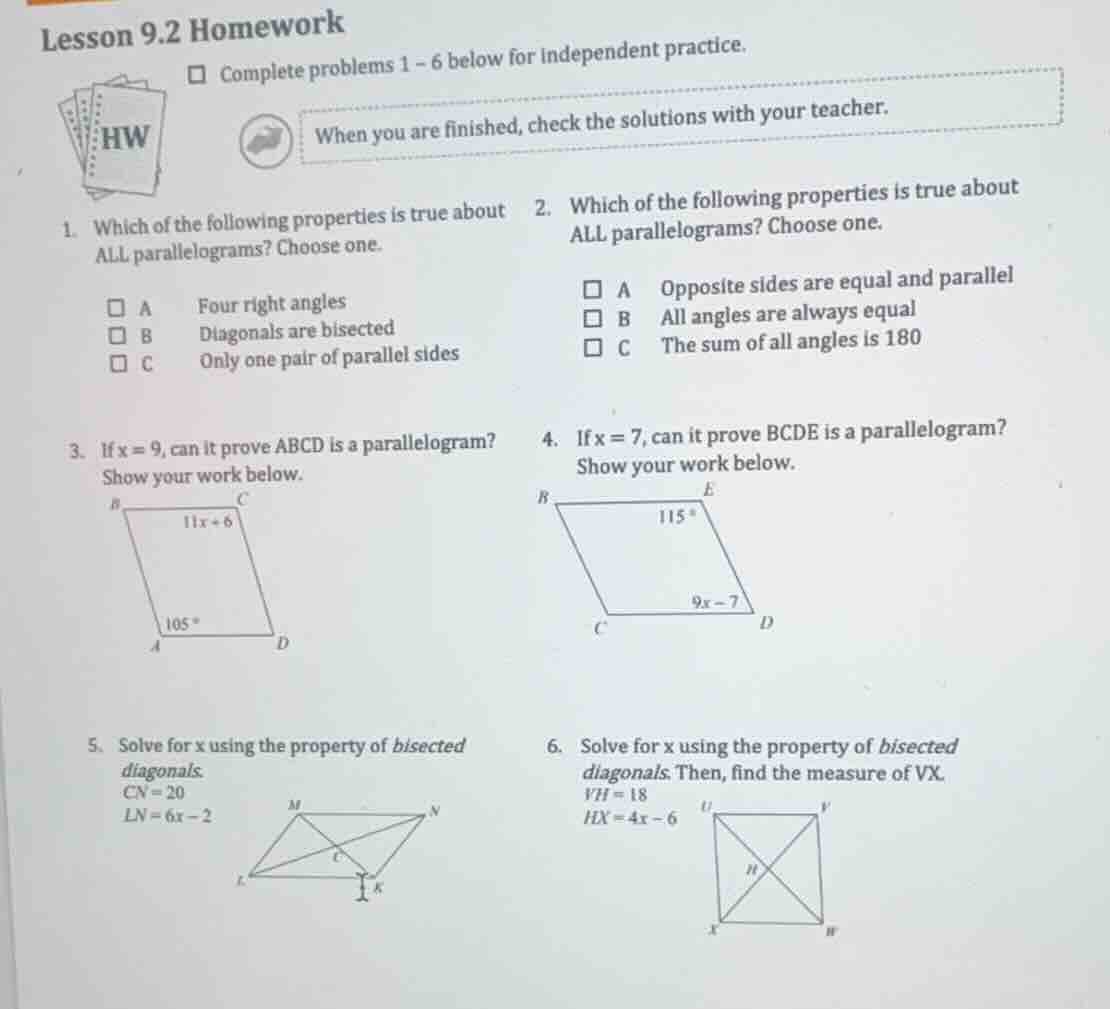
Question
lesson 9.2 homework
complete problems 1-6 below for independent practice.
when you are finished, check the solutions with your teacher.
- which of the following properties is true about all parallelograms? choose one.
a four right angles
b diagonals are bisected
c only one pair of parallel sides
- which of the following properties is true about all parallelograms? choose one.
a opposite sides are equal and parallel
b all angles are always equal
c the sum of all angles is 180
- if \\(x = 9\\), can it prove abcd is a parallelogram? show your work below.
- if \\(x = 7\\), can it prove bcde is a parallelogram? show your work below.
- solve for \\(x\\) using the property of bisected diagonals.
\\(cn = 20\\)
\\(ln = 6x - 2\\)
- solve for \\(x\\) using the property of bisected diagonals. then, find the measure of \\(vx\\).
\\(vh = 18\\)
\\(hx = 4x - 6\\)
Analyze Question 1 and Question 2
Using the Parallelogram Properties knowledge point
- For Question 1, a fundamental property of all parallelograms is that their diagonals bisect each other. Thus, option B is correct.
- For Question 2, by definition and properties of a parallelogram, opposite sides are both equal in length and parallel. Thus, option A is correct.
Analyze Question 3
Using the Converse of Parallelogram Theorems and Solving Linear Equations knowledge points
- In quadrilateral \(ABCD\), we are given \(\angle A = 105^\circ\) and \(\angle C = (11x + 6)^\circ\).
- Substitute \(x = 9\):
- Since \(\angle A = \angle C = 105^\circ\), one pair of opposite angles is congruent. However, to prove a quadrilateral is a parallelogram using opposite angles, we must show both pairs of opposite angles are congruent. Since we have no information about \(\angle B\) and \(\angle D\), we cannot prove \(ABCD\) is a parallelogram.
Analyze Question 4
Using the Converse of Parallelogram Theorems and Solving Linear Equations knowledge points
- In quadrilateral \(BCDE\), we are given consecutive angles \(\angle E = 115^\circ\) and \(\angle D = (9x - 7)^\circ\).
- Substitute \(x = 7\):
- Check if consecutive angles are supplementary:
- Since consecutive angles are not supplementary, the lines \(BE\) and \(CD\) are not parallel, so \(BCDE\) cannot be a parallelogram.
Analyze Question 5
Using the Parallelogram Diagonal Properties and Solving Linear Equations knowledge points
- Diagonals of parallelogram \(LMKN\) bisect each other at intersection point \(C\). Therefore, diagonal \(LN\) is bisected by diagonal \(MK\), meaning \(LN = 2 \cdot CN\).
- Set up the equation:
Analyze Question 6
Using the Parallelogram Diagonal Properties and Solving Linear Equations knowledge points
- Diagonals of parallelogram \(UVWX\) bisect each other at intersection point \(H\). Therefore, diagonal \(VX\) is bisected by diagonal \(UW\), meaning \(VX = 2 \cdot VH\) and \(HX = VH\).
- Set up the equation \(HX = VH\):
- Find the measure of \(VX\):

Snap & solve any problem in the app
Get step-by-step solutions on Sovi AI
Photo-based solutions with guided steps
Explore more problems and detailed explanations
| No. | Answer |
|---|---|
| 2 | A (Opposite sides are equal and parallel) |
| 3 | No; \(\angle C = 105^\circ\), which only proves one pair of opposite angles is congruent. |
| 4 | No; \(\angle D = 56^\circ\), so consecutive angles are not supplementary (\(115^\circ + 56^\circ = 171^\circ
eq 180^\circ\)). |
| 5 | \(x = 7\) |
| 6 | \(x = 6\), \(VX = 36\) |