QUESTION IMAGE
Question
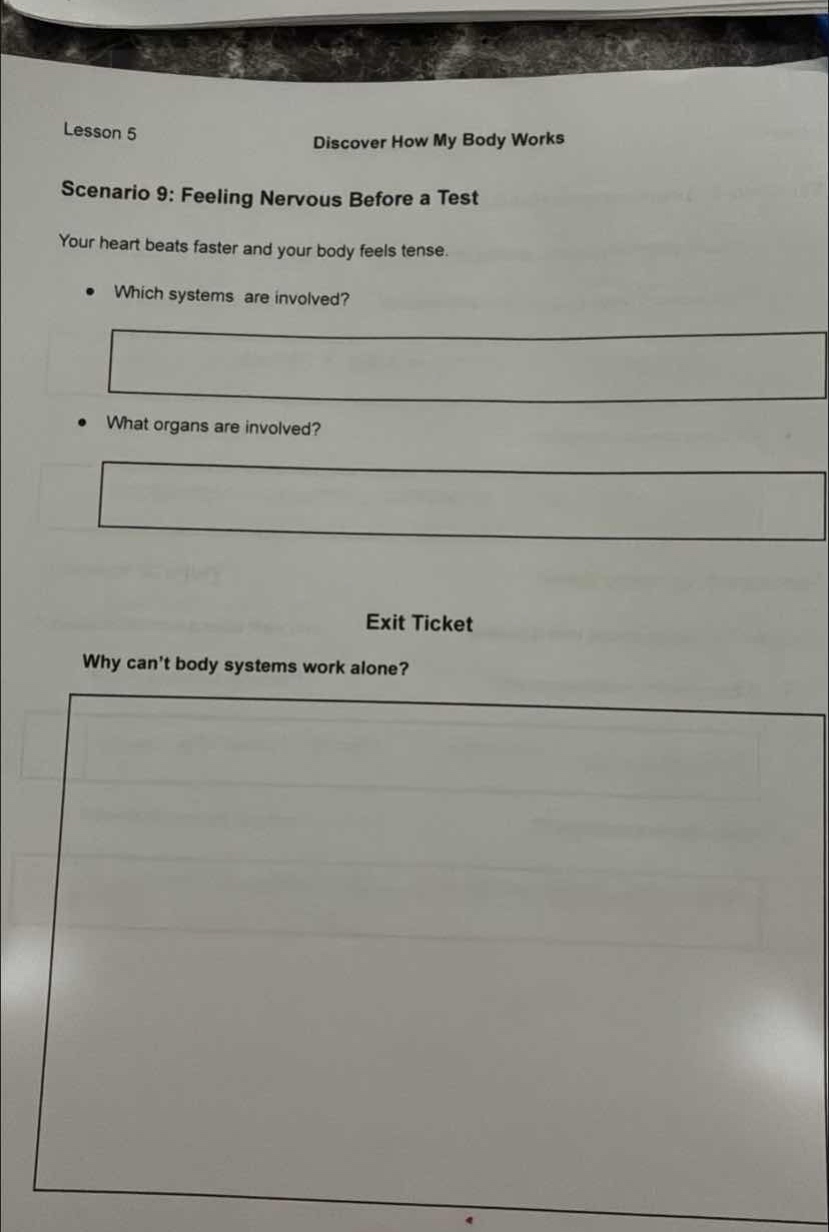
lesson 5 discover how my body works
scenario 9: feeling nervous before a test
your heart beats faster and your body feels tense.
- which systems are involved?
- what organs are involved?
exit ticket
why cant body systems work alone?
<pre_analysis>
{
"quality": "clear",
"question_count": 3,
"skills_matched": [
"direct_cot",
"explain_then_answer",
"tutor"
],
"needs_drawing": false,
"concepts_used": [],
"new_concepts": [
"Human Body Systems",
"System Interactions",
"Nervous System Response"
],
"current_concepts": [
"Human Body Systems",
"System Interactions",
"Nervous System Response"
]
}
</pre_analysis>
<reasoning>
Identify systems in Scenario 9
The scenario describes feeling nervous, a faster heartbeat, and tense muscles.
- Feeling nervous is controlled by the nervous system (brain and nerves).
- A faster heartbeat involves the circulatory system (cardiovascular system).
- Tense muscles involve the muscular system (and skeletal system).
Identify organs in Scenario 9
Based on the systems identified:
- The nervous system involves the brain and nerves.
- The circulatory system involves the heart.
- The muscular system involves the muscles.
Explain system interdependence
Body systems cannot work alone because they are interconnected and depend on each other to maintain homeostasis and keep the body functioning. For example, muscles need oxygen delivered by the circulatory system, which gets oxygen from the respiratory system, all coordinated by the nervous system.
</reasoning>
<answer>
Question 1
Which systems are involved?
<blank>Nervous system, circulatory system, and muscular system</blank>
Question 2
What organs are involved?
<blank>Brain, heart, and muscles</blank>
Question 3
Why can't body systems work alone?
<blank>Body systems must work together to maintain homeostasis and keep the organism alive. Each system performs a specific function that supports and relies on the functions of other systems, such as the circulatory system delivering oxygen from the respiratory system to the muscular system, all coordinated by the nervous system.</blank>
</answer>
<post_analysis>
{
"subject": "Natural Science",
"question_type": "Fill-in-the-blank",
"knowledge_point": [
"Natural Science",
"Biology",
"Human Body Systems"
]
}
</post_analysis>
Snap & solve any problem in the app
Get step-by-step solutions on Sovi AI
Photo-based solutions with guided steps
Explore more problems and detailed explanations
<pre_analysis>
{
"quality": "clear",
"question_count": 3,
"skills_matched": [
"direct_cot",
"explain_then_answer",
"tutor"
],
"needs_drawing": false,
"concepts_used": [],
"new_concepts": [
"Human Body Systems",
"System Interactions",
"Nervous System Response"
],
"current_concepts": [
"Human Body Systems",
"System Interactions",
"Nervous System Response"
]
}
</pre_analysis>
<reasoning>
Identify systems in Scenario 9
The scenario describes feeling nervous, a faster heartbeat, and tense muscles.
- Feeling nervous is controlled by the nervous system (brain and nerves).
- A faster heartbeat involves the circulatory system (cardiovascular system).
- Tense muscles involve the muscular system (and skeletal system).
Identify organs in Scenario 9
Based on the systems identified:
- The nervous system involves the brain and nerves.
- The circulatory system involves the heart.
- The muscular system involves the muscles.
Explain system interdependence
Body systems cannot work alone because they are interconnected and depend on each other to maintain homeostasis and keep the body functioning. For example, muscles need oxygen delivered by the circulatory system, which gets oxygen from the respiratory system, all coordinated by the nervous system.
</reasoning>
<answer>
Question 1
Which systems are involved?
<blank>Nervous system, circulatory system, and muscular system</blank>
Question 2
What organs are involved?
<blank>Brain, heart, and muscles</blank>
Question 3
Why can't body systems work alone?
<blank>Body systems must work together to maintain homeostasis and keep the organism alive. Each system performs a specific function that supports and relies on the functions of other systems, such as the circulatory system delivering oxygen from the respiratory system to the muscular system, all coordinated by the nervous system.</blank>
</answer>
<post_analysis>
{
"subject": "Natural Science",
"question_type": "Fill-in-the-blank",
"knowledge_point": [
"Natural Science",
"Biology",
"Human Body Systems"
]
}
</post_analysis>