QUESTION IMAGE
Question
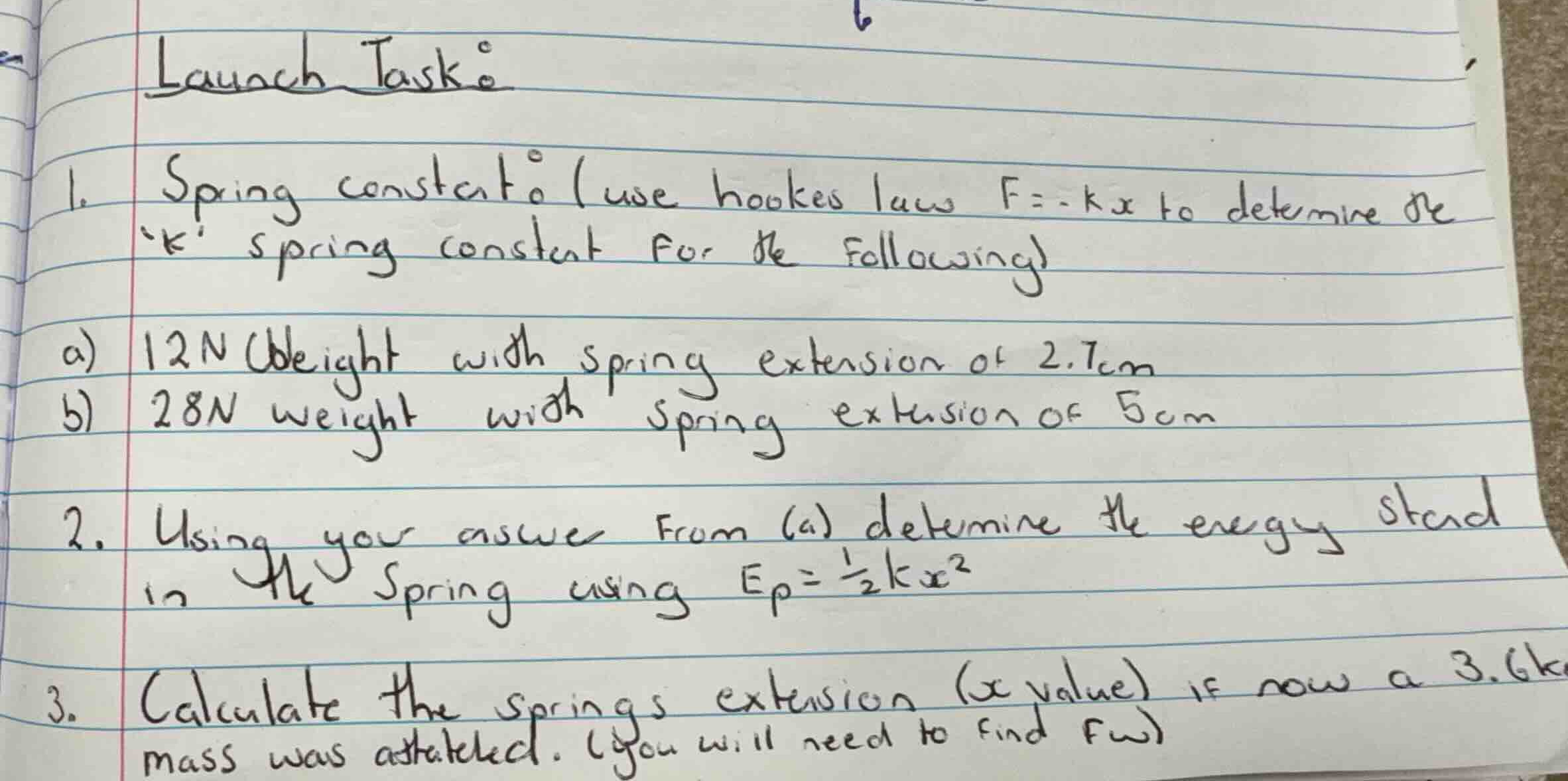
launch task:
- spring constant: (use hookes law \\(f = -kx\\) to determine the k spring constant for the following)
a) 12n weight with spring extension of 2.7cm
b) 28n weight with spring extension of 5cm
- using your answer from (a) determine the energy stored in the spring using \\(e_p = \frac{1}{2}kx^2\\)
- calculate the springs extension (x value) if now a 3.6kg mass was attached. (you will need to find fw)
<pre_analysis>
{
"quality": "clear",
"question_count": 4,
"skills_matched": [
"step_cot",
"table_formatter",
"explain_then_answer",
"tutor"
],
"needs_drawing": false,
"concepts_used": [],
"new_concepts": [
"Hooke's Law",
"Elastic Potential Energy",
"Spring Constant"
],
"current_concepts": [
"Hooke's Law",
"Elastic Potential Energy",
"Spring Constant"
]
}
</pre_analysis>
<reasoning>
Convert units to SI standards
To solve these physics problems accurately, we must first convert all given values into standard SI units.
- Force/Weight is already in Newtons (\(\text{N}\)).
- Extensions must be converted from centimeters (\(\text{cm}\)) to meters (\(\text{m}\)) by dividing by \(100\):
- For 1(a): \(x = 2.7\text{ cm} = 0.027\text{ m}\)
- For 1(b): \(x = 5\text{ cm} = 0.05\text{ m}\)
- Mass in question 3 is given in kilograms (\(\text{kg}\)), which is already the standard SI unit: \(m = 3.6\text{ kg}\).
Calculate spring constants for Question 1
Using Hooke's Law, the magnitude of the restoring force exerted by a spring is related to its extension by:
\[F = kx \implies k = \frac{F}{x}\]
- For 1(a):
- Given: \(F = 12\text{ N}\), \(x = 0.027\text{ m}\)
- Calculation:
\[k = \frac{12\text{ N}}{0.027\text{ m}} \approx 444.44\text{ N/m}\]
- For 1(b):
- Given: \(F = 28\text{ N}\), \(x = 0.05\text{ m}\)
- Calculation:
\[k = \frac{28\text{ N}}{0.05\text{ m}} = 560\text{ N/m}\]
Calculate elastic potential energy for Question 2
Using the spring constant \(k \approx 444.44\text{ N/m}\) from 1(a), we calculate the elastic potential energy (\(E_p\)) stored in the spring when extended by \(x = 0.027\text{ m}\):
\[E_p = \frac{1}{2}kx^2\]
- Calculation:
\[E_p = \frac{1}{2} \times 444.44\text{ N/m} \times (0.027\text{ m})^2\]
\[E_p = 222.22 \times 0.000729 \approx 0.162\text{ J}\]
Calculate spring extension for Question 3
First, find the weight force (\(F_w\)) acting on the spring due to the \(3.6\text{ kg}\) mass. Using gravity \(g \approx 9.8\text{ m/s}^2\) (or \(9.81\text{ m/s}^2\)):
\[F_w = m \cdot g = 3.6\text{ kg} \times 9.8\text{ m/s}^2 = 35.28\text{ N}\]
(If using \(g = 9.81\text{ m/s}^2\), \(F_w = 35.316\text{ N}\))
Next, assuming we use the spring from 1(a) with \(k \approx 444.44\text{ N/m}\), we solve for the new extension \(x\):
\[F_w = kx \implies x = \frac{F_w}{k}\]
- Calculation:
\[x = \frac{35.28\text{ N}}{444.44\text{ N/m}} \approx 0.0794\text{ m} = 7.94\text{ cm}\]
</reasoning>
<answer>
| No. | Problem | Answer |
|---|---|---|
| 1(b) | Spring constant for \(28\text{ N}\) weight with \(5\text{ cm}\) extension | \(k = 560\text{ N/m}\) |
| 2 | Energy stored in spring 1(a) using \(E_p = \frac{1}{2}kx^2\) | \(E_p \approx 0.162\text{ J}\) |
| 3 | Extension \(x\) for a \(3.6\text{ kg}\) mass attached to spring 1(a) | \(x \approx 0.079\text{ m}\) (or \(7.9\text{ cm}\)) |
</answer>
<post_analysis>
{
"subject": "Natural Science",
"question_type": "Multi-part",
"knowledge_point": [
"Natural Science",
"Physics",
"Hooke's Law"
]
}
</post_analysis>
Snap & solve any problem in the app
Get step-by-step solutions on Sovi AI
Photo-based solutions with guided steps
Explore more problems and detailed explanations
<pre_analysis>
{
"quality": "clear",
"question_count": 4,
"skills_matched": [
"step_cot",
"table_formatter",
"explain_then_answer",
"tutor"
],
"needs_drawing": false,
"concepts_used": [],
"new_concepts": [
"Hooke's Law",
"Elastic Potential Energy",
"Spring Constant"
],
"current_concepts": [
"Hooke's Law",
"Elastic Potential Energy",
"Spring Constant"
]
}
</pre_analysis>
<reasoning>
Convert units to SI standards
To solve these physics problems accurately, we must first convert all given values into standard SI units.
- Force/Weight is already in Newtons (\(\text{N}\)).
- Extensions must be converted from centimeters (\(\text{cm}\)) to meters (\(\text{m}\)) by dividing by \(100\):
- For 1(a): \(x = 2.7\text{ cm} = 0.027\text{ m}\)
- For 1(b): \(x = 5\text{ cm} = 0.05\text{ m}\)
- Mass in question 3 is given in kilograms (\(\text{kg}\)), which is already the standard SI unit: \(m = 3.6\text{ kg}\).
Calculate spring constants for Question 1
Using Hooke's Law, the magnitude of the restoring force exerted by a spring is related to its extension by:
\[F = kx \implies k = \frac{F}{x}\]
- For 1(a):
- Given: \(F = 12\text{ N}\), \(x = 0.027\text{ m}\)
- Calculation:
\[k = \frac{12\text{ N}}{0.027\text{ m}} \approx 444.44\text{ N/m}\]
- For 1(b):
- Given: \(F = 28\text{ N}\), \(x = 0.05\text{ m}\)
- Calculation:
\[k = \frac{28\text{ N}}{0.05\text{ m}} = 560\text{ N/m}\]
Calculate elastic potential energy for Question 2
Using the spring constant \(k \approx 444.44\text{ N/m}\) from 1(a), we calculate the elastic potential energy (\(E_p\)) stored in the spring when extended by \(x = 0.027\text{ m}\):
\[E_p = \frac{1}{2}kx^2\]
- Calculation:
\[E_p = \frac{1}{2} \times 444.44\text{ N/m} \times (0.027\text{ m})^2\]
\[E_p = 222.22 \times 0.000729 \approx 0.162\text{ J}\]
Calculate spring extension for Question 3
First, find the weight force (\(F_w\)) acting on the spring due to the \(3.6\text{ kg}\) mass. Using gravity \(g \approx 9.8\text{ m/s}^2\) (or \(9.81\text{ m/s}^2\)):
\[F_w = m \cdot g = 3.6\text{ kg} \times 9.8\text{ m/s}^2 = 35.28\text{ N}\]
(If using \(g = 9.81\text{ m/s}^2\), \(F_w = 35.316\text{ N}\))
Next, assuming we use the spring from 1(a) with \(k \approx 444.44\text{ N/m}\), we solve for the new extension \(x\):
\[F_w = kx \implies x = \frac{F_w}{k}\]
- Calculation:
\[x = \frac{35.28\text{ N}}{444.44\text{ N/m}} \approx 0.0794\text{ m} = 7.94\text{ cm}\]
</reasoning>
<answer>
| No. | Problem | Answer |
|---|---|---|
| 1(b) | Spring constant for \(28\text{ N}\) weight with \(5\text{ cm}\) extension | \(k = 560\text{ N/m}\) |
| 2 | Energy stored in spring 1(a) using \(E_p = \frac{1}{2}kx^2\) | \(E_p \approx 0.162\text{ J}\) |
| 3 | Extension \(x\) for a \(3.6\text{ kg}\) mass attached to spring 1(a) | \(x \approx 0.079\text{ m}\) (or \(7.9\text{ cm}\)) |
</answer>
<post_analysis>
{
"subject": "Natural Science",
"question_type": "Multi-part",
"knowledge_point": [
"Natural Science",
"Physics",
"Hooke's Law"
]
}
</post_analysis>