QUESTION IMAGE
Question
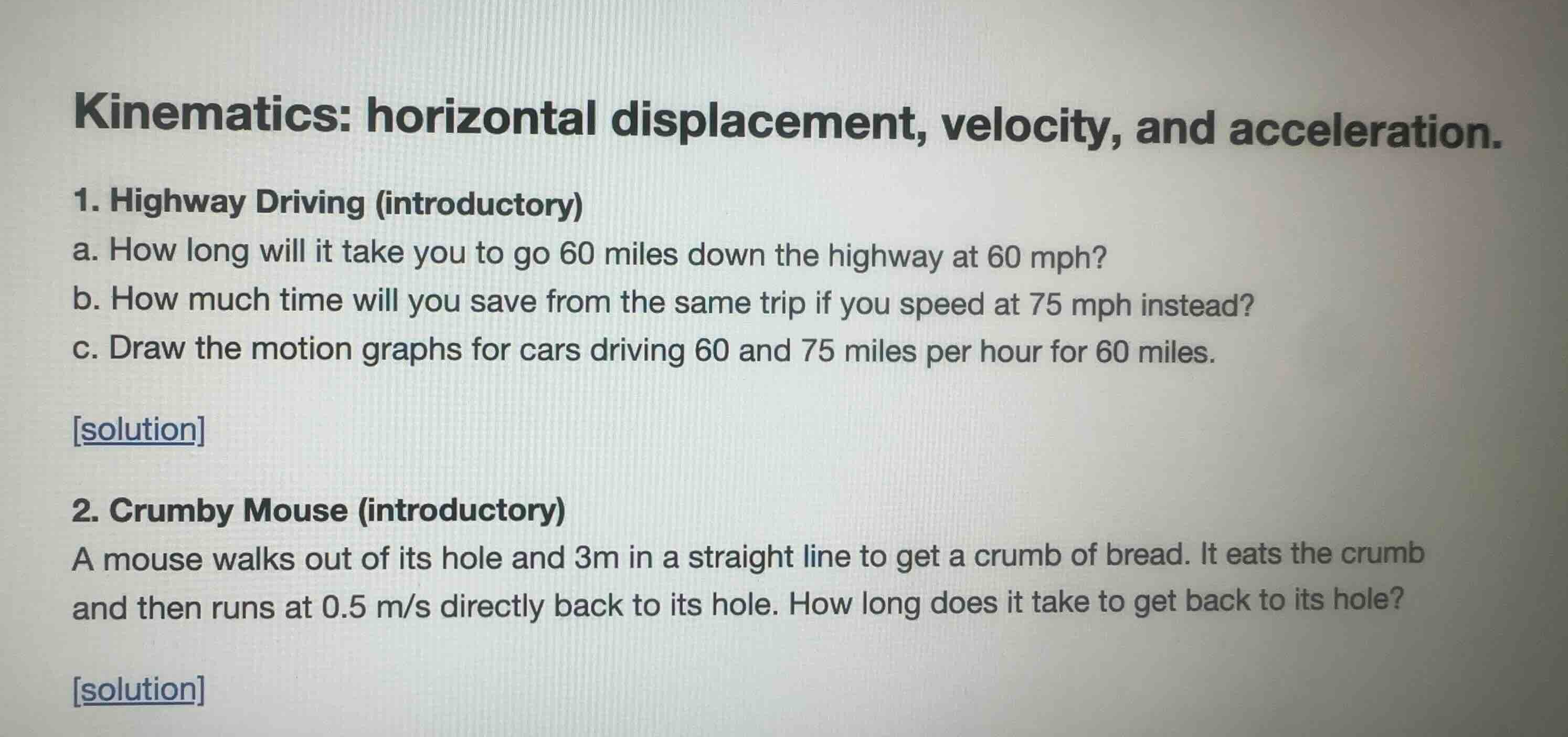
kinematics: horizontal displacement, velocity, and acceleration.
- highway driving (introductory)
a. how long will it take you to go 60 miles down the highway at 60 mph?
b. how much time will you save from the same trip if you speed at 75 mph instead?
c. draw the motion graphs for cars driving 60 and 75 miles per hour for 60 miles.
solution
- crumby mouse (introductory)
a mouse walks out of its hole and 3m in a straight line to get a crumb of bread. it eats the crumb and then runs at 0.5 m/s directly back to its hole. how long does it take to get back to its hole?
solution
Identify given values and formulas
We analyze the two introductory kinematics problems.
For constant velocity motion, the fundamental relationship is:
Where \(d\) is displacement, \(v\) is velocity, and \(t\) is time.
Rearranging for time gives:
Solve Question 1 parts (a) and (b)
For part (a), the distance is \(d = 60\text{ miles}\) and the speed is \(v_1 = 60\text{ mph}\).
For part (b), the speed is increased to \(v_2 = 75\text{ mph}\).
The time saved is:
Describe Question 1 part (c) motion graphs
For part (c), we plot position \(x(t)\) versus time \(t\) in hours.
- Car 1 (60 mph): A straight line from \((0,0)\) to \((1, 60)\).
- Car 2 (75 mph): A straight line from \((0,0)\) to \((0.8, 60)\).
Solve Question 2
The mouse travels a distance of \(d = 3\text{ m}\) back to its hole at a speed of \(v = 0.5\text{ m/s}\).
Using the time formula:

Snap & solve any problem in the app
Get step-by-step solutions on Sovi AI
Photo-based solutions with guided steps
Explore more problems and detailed explanations
Question 1
a. It will take 1 hour (or 60 minutes).
b. You will save 12 minutes (0.2 hours).
c. The motion graph shows position \(x\) (miles) versus time \(t\) (hours). The line for 75 mph is steeper, reaching 60 miles at \(t = 0.8\text{ hours}\), while the line for 60 mph reaches 60 miles at \(t = 1.0\text{ hour}\).
Question 2
It takes the mouse 6 seconds to get back to its hole.