QUESTION IMAGE
Question
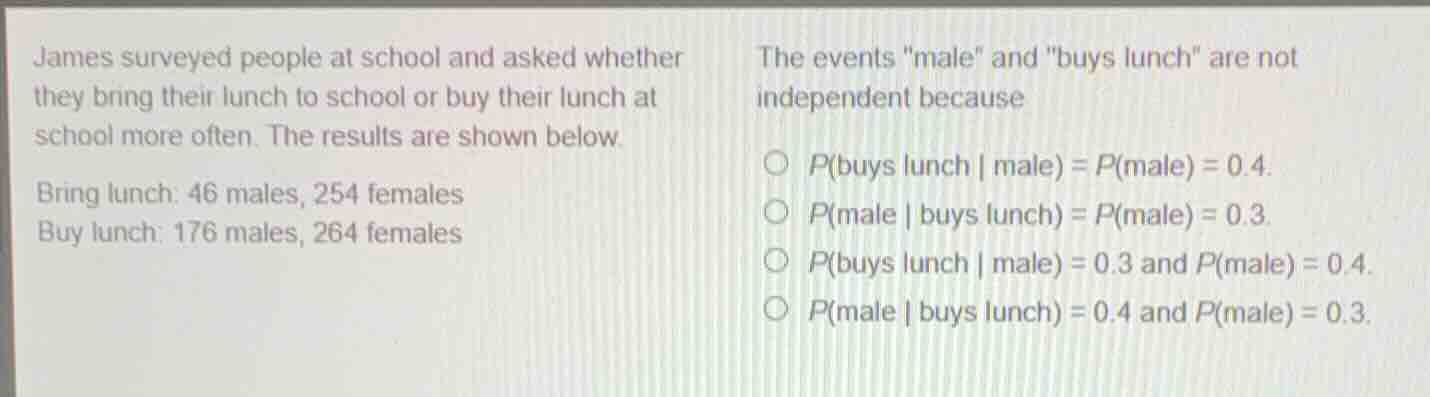
james surveyed people at school and asked whether they bring their lunch to school or buy their lunch at school more often. the results are shown below.
bring lunch: 46 males, 254 females
buy lunch: 176 males, 264 females
the events \male\ and \buys lunch\ are not independent because
\\(p(\text{buys lunch} \mid \text{male}) = p(\text{male}) = 0.4\\).
\\(p(\text{male} \mid \text{buys lunch}) = p(\text{male}) = 0.3\\).
\\(p(\text{buys lunch} \mid \text{male}) = 0.3\\) and \\(p(\text{male}) = 0.4\\).
\\(p(\text{male} \mid \text{buys lunch}) = 0.4\\) and \\(p(\text{male}) = 0.3\\).
Construct a two-way frequency table
Using the Two-Way Frequency Tables knowledge point, we organize the survey data:
| Male | Female | Total | |
|---|---|---|---|
| Buy lunch | 176 | 264 | 440 |
| Total | 222 | 518 | 740 |
Calculate the probability of being male
Using the Conditional Probability Calculation and Independent Events knowledge points
Calculate the conditional probability of being male given they buy lunch
Using the Conditional Probability Calculation and Independent Events knowledge points
Determine independence condition
Using the Independent Events knowledge point

Snap & solve any problem in the app
Get step-by-step solutions on Sovi AI
Photo-based solutions with guided steps
Explore more problems and detailed explanations
- (A) \(P(\text{buys lunch} \mid \text{male}) = P(\text{male}) = 0.4\).
- (B) \(P(\text{male} \mid \text{buys lunch}) = P(\text{male}) = 0.3\).
- (C) \(P(\text{buys lunch} \mid \text{male}) = 0.3\) and \(P(\text{male}) = 0.4\).
- (D) \(P(\text{male} \mid \text{buys lunch}) = 0.4\) and \(P(\text{male}) = 0.3\). (Correct answer)