QUESTION IMAGE
Question
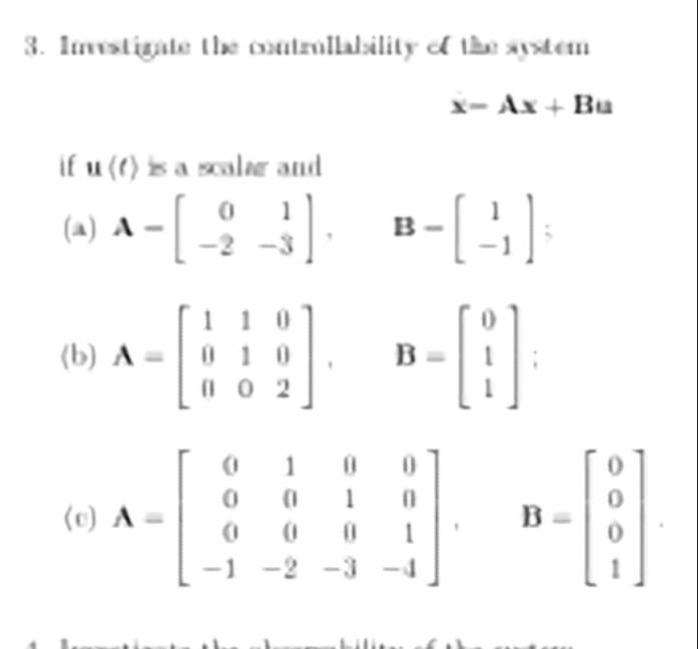
- investigate the controllability of the system
\\\dot{\mathbf{x}} = \mathbf{a}\mathbf{x} + \mathbf{b}\mathbf{u}\\
if \\(\mathbf{u}(t)\\) is a scalar and
(a) \\(\mathbf{a} = \
\\), \\(\mathbf{b} = \
\\);
(b) \\(\mathbf{a} = \
\\), \\(\mathbf{b} = \
\\);
(c) \\(\mathbf{a} = \
\\), \\(\mathbf{b} = \
\\).
🆕 New Concept Discovered: Controllability of Linear Systems
Determining if a system can be steered to any state using its inputs.
Step 1: Understand the Controllability Criterion
A linear time-invariant system \(\dot{\mathbf{x}} = \mathbf{A}\mathbf{x} + \mathbf{B}\mathbf{u}\) with state dimension \(n\) is completely state controllable if and only if the controllability matrix \(\mathcal{C}\) has full row rank \(n\):
If \(\det(\mathcal{C})
eq 0\) (for square \(\mathcal{C}\)), the system is controllable.
---
Step 2: Investigate System (a)
Given:
Here, \(n = 2\). The controllability matrix is:
Calculate \(\mathbf{A}\mathbf{B}\):
Construct \(\mathcal{C}\):
Calculate the determinant of \(\mathcal{C}\):
Since \(\det(\mathcal{C}) = 0\), the rank of \(\mathcal{C}\) is \(1 < 2\).
Conclusion for (a): The system is uncontrollable.
---
Step 3: Investigate System (b)
Given:
Here, \(n = 3\). The controllability matrix is:
Calculate \(\mathbf{A}\mathbf{B}\):
Calculate \(\mathbf{A}^2\mathbf{B}\):
Construct \(\mathcal{C}\):
Calculate the determinant of \(\mathcal{C}\) by expanding along the first row:
Since \(\det(\mathcal{C}) = -1
eq 0\), the matrix has full rank (\(\text{rank} = 3\)).
Conclusion for (b): The system is controllable.
---
Step 4: Investigate System (c)
Given:
Here, the system is in controllable canonical form. For any system where \(\mathbf{A}\) is in companion form:
the system is always completely state controllable. Let's verify this by constructin…

Snap & solve any problem in the app
Get step-by-step solutions on Sovi AI
Photo-based solutions with guided steps
Explore more problems and detailed explanations
- (a) Uncontrollable (rank of \(\mathcal{C}\) is 1)
- (b) Controllable (rank of \(\mathcal{C}\) is 3)
- (c) Controllable (rank of \(\mathcal{C}\) is 4)