QUESTION IMAGE
Question
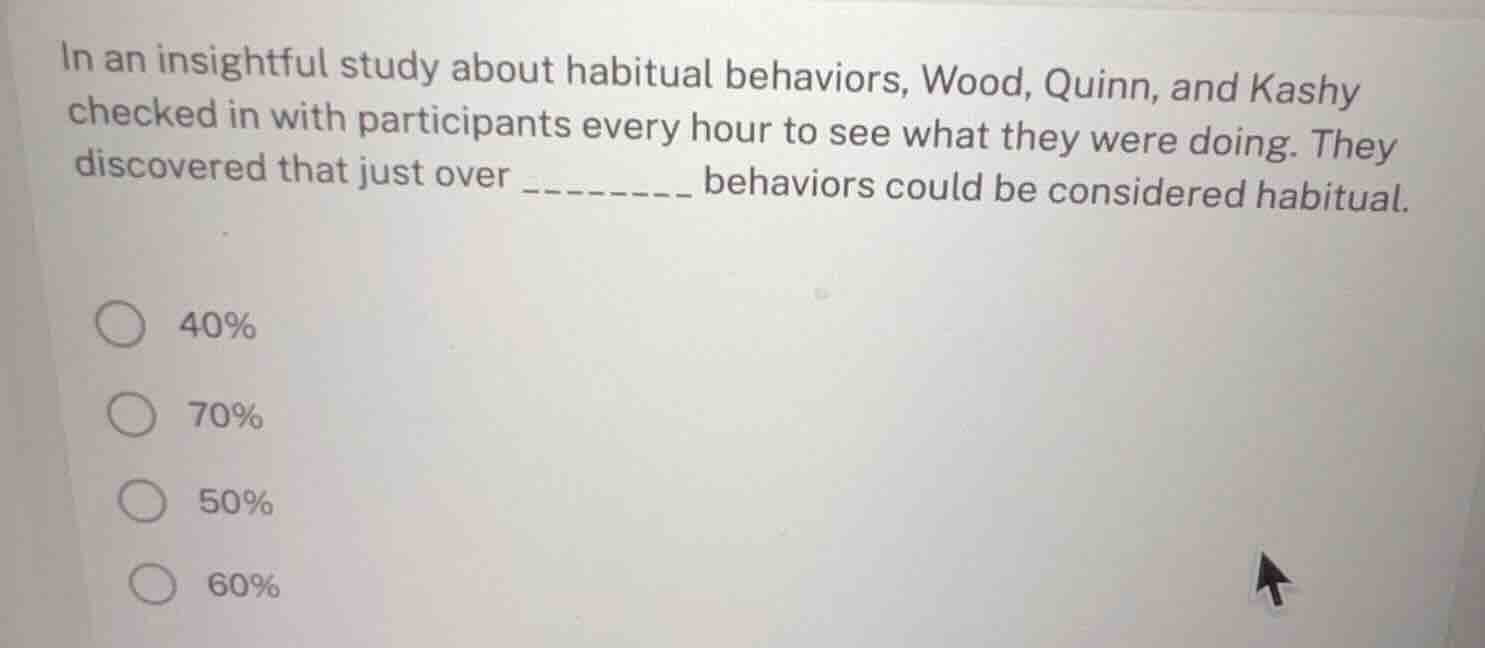
in an insightful study about habitual behaviors, wood, quinn, and kashy checked in with participants every hour to see what they were doing. they discovered that just over ________ behaviors could be considered habitual.
40%
70%
50%
60%
<pre_analysis>
{
"quality": "clear",
"question_count": 1,
"skills_matched": [
"direct_cot",
"multiple_choice_formatter",
"explain_then_answer",
"tutor",
"mastery_adaptive_brevity"
],
"needs_drawing": false,
"concepts_used": [
"Habit Formation Psychology"
],
"new_concepts": [],
"current_concepts": [
"Habit Formation Psychology",
"Habitual Behaviors Study"
]
}
</pre_analysis>
<reasoning>
Identify the study and key findings
Using the Habit Formation Psychology knowledge point
The question references a classic study on daily habits conducted by Wendy Wood, Jeffrey M. Quinn, and Deborah A. Kashy (2002), titled "Habits in Everyday Life: Thought, Emotion, and Action."
Analyze the empirical data
Using the Habit Formation Psychology knowledge point
In this diary study, participants were prompted at random intervals throughout the day to report what they were doing, what they were thinking, and how they felt. The researchers found that approximately \(43\%\) of behaviors were performed almost daily and in the same physical location, meeting the operational definition of habits.
Match findings to the options
Using the Habit Formation Psychology knowledge point
The value of \(43\%\) corresponds to the phrase "just over" one of the given percentage options. Specifically, \(43\%\) is "just over" \(40\%\).
</reasoning>
<answer>
<mcq-correct>(A) 40%</mcq-correct>
<mcq-option>(B) 70%</mcq-option>
<mcq-option>(C) 50%</mcq-option>
<mcq-option>(D) 60%</mcq-option>
</answer>
<post_analysis>
{
"subject": "Social Science",
"question_type": "Multiple Choice",
"knowledge_point": [
"Social Science",
"Psychology",
"Habit Formation Psychology"
]
}
</post_analysis>
Snap & solve any problem in the app
Get step-by-step solutions on Sovi AI
Photo-based solutions with guided steps
Explore more problems and detailed explanations
<pre_analysis>
{
"quality": "clear",
"question_count": 1,
"skills_matched": [
"direct_cot",
"multiple_choice_formatter",
"explain_then_answer",
"tutor",
"mastery_adaptive_brevity"
],
"needs_drawing": false,
"concepts_used": [
"Habit Formation Psychology"
],
"new_concepts": [],
"current_concepts": [
"Habit Formation Psychology",
"Habitual Behaviors Study"
]
}
</pre_analysis>
<reasoning>
Identify the study and key findings
Using the Habit Formation Psychology knowledge point
The question references a classic study on daily habits conducted by Wendy Wood, Jeffrey M. Quinn, and Deborah A. Kashy (2002), titled "Habits in Everyday Life: Thought, Emotion, and Action."
Analyze the empirical data
Using the Habit Formation Psychology knowledge point
In this diary study, participants were prompted at random intervals throughout the day to report what they were doing, what they were thinking, and how they felt. The researchers found that approximately \(43\%\) of behaviors were performed almost daily and in the same physical location, meeting the operational definition of habits.
Match findings to the options
Using the Habit Formation Psychology knowledge point
The value of \(43\%\) corresponds to the phrase "just over" one of the given percentage options. Specifically, \(43\%\) is "just over" \(40\%\).
</reasoning>
<answer>
<mcq-correct>(A) 40%</mcq-correct>
<mcq-option>(B) 70%</mcq-option>
<mcq-option>(C) 50%</mcq-option>
<mcq-option>(D) 60%</mcq-option>
</answer>
<post_analysis>
{
"subject": "Social Science",
"question_type": "Multiple Choice",
"knowledge_point": [
"Social Science",
"Psychology",
"Habit Formation Psychology"
]
}
</post_analysis>