QUESTION IMAGE
Question
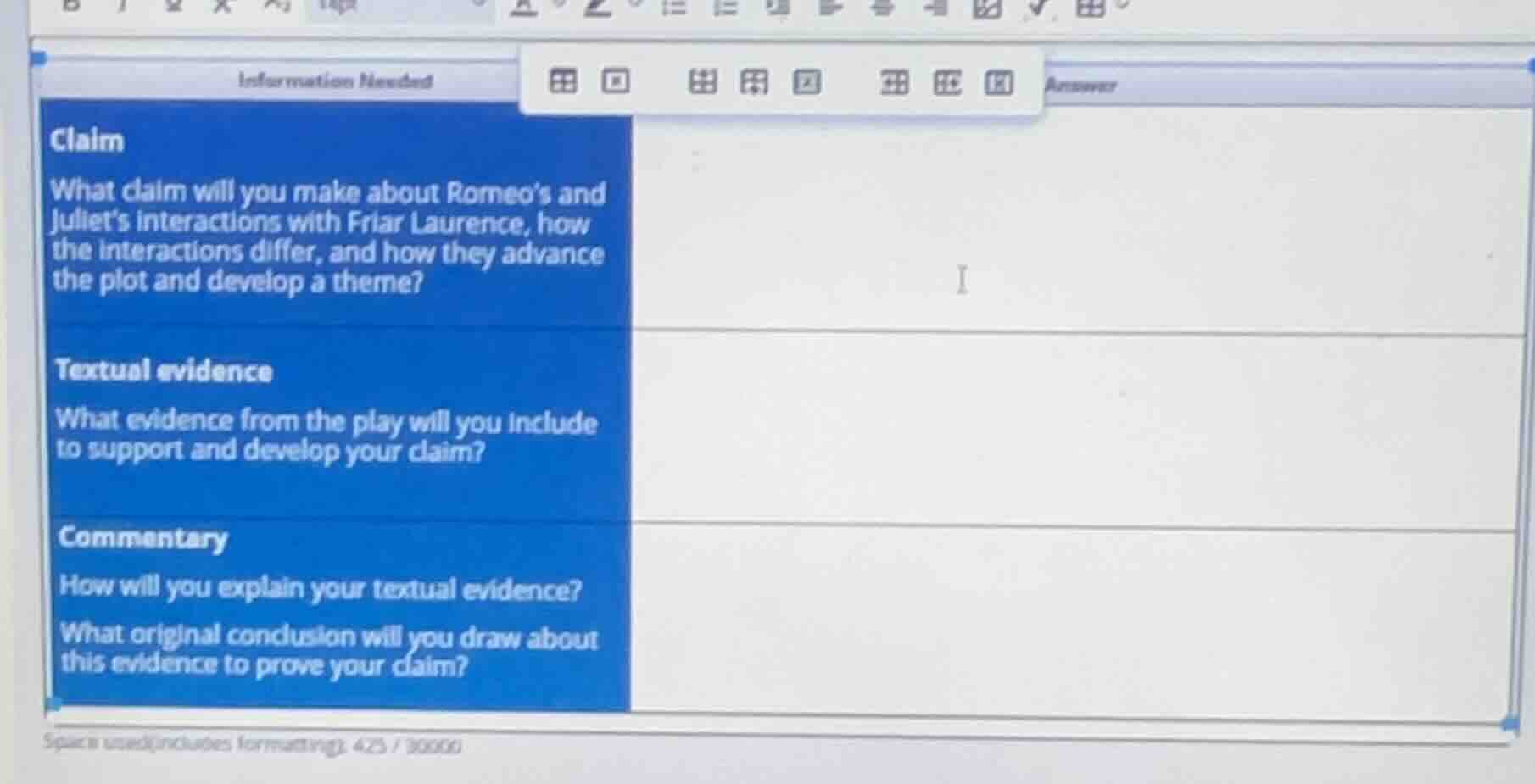
information needed
claim
what claim will you make about romeos and juliets interactions with friar laurence, how the interactions differ, and how they advance the plot and develop a theme?
textual evidence
what evidence from the play will you include to support and develop your claim?
commentary
how will you explain your textual evidence?
what original conclusion will you draw about this evidence to prove your claim?
Formulate a comparative claim
Romeo's interactions with Friar Laurence are marked by volatile, emotional outbursts, whereas Juliet's interactions are characterized by desperate but more structured pleas for practical solutions. These contrasting dynamics advance the plot by forcing the Friar to devise increasingly risky schemes (such as the fake-death plan) and develop the theme that youthful passion, when unguided by rational moderation, leads to tragic, self-destructive outcomes.
Select textual evidence
- Romeo (Act 3, Scene 3): "’Tis torture, and not mercy. Heaven is here / Where Juliet lives; and every cat and dog / And little mouse, every unworthy thing, / Live here in heaven and may look on her; / But Romeo may not."
- Juliet (Act 4, Scene 1): "O, bid me leap, rather than marry Paris, / From off the battlements of yonder tower... / And I will do it without fear or doubt, / To live an unstain'd wife to my sweet love."
Provide commentary and analysis
Romeo's dramatic lamentation over his banishment shows his immediate surrender to despair, rejecting the Friar's philosophical comfort ("adversity's sweet milk, philosophy") and forcing the Friar to act quickly to prevent Romeo's suicide. In contrast, Juliet's willingness to endure terrifying physical feats rather than betray her marriage vows shows a resolute, goal-oriented desperation. This difference drives the Friar from offering verbal counsel to executing the highly dangerous sleeping potion plan, illustrating how the overwhelming intensity of their love overrides rational guidance and precipitates their tragic end.

Snap & solve any problem in the app
Get step-by-step solutions on Sovi AI
Photo-based solutions with guided steps
Explore more problems and detailed explanations
Claim
Romeo's interactions with Friar Laurence are marked by volatile, emotional outbursts, whereas Juliet's interactions are characterized by desperate but more structured pleas for practical solutions. These contrasting dynamics advance the plot by forcing the Friar to devise increasingly risky schemes (such as the fake-death plan) and develop the theme that youthful passion, when unguided by rational moderation, leads to tragic, self-destructive outcomes.
Textual Evidence
- Romeo's Interaction (Act 3, Scene 3):
"’Tis torture, and not mercy. Heaven is here / Where Juliet lives; and every cat and dog / And little mouse, every unworthy thing, / Live here in heaven and may look on her; / But Romeo may not."
- Juliet's Interaction (Act 4, Scene 1):
"O, bid me leap, rather than marry Paris, / From off the battlements of yonder tower... / And I will do it without fear or doubt, / To live an unstain'd wife to my sweet love."
Commentary
Romeo's dramatic lamentation over his banishment shows his immediate surrender to despair, rejecting the Friar's philosophical comfort ("adversity's sweet milk, philosophy") and forcing the Friar to act quickly to prevent Romeo's suicide. In contrast, Juliet's willingness to endure terrifying physical feats rather than betray her marriage vows shows a resolute, goal-oriented desperation. This difference drives the Friar from offering verbal counsel to executing the highly dangerous sleeping potion plan, illustrating how the overwhelming intensity of their love overrides rational guidance and precipitates their tragic end.