QUESTION IMAGE
Question
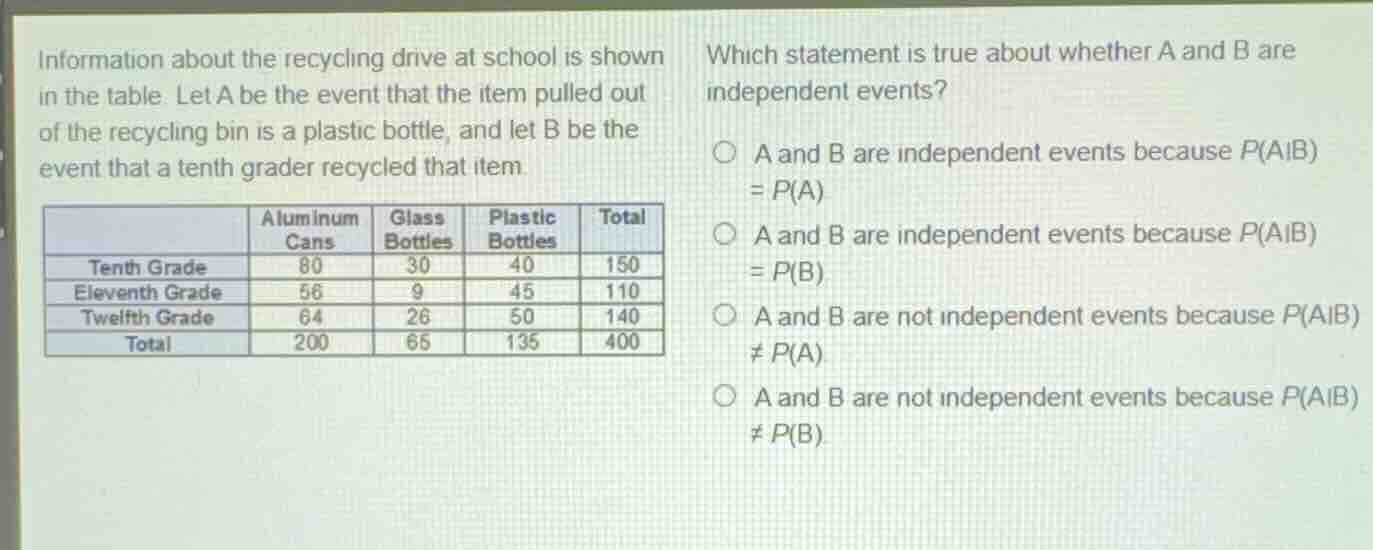
information about the recycling drive at school is shown in the table. let a be the event that the item pulled out of the recycling bin is a plastic bottle, and let b be the event that a tenth grader recycled that item.
which statement is true about whether a and b are independent events?
- a and b are independent events because \\(p(a|b) = p(a)\\)
- a and b are independent events because \\(p(a|b) = p(b)\\)
- a and b are not independent events because \\(p(a|b) \
eq p(a)\\)
- a and b are not independent events because \\(p(a|b) \
eq p(b)\\)
Define the events and extract values
Using the Two-Way Frequency Tables knowledge point
- Total number of items: \(N = 400\)
- Event \(A\): The item is a plastic bottle.
- Total plastic bottles: \(135\)
- Event \(B\): A tenth grader recycled the item.
- Total items recycled by tenth graders: \(150\)
- Intersection \(A \cap B\): Plastic bottles recycled by tenth graders: \(40\)
Calculate the probability of event A
Using the Conditional Probability Calculation knowledge point
Calculate the conditional probability P(A|B)
Using the Conditional Probability Calculation knowledge point
Determine independence
Using the Independent Events knowledge point
Since the conditional probability of \(A\) given \(B\) is not equal to the unconditional probability of \(A\), the events are not independent.

Snap & solve any problem in the app
Get step-by-step solutions on Sovi AI
Photo-based solutions with guided steps
Explore more problems and detailed explanations
- (A) A and B are independent events because \(P(A|B) = P(A)\)
- (B) A and B are independent events because \(P(A|B) = P(B)\)</mcq-correct>
- **(C) A and B are not independent events because \(P(A|B)
eq P(A)\) (Correct answer)**
<mcq-option>(D) A and B are not independent events because \(P(A|B)
eq P(B)\)