QUESTION IMAGE
Question
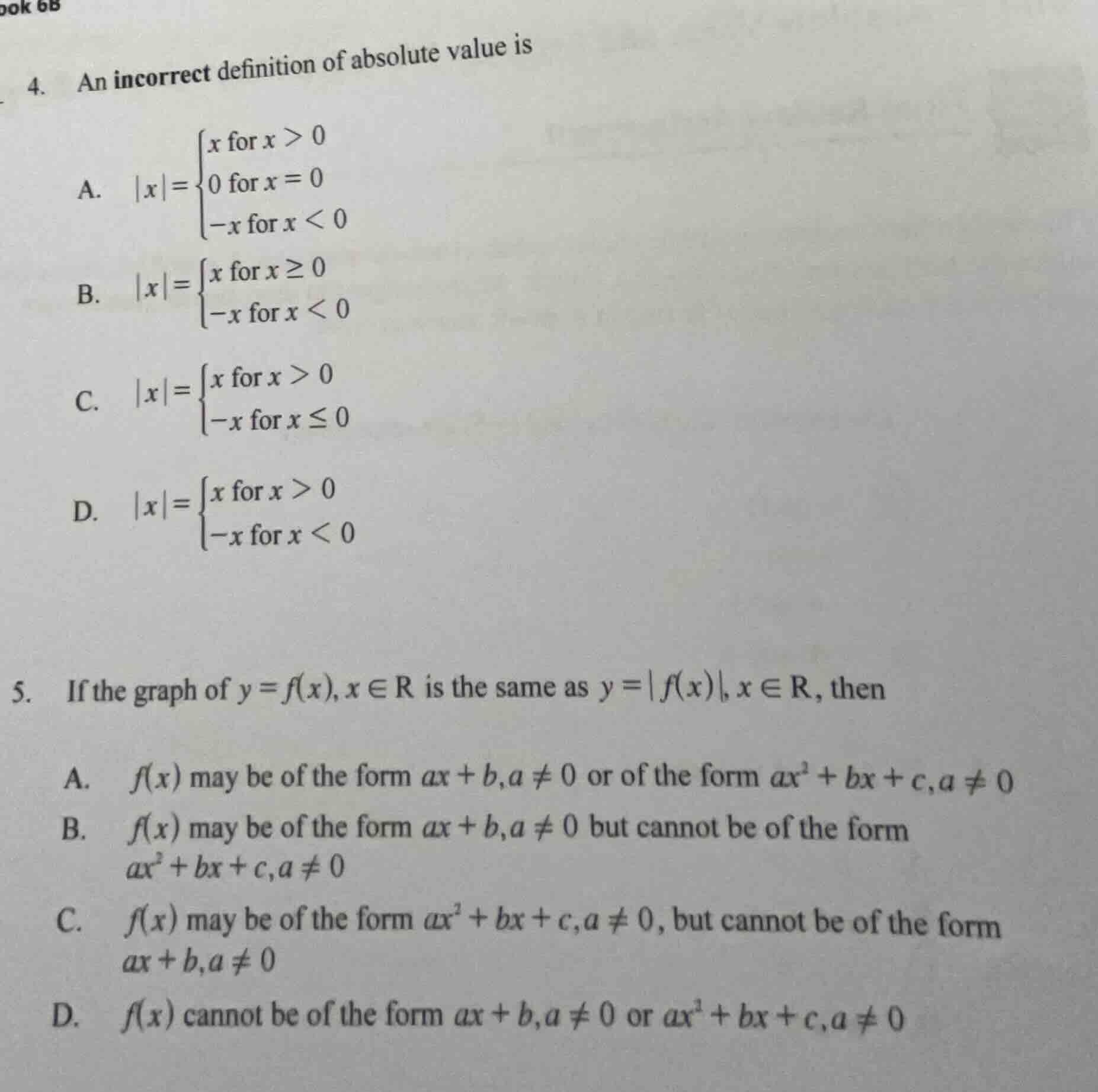
- an incorrect definition of absolute value is
a. $|x|=\
$
b. $|x|=\
$
c. $|x|=\
$
d. $|x|=\
$
- if the graph of $y = f(x),x\in\mathrm{r}$ is the same as $y = |f(x)|,x\in\mathrm{r}$, then
a. $f(x)$ may be of the form $ax + b,a\
eq0$ or of the form $ax^2 + bx + c,a\
eq0$
b. $f(x)$ may be of the form $ax + b,a\
eq0$ but cannot be of the form $ax^2 + bx + c,a\
eq0$
c. $f(x)$ may be of the form $ax^2 + bx + c,a\
eq0$, but cannot be of the form $ax + b,a\
eq0$
d. $f(x)$ cannot be of the form $ax + b,a\
eq0$ or $ax^2 + bx + c,a\
eq0$
For Question 4:
Step1: Recall absolute value definition
The absolute value $|x|$ is the non-negative value of $x$: $|0|=0$, $|x|=x$ for $x>0$, $|x|=-x$ for $x<0$.
Step2: Analyze each option
- Option A: Covers all cases ($x>0, x=0, x<0$) correctly.
- Option B: Combines $x=0$ with $x>0$ (since $|0|=0=0$), correct.
- Option C: Combines $x=0$ with $x<0$ (since $|0|=0=-0$), correct.
- Option D: Does not define $|x|$ for $x=0$, so it is incorrect.
Step1: Interpret the condition
If $y=f(x)$ and $y=|f(x)|$ have identical graphs, then $f(x) \geq 0$ for all $x \in \mathbb{R}$.
Step2: Analyze linear functions
A linear function $f(x)=ax+b, a
eq0$ is a line with slope $a
eq0$, so it will take negative values for some $x \in \mathbb{R}$. Thus it cannot satisfy the condition.
Step3: Analyze quadratic functions
A quadratic function $f(x)=ax^2+bx+c, a
eq0$ can be non-negative for all $x \in \mathbb{R}$ if it opens upward ($a>0$) and has no real roots (or a repeated root, i.e., discriminant $\Delta=b^2-4ac \leq0$). So it can satisfy the condition.

Snap & solve any problem in the app
Get step-by-step solutions on Sovi AI
Photo-based solutions with guided steps
Explore more problems and detailed explanations
D. $|x|=
$
---