QUESTION IMAGE
Question
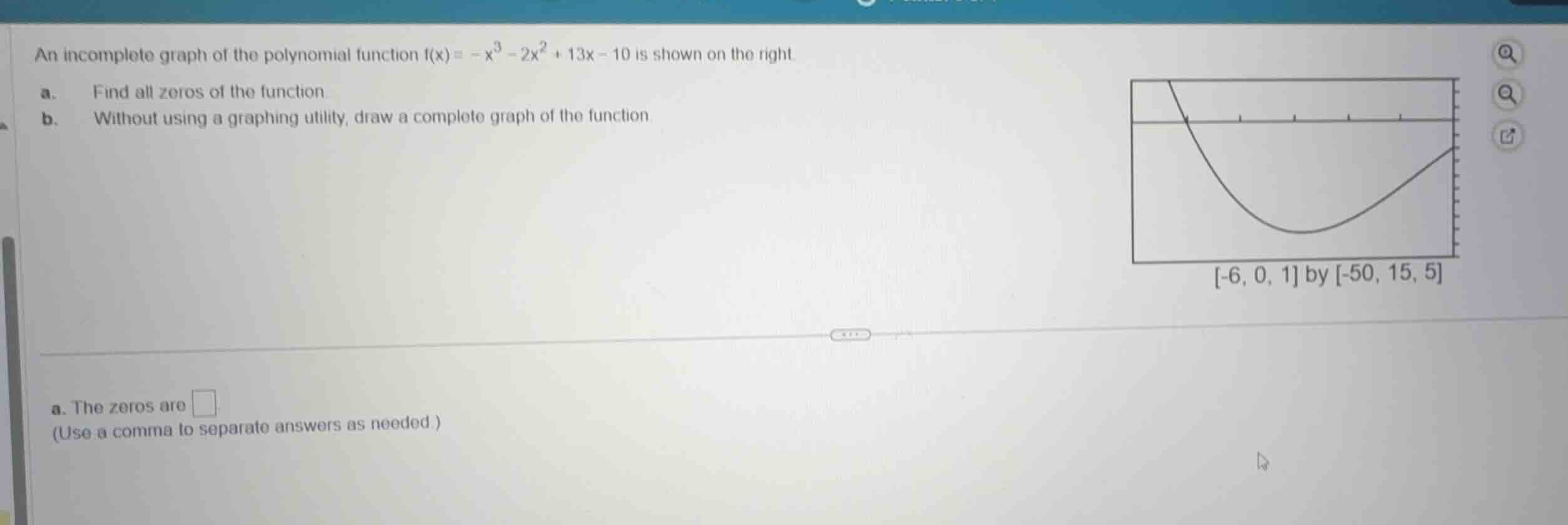
an incomplete graph of the polynomial function \\(f(x) = -x^3 - 2x^2 + 13x - 10\\) is shown on the right.
a. find all zeros of the function.
b. without using a graphing utility, draw a complete graph of the function.
a. the zeros are
(use a comma to separate answers as needed.)
<pre_analysis>
{
"quality": "clear",
"question_count": 1,
"skills_matched": [
"step_cot",
"blank_filling_formatter",
"explain_then_answer",
"tutor",
"mastery_adaptive_brevity"
],
"needs_drawing": true,
"concepts_used": [
"Rational Root Theorem",
"Synthetic Division",
"Quadratic Formula"
],
"new_concepts": [],
"current_concepts": [
"Rational Root Theorem",
"Synthetic Division",
"Quadratic Formula",
"Finding Zeros of Factored Polynomials"
]
}
</pre_analysis>
<reasoning>
Identify potential rational zeros
Using the Rational Root Theorem knowledge point
\[
\text{Possible rational roots of } f(x) = -x^3 - 2x^2 + 13x - 10 \text{ are factors of } -10: \pm 1, \pm 2, \pm 5, \pm 10.
\]
Test potential roots to find a zero
Using the Rational Root Theorem knowledge point
\[
f(1) = -(1)^3 - 2(1)^2 + 13(1) - 10 = -1 - 2 + 13 - 10 = 0
\]
Perform polynomial division
Using the Synthetic Division knowledge point
\[
\]
\[
f(x) = (x - 1)(-x^2 - 3x + 10) = -(x - 1)(x^2 + 3x - 10)
\]
Factor the remaining quadratic expression
Using the Factoring Quadratic Trinomials knowledge point
\[
x^2 + 3x - 10 = (x + 5)(x - 2)
\]
Determine all zeros of the function
Using the Finding Zeros of Factored Polynomials knowledge point
\[
f(x) = -(x - 1)(x + 5)(x - 2) = 0 \implies x = 1, -5, 2
\]
</reasoning>
<answer>
a. The zeros are <blank>-5, 1, 2</blank>
(Use a comma to separate answers as needed.)
</answer>
<plot>
{
"elements": [
{
"type": "functiongraph",
"params": [
{
"js": "-xxx - 2xx + 13*x - 10",
"latex": "-x^3 - 2x^2 + 13x - 10"
},
-6,
3
],
"properties": {
"strokeColor": "#8C55F2",
"strokeWidth": 3,
"name": "f(x)"
}
},
{
"type": "point",
"params": [[-5, 0]],
"properties": {
"name": "(-5, 0)",
"color": "#F2557F",
"size": 4,
"withLabel": true
}
},
{
"type": "point",
"params": [[1, 0]],
"properties": {
"name": "(1, 0)",
"color": "#F2557F",
"size": 4,
"withLabel": true
}
},
{
"type": "point",
"params": [[2, 0]],
"properties": {
"name": "(2, 0)",
"color": "#F2557F",
"size": 4,
"withLabel": true
}
}
],
"timestamps": [0.5, 1.0, 1.5]
}
</plot>
<post_analysis>
{
"subject": "Mathematics",
"question_type": "Fill-in-the-blank",
"knowledge_point": [
"Mathematics",
"Algebra",
"Finding Zeros of Factored Polynomials"
]
}
</post_analysis>
Snap & solve any problem in the app
Get step-by-step solutions on Sovi AI
Photo-based solutions with guided steps
Explore more problems and detailed explanations
<pre_analysis>
{
"quality": "clear",
"question_count": 1,
"skills_matched": [
"step_cot",
"blank_filling_formatter",
"explain_then_answer",
"tutor",
"mastery_adaptive_brevity"
],
"needs_drawing": true,
"concepts_used": [
"Rational Root Theorem",
"Synthetic Division",
"Quadratic Formula"
],
"new_concepts": [],
"current_concepts": [
"Rational Root Theorem",
"Synthetic Division",
"Quadratic Formula",
"Finding Zeros of Factored Polynomials"
]
}
</pre_analysis>
<reasoning>
Identify potential rational zeros
Using the Rational Root Theorem knowledge point
\[
\text{Possible rational roots of } f(x) = -x^3 - 2x^2 + 13x - 10 \text{ are factors of } -10: \pm 1, \pm 2, \pm 5, \pm 10.
\]
Test potential roots to find a zero
Using the Rational Root Theorem knowledge point
\[
f(1) = -(1)^3 - 2(1)^2 + 13(1) - 10 = -1 - 2 + 13 - 10 = 0
\]
Perform polynomial division
Using the Synthetic Division knowledge point
\[
\]
\[
f(x) = (x - 1)(-x^2 - 3x + 10) = -(x - 1)(x^2 + 3x - 10)
\]
Factor the remaining quadratic expression
Using the Factoring Quadratic Trinomials knowledge point
\[
x^2 + 3x - 10 = (x + 5)(x - 2)
\]
Determine all zeros of the function
Using the Finding Zeros of Factored Polynomials knowledge point
\[
f(x) = -(x - 1)(x + 5)(x - 2) = 0 \implies x = 1, -5, 2
\]
</reasoning>
<answer>
a. The zeros are <blank>-5, 1, 2</blank>
(Use a comma to separate answers as needed.)
</answer>
<plot>
{
"elements": [
{
"type": "functiongraph",
"params": [
{
"js": "-xxx - 2xx + 13*x - 10",
"latex": "-x^3 - 2x^2 + 13x - 10"
},
-6,
3
],
"properties": {
"strokeColor": "#8C55F2",
"strokeWidth": 3,
"name": "f(x)"
}
},
{
"type": "point",
"params": [[-5, 0]],
"properties": {
"name": "(-5, 0)",
"color": "#F2557F",
"size": 4,
"withLabel": true
}
},
{
"type": "point",
"params": [[1, 0]],
"properties": {
"name": "(1, 0)",
"color": "#F2557F",
"size": 4,
"withLabel": true
}
},
{
"type": "point",
"params": [[2, 0]],
"properties": {
"name": "(2, 0)",
"color": "#F2557F",
"size": 4,
"withLabel": true
}
}
],
"timestamps": [0.5, 1.0, 1.5]
}
</plot>
<post_analysis>
{
"subject": "Mathematics",
"question_type": "Fill-in-the-blank",
"knowledge_point": [
"Mathematics",
"Algebra",
"Finding Zeros of Factored Polynomials"
]
}
</post_analysis>