QUESTION IMAGE
Question
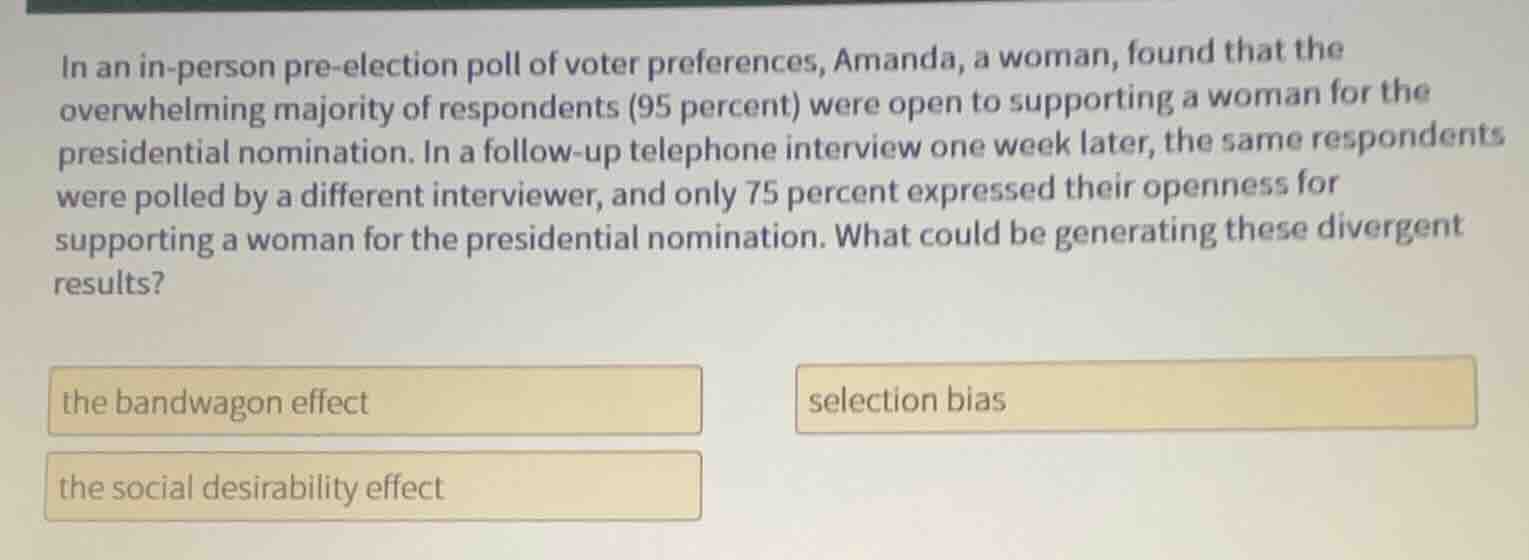
in an in-person pre-election poll of voter preferences, amanda, a woman, found that the overwhelming majority of respondents (95 percent) were open to supporting a woman for the presidential nomination. in a follow-up telephone interview one week later, the same respondents were polled by a different interviewer, and only 75 percent expressed their openness for supporting a woman for the presidential nomination. what could be generating these divergent results?
the bandwagon effect
selection bias
the social desirability effect
Analyze the experimental setup and results
The first poll was conducted in-person by Amanda, a female interviewer, yielding a 95% positive response rate. The second poll was conducted over the telephone by a different interviewer, yielding a 75% positive response rate among the exact same respondents.
Identify the source of divergence
The presence of a female interviewer in-person likely pressured respondents to give a socially acceptable answer (supporting a female candidate) to avoid appearing biased. When polled anonymously or via telephone by a different interviewer, respondents felt less social pressure and answered more honestly.
Match with the correct concept
This phenomenon, where respondents give answers they believe are socially desirable or expected rather than their true beliefs, is known as the social desirability effect (often amplified by interviewer bias).

Snap & solve any problem in the app
Get step-by-step solutions on Sovi AI
Photo-based solutions with guided steps
Explore more problems and detailed explanations
- the bandwagon effect
- selection bias
- the social desirability effect (Correct answer)