QUESTION IMAGE
Question
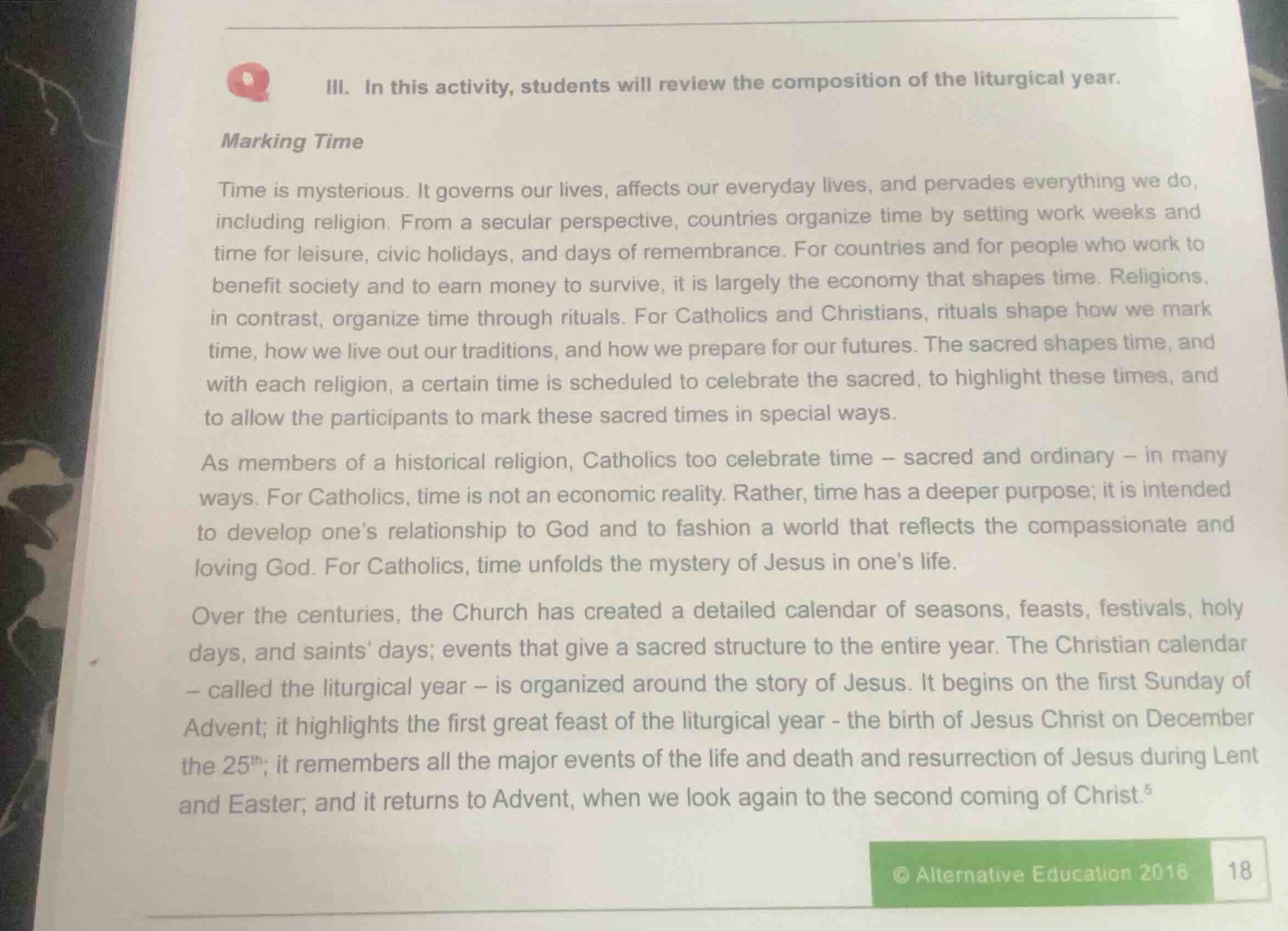
iii. in this activity, students will review the composition of the liturgical year.
marking time
time is mysterious. it governs our lives, affects our everyday lives, and pervades everything we do, including religion. from a secular perspective, countries organize time by setting work weeks and time for leisure, civic holidays, and days of remembrance. for countries and for people who work to benefit society and to earn money to survive, it is largely the economy that shapes time. religions, in contrast, organize time through rituals. for catholics and christians, rituals shape how we mark time, how we live out our traditions, and how we prepare for our futures. the sacred shapes time, and with each religion, a certain time is scheduled to celebrate the sacred, to highlight these times, and to allow the participants to mark these sacred times in special ways.
as members of a historical religion, catholics too celebrate time - sacred and ordinary - in many ways. for catholics, time is not an economic reality. rather, time has a deeper purpose; it is intended to develop ones relationship to god and to fashion a world that reflects the compassionate and loving god. for catholics, time unfolds the mystery of jesus in ones life.
over the centuries, the church has created a detailed calendar of seasons, feasts, festivals, holy days, and saints days; events that give a sacred structure to the entire year. the christian calendar - called the liturgical year - is organized around the story of jesus. it begins on the first sunday of advent; it highlights the first great feast of the liturgical year - the birth of jesus christ on december the 25th; it remembers all the major events of the life and death and resurrection of jesus during lent and easter; and it returns to advent, when we look again to the second coming of christ.5
Analyze the text's core theme
The passage contrasts secular time with sacred time. Secular time is shaped by economic realities, work, and civic schedules. In contrast, religious time is organized around rituals and spiritual mysteries.
Define the liturgical year
The text explains that the Christian calendar is called the liturgical year. It is structured around the story of Jesus, marking his life, death, and resurrection.
Identify the starting point
According to the third paragraph, the liturgical year begins on the first Sunday of Advent.
Identify key highlighted events
The calendar highlights major events: the birth of Jesus (Christmas) on December 25th, his life, death, and resurrection (during Lent and Easter), and his second coming.
Summarize the purpose
For Catholics, the liturgical year serves a deeper purpose. It helps develop a relationship with God and unfolds the mystery of Jesus in one's life.

Snap & solve any problem in the app
Get step-by-step solutions on Sovi AI
Photo-based solutions with guided steps
Explore more problems and detailed explanations
Based on the provided text, the liturgical year is the Christian calendar organized around the story of Jesus.
Key details include:
- Purpose: It structures the year to help believers develop their relationship with God and unfold the mystery of Jesus in their lives.
- Beginning: It starts on the first Sunday of Advent.
- Key Events: It highlights the birth of Jesus (December 25th), remembers his life, death, and resurrection (during Lent and Easter), and looks forward to his second coming.