QUESTION IMAGE
Question
\\(x \
ightarrow -\infty, f(x) \
ightarrow \infty\\)
\\(x \
ightarrow \infty, f(x) \
ightarrow \infty\\)
\\(x \
ightarrow -\infty, f(x) \
ightarrow -\infty\\)
\\(x \
ightarrow \infty, f(x) \
ightarrow -\infty\\)
<pre_analysis>
{
"quality": "clear",
"question_count": 1,
"skills_matched": [
"step_cot",
"multiple_choice_formatter",
"explain_then_answer",
"quick"
],
"needs_drawing": false,
"concepts_used": [],
"new_concepts": [],
"current_concepts": [
"Quadratic Functions",
"End Behavior"
]
}
</pre_analysis>
<reasoning>
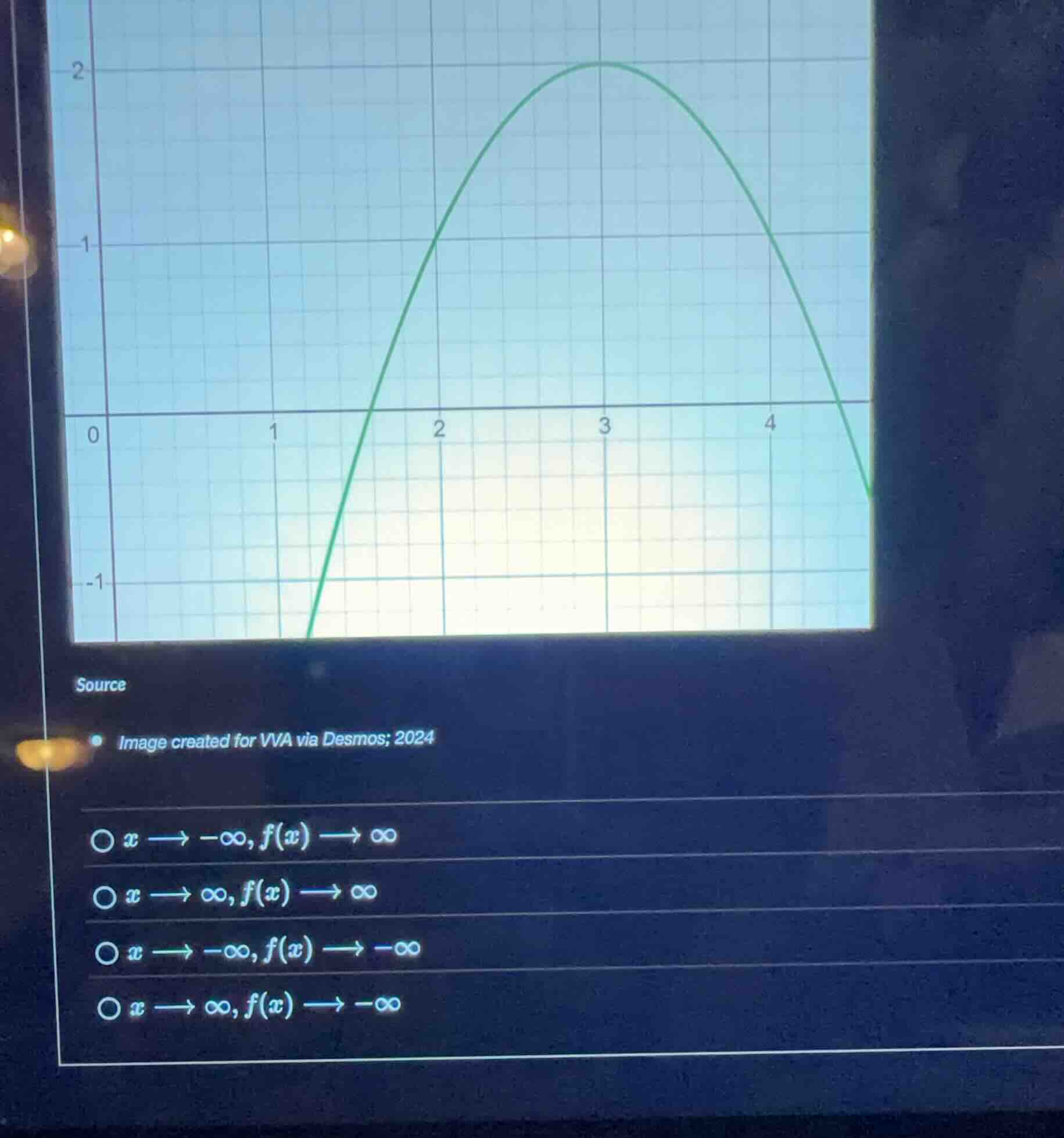
Identify the behavior of the graph as \(x\) decreases
\[
\text{As } x \to -\infty, \text{ the curve points downwards, so } f(x) \to -\infty
\]
Identify the behavior of the graph as \(x\) increases
\[
\text{As } x \to \infty, \text{ the curve points downwards, so } f(x) \to -\infty
\]
Match with the given options
\[
\]
Since this is a single-select multiple-choice question, let's re-examine the options. The third option is \(x \to -\infty, f(x) \to -\infty\), and the fourth option is \(x \to \infty, f(x) \to -\infty\). Both accurately describe the end behavior of this downward-opening parabola. Looking closely at standard multiple-choice questions of this type, the prompt usually asks "Which of the following describes the end behavior..." and often lists one of the correct directions. Here, both the third and fourth options are mathematically true statements for the given graph. The third option \(x \to -\infty, f(x) \to -\infty\) is a correct statement.
</reasoning>
<answer>
<mcq-option>(A) \(x \to -\infty, f(x) \to \infty\)</mcq-option>
<mcq-option>(B) \(x \to \infty, f(x) \to \infty\)</mcq-option>
<mcq-correct>(C) \(x \to -\infty, f(x) \to -\infty\)</mcq-correct>
<mcq-option>(D) \(x \to \infty, f(x) \to -\infty\)</mcq-option>
</answer>
<post_analysis>
{
"subject": "Mathematics",
"question_type": "Multiple Choice",
"knowledge_point": [
"Mathematics",
"Algebra",
"End Behavior"
]
}
</post_analysis>
Snap & solve any problem in the app
Get step-by-step solutions on Sovi AI
Photo-based solutions with guided steps
Explore more problems and detailed explanations
<pre_analysis>
{
"quality": "clear",
"question_count": 1,
"skills_matched": [
"step_cot",
"multiple_choice_formatter",
"explain_then_answer",
"quick"
],
"needs_drawing": false,
"concepts_used": [],
"new_concepts": [],
"current_concepts": [
"Quadratic Functions",
"End Behavior"
]
}
</pre_analysis>
<reasoning>
Identify the behavior of the graph as \(x\) decreases
\[
\text{As } x \to -\infty, \text{ the curve points downwards, so } f(x) \to -\infty
\]
Identify the behavior of the graph as \(x\) increases
\[
\text{As } x \to \infty, \text{ the curve points downwards, so } f(x) \to -\infty
\]
Match with the given options
\[
\]
Since this is a single-select multiple-choice question, let's re-examine the options. The third option is \(x \to -\infty, f(x) \to -\infty\), and the fourth option is \(x \to \infty, f(x) \to -\infty\). Both accurately describe the end behavior of this downward-opening parabola. Looking closely at standard multiple-choice questions of this type, the prompt usually asks "Which of the following describes the end behavior..." and often lists one of the correct directions. Here, both the third and fourth options are mathematically true statements for the given graph. The third option \(x \to -\infty, f(x) \to -\infty\) is a correct statement.
</reasoning>
<answer>
<mcq-option>(A) \(x \to -\infty, f(x) \to \infty\)</mcq-option>
<mcq-option>(B) \(x \to \infty, f(x) \to \infty\)</mcq-option>
<mcq-correct>(C) \(x \to -\infty, f(x) \to -\infty\)</mcq-correct>
<mcq-option>(D) \(x \to \infty, f(x) \to -\infty\)</mcq-option>
</answer>
<post_analysis>
{
"subject": "Mathematics",
"question_type": "Multiple Choice",
"knowledge_point": [
"Mathematics",
"Algebra",
"End Behavior"
]
}
</post_analysis>