QUESTION IMAGE
Question
identifying a venn diagram
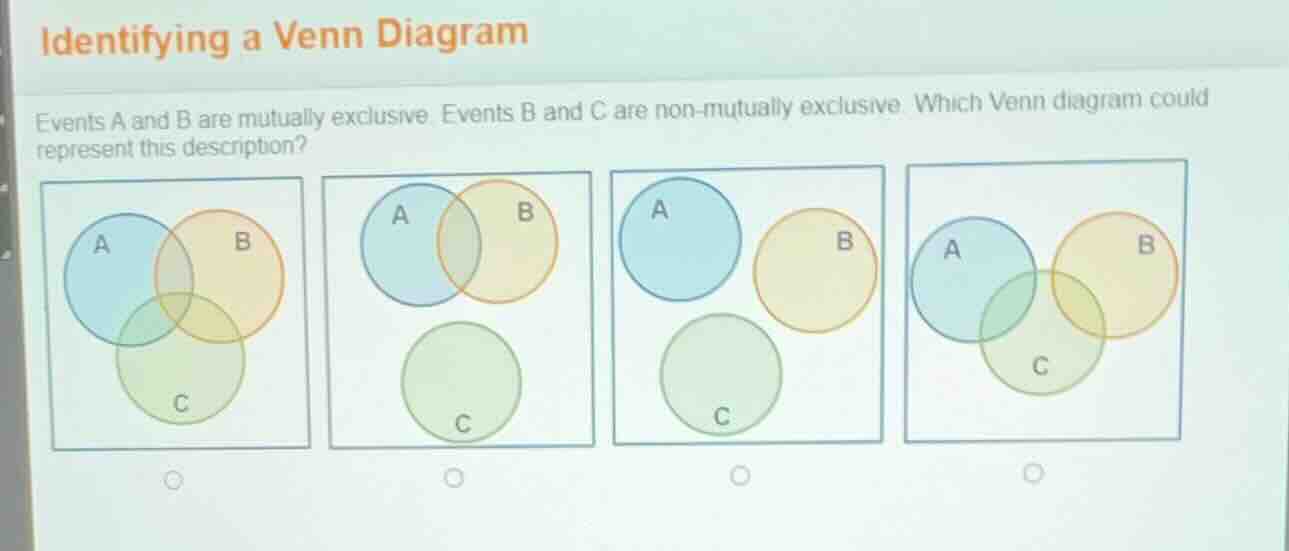
events a and b are mutually exclusive. events b and c are non-mutually exclusive. which venn diagram could represent this description?
Analyze the condition for events A and B
Using the Mutually Exclusive Events knowledge point
- Mutually exclusive events cannot occur at the same time.
- In a Venn diagram, this means circles \(A\) and \(B\) must not overlap (they must be completely disjoint).
Analyze the condition for events B and C
Using the Non-Mutually Exclusive Events knowledge point
- Non-mutually exclusive events can occur at the same time.
- In a Venn diagram, this means circles \(B\) and \(C\) must overlap (they must share a common region).
Evaluate the given options
- First diagram: Circles \(A\) and \(B\) overlap. This violates the condition that \(A\) and \(B\) are mutually exclusive.
- Second diagram: Circles \(A\) and \(B\) overlap. This violates the condition that \(A\) and \(B\) are mutually exclusive.
- Third diagram: Circles \(A\) and \(B\) do not overlap (mutually exclusive). However, circles \(B\) and \(C\) do not overlap either, which violates the condition that \(B\) and \(C\) are non-mutually exclusive.
- Fourth diagram: Circles \(A\) and \(B\) do not overlap (mutually exclusive). Circles \(B\) and \(C\) overlap (non-mutually exclusive). This matches all given descriptions.

Snap & solve any problem in the app
Get step-by-step solutions on Sovi AI
Photo-based solutions with guided steps
Explore more problems and detailed explanations
- (A) First diagram: Circles A, B, and C all overlap with each other.
- (B) Second diagram: Circles A and B overlap, while circle C is separate.
- (C) Third diagram: Circles A, B, and C are all completely separate.
- (D) Fourth diagram: Circles A and B do not overlap, while circles B and C overlap. (Correct answer)