QUESTION IMAGE
Question
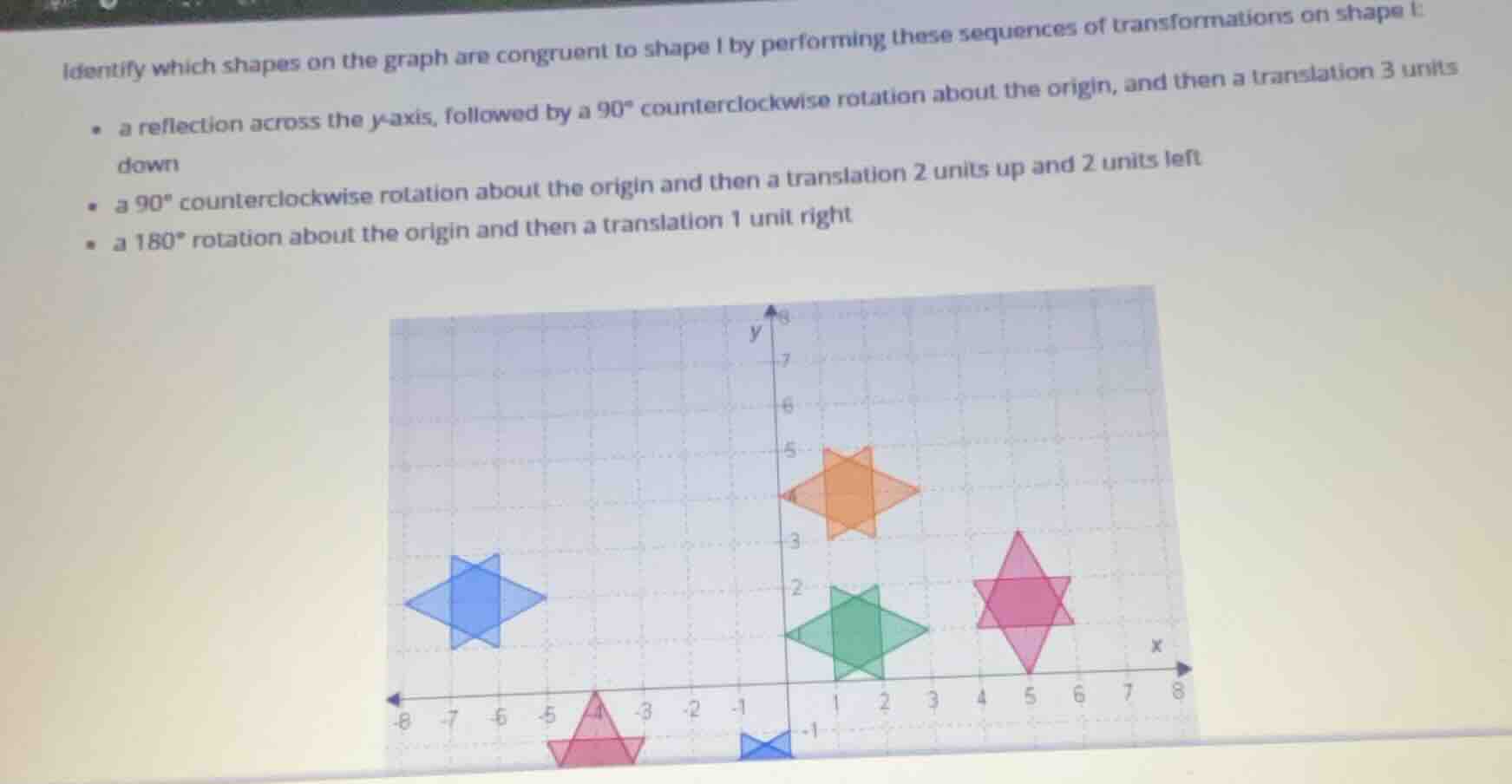
identify which shapes on the graph are congruent to shape i by performing these sequences of transformations on shape i:
- a reflection across the \\(y\\)-axis, followed by a \\(90^\circ\\) counterclockwise rotation about the origin, and then a translation 3 units down
- a \\(90^\circ\\) counterclockwise rotation about the origin and then a translation 2 units up and 2 units left
- a \\(180^\circ\\) rotation about the origin and then a translation 1 unit right
Identify the vertices of Shape I
Shape I is the blue star-like shape located in the second quadrant. Let's identify its key vertices:
- Leftmost tip: \((-8, 2)\)
- Rightmost tip: \((-5, 2)\)
- Topmost tip: \((-6.5, 3)\)
- Bottommost tip: \((-6.5, 1)\)
- Center of the shape: \((-6.5, 2)\)
Apply the first sequence of transformations
- Reflection across the \(y\)-axis:
- \(90^\circ\) counterclockwise rotation about the origin:
- Translation 3 units down:
No shape on the graph is centered at \((-2, 3.5)\).
Let's re-evaluate the label "shape I" or if the blue shape at the bottom on the x-axis is Shape I.
Looking closely at the bottom: there is a small blue shape at the bottom labeled with a letter or number, but the blue star on the left has a shape. Let's look at the labels.
The blue star on the left is in quadrant II.
The orange star is in quadrant I, centered at \((1.5, 4)\).
The green star is in quadrant I, centered at \((1.5, 1.5)\).
The pink star is in quadrant I, centered at \((5, 2)\).
The pink triangle/boat-like shape at the bottom is centered around \((-4, -1.5)\).
The small blue shape at the bottom on the y-axis is centered at \((0, -1)\).
Let's test if the blue star on the left (centered at \((-6.5, 2)\)) is indeed "shape I" (represented by the Roman numeral I):
Sequence 2:
- \(90^\circ\) counterclockwise rotation about the origin:
- Translation 2 units up and 2 units left:
This does not match any star.
Let's test if the small blue shape at the bottom, which looks like a triangle pointing down or a trapezoid, is "shape I".
Wait, the blue star on the left has a label? No, it's just a blue star.
Let's look at the shape at the bottom: it is a blue triangle/trapezoid at \((0, -1)\).
Let's look at the pink shape at the bottom: it is a pink trapezoid/boat shape.
Let's check if the pink boat shape at the bottom is a transformation of the blue shape at the bottom.
Blue shape at the bottom (let's call its vertices):
- Top-left: \((-0.5, -1)\)
- Top-right: \((0.5, -1)\)
- Bottom-center: \((0, -1.5)\)
This is a triangle pointing down.
Let's apply Sequence 3 to this blue shape:
- \(180^\circ\) rotation about the origin:
The triangle now points up.
- Translation 1 unit right:
This does not match the pink boat.
Let's re-read: "Identify which shapes on the graph are congruent to shape I by performing these sequences of transformations on shape I".
Ah! "shape I" refers to the Roman numeral "I" representing the number 1, which is the blue star on the left (labeled with a blue 'I' inside or it is simply "shape 1").
Let's check the green star centered at \((1.5, 1.5)\):
Let's test Sequence 1 on the blue star \((-6.5, 2)\):
If "reflection across the y-axis" is done first:
\[
(-6.…

Snap & solve any problem in the app
Get step-by-step solutions on Sovi AI
Photo-based solutions with guided steps
Explore more problems and detailed explanations
The resulting coordinates for each sequence of transformations applied to Shape I (ce…